
Channel Crossing to Life
Channel Crossing to Life is a bronze sculpture by Frank Meisler, created with his long-time collaborator Arie Ovadia. It stands on the Koningin Emmaboulevard at the ferry port of Hoek van Holland in Rotterdam. The work commemorates the Kindertransport, through which children from Germany, Austria, Poland, and Czechoslovakia, considered Jewish under the Nuremberg Laws, were brought to Great Britain. Most departed from Hoek van Holland for Harwich, with support from the Dutch government and volunteer helpers. The sculpture was unveiled on 30 November 2011 by Rotterdam mayor Ahmed Aboutaleb, in the presence of nearly 40 former Kindertransport children, including Meisler himself.
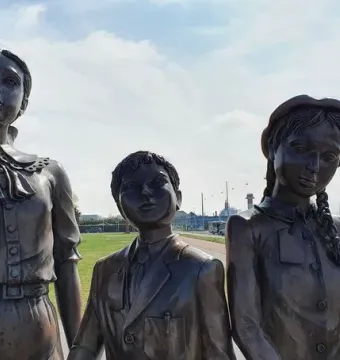
April 2022 © Qwertzu111111 · CC BY-SA 4.0
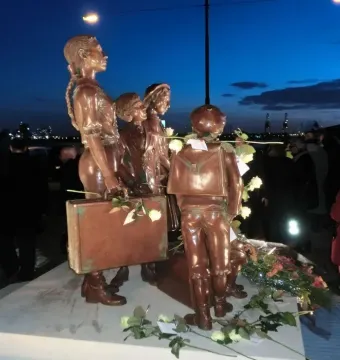
November 2011 © Hajog · CC BY-SA 3.0
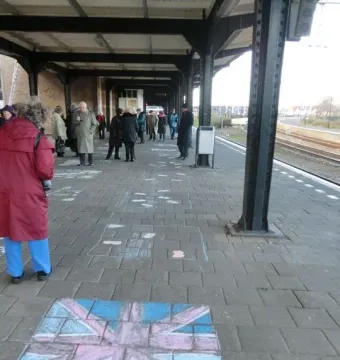
November 2011 © Hajog · CC BY-SA 3.0
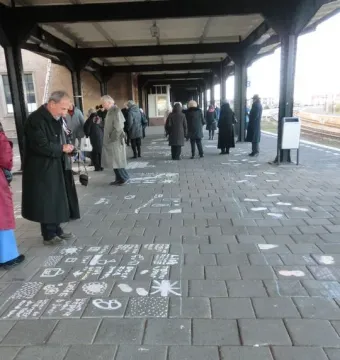
November 2011 © Hajog · CC BY-SA 3.0
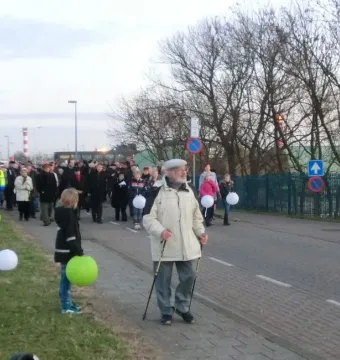
November 2011 © Hajog · CC BY-SA 3.0
Identification | |
| Title | Kindertransport – Channel Crossing to Life |
| Type | Bronze sculpture group |
Creator | |
| Artist | Frank Meisler |
| Co-creator | Arie Ovadia |
Historical context | |
| Support for the transports | Supported by the Dutch government and voluntary helpers |
| First transport date | 2 December 1938 |
| Approximate number of children transported | About 10,000 children |
| Context | Refers to the transport of children from the German Reich and from countries threatened by it to Great Britain, usually departing from Hoek van Holland to Harwich |
| Subject | The Kindertransport of children from Germany, Austria, Poland, and Czechoslovakia who were regarded as Jewish under the Nuremberg Laws |
| Year | 2011 |
| Last transport period | Until the outbreak of war in 1939 |
Location and ownership | |
| Current location | Koningin Emmaboulevard, ferry port of Hoek van Holland, Rotterdam, Netherlands |
| Sculptor location | Jaffa, Israel |
Physical characteristics | |
| Figure count | Six children |
| Scale | Life-size |
| Depicted age group | Children |
Appearance | |
| Associated newspaper | A newspaper sheet from the Dutch newspaper The Dutchman |
| Stylistic note | The sculpture groups show common features as well as differing design details |
| Newspaper text quoted | Allowing German Jewish Children and thousands of Jews to leave Germany |
| Newspaper date | 11 November 1938 |
| Props and belongings | Suitcases, backpacks, a stuffed animal, and a violin case |
| Depicted scene | The children are shown waiting for the ferry that is to take them from Rotterdam to Great Britain |
| Theme | Kindertransport; children waiting to cross by ferry to Great Britain |
| Direction of gaze | All standing children look toward the water; the seated boy is not described as doing so |
Materials | |
| Material | Bronze |
Iconography and meaning | |
| Plaque inscription | CHANNEL CROSSING TO LIFE / 1938 · KINDERTRANSPORTS · 1939. |
| Plaque context | Between 1938 and the outbreak of war, 10,000 mainly Jewish children from Germany, Austria, and Czechoslovakia were permitted to enter England without their parents and escape Nazi persecution |
| Route on plaque | Most crossed the Channel from Hoek of Holland to Harwich |
| Aid on plaque | Their journey was aided by the Dutch government and Dutch volunteers |
| Dedication | Dedicated to the people of Holland and the United Kingdom who saved these children from certain death |
History and restoration | |
| Contribution note for David Segal | In honour of his father Markus Segal, New York, USA |
| Contribution note for Lisa Bechner | For her initiative and dedication |
| Contribution note for Kindertransport Association of Jewish Refugees | In recognition of Dutch heroism and gratitude for the safe passage of the Kindertransport Association of Jewish Refugees, London, U.K. |
| Contribution note for Michael Spektor’s Family | We must always remember… |
| Unveiled by | Ahmed Aboutaleb, Mayor of Rotterdam |
| Contributors thanked | David Segal; Michael Spektor’s Family; Friends and Leaders Worldwide; ISRAEL BONDS; the Kindertransport Association of Jewish Refugees, London, U.K.; Lisa Bechner |
| Additional inscription language | Also given in Dutch |
| Additional inscription | This sculpture has been created thanks to the strong support of the City of Rotterdam |
| Unveiling attendees | Nearly 40 guests who had themselves reached Great Britain as children via the transports, including Frank Meisler |
| Unveiling date | 30 November 2011 |
Significance | |
| European route | Part of the European route of the Kindertransporte |
Other | |
| Locations | Other stations of the Kindertransporte |