
Sphinxes of El Salobral
The Sphinxes of El Salobral are a pair of identical Iberian sculptures discovered by chance in 1901 in El Salobral, a district of Albacete. They are often mistakenly treated as a single work, but they were carved as mirrored companions to be placed opposite each other, likely flanking the entrance or corners of a funerary mound. After their discovery, and amid the archaeological looting suffered by Iberian sculpture at the beginning of the 20th century, they were sold by archaeologist Pierre Paris to the Louvre. Today, one sphinx, the better known of the two, is in the National Archaeological Museum in Madrid, while the other is in the holdings of the Municipal Museum of Saint-Germain-en-Laye.
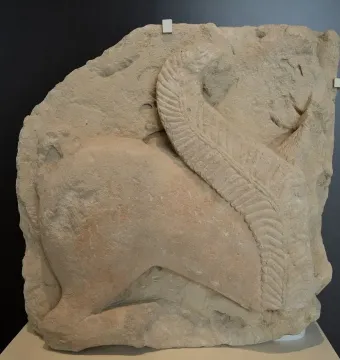
September 2015 © Dorieo · CC BY-SA 4.0
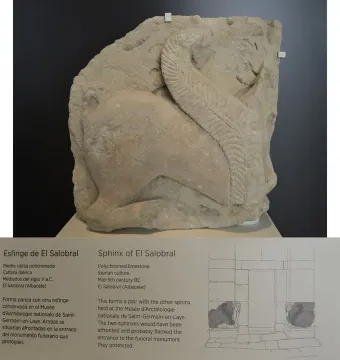
August 2018 © Dorieo · CC BY-SA 4.0
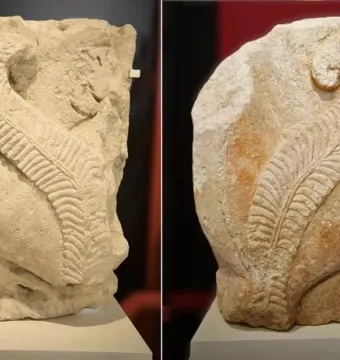
© Macucal · CC BY-SA 4.0
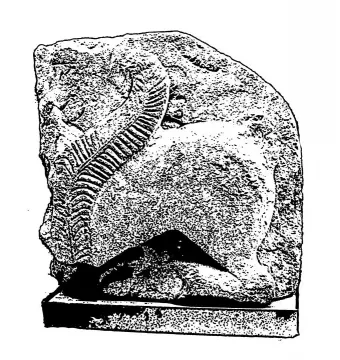
© Ángel Plaza Simón · CC BY-SA 4.0
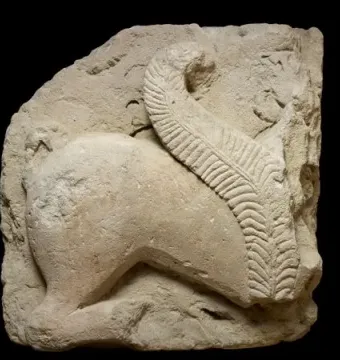
0475 © Relanzón, Santiago (photo) · CC BY-SA 4.0
Identification | |
| Title | Sphinxes of El Salobral |
| Type | Pair of Iberian sphinx sculptures |
| Number of sculptures | Two |
| Alternative name | Twin sphinxes of El Salobral |
Discovery and provenance | |
| Discovery date | 1901 |
| Discovery method | Accidental discovery |
| Discovery location | El Salobral, Albacete, Spain |
| Discovery context | Found after archaeological looting of Iberian sculpture in the early 20th century |
| Subsequent ownership | Sold by archaeologist Pierre Paris to the Louvre Museum |
Historical context | |
| Possible context | Believed to have formed part of a funerary tower-shaped complex similar to the Mausoleum of Pozo Moro |
| Dating | End of the 6th century BC, based on stylistic characteristics |
Physical characteristics | |
| Form | Two identical sculptures carved as mirror images |
| Intended placement | Designed to face each other and flank the entrance or corners of a funerary tumulus |
Iconography and meaning | |
| Function | Apotropaic and psychopompic, with magical significance; intended to protect the funerary monument and guide the deceased's soul to the underworld |
Materials | |
| Polychromy | The preserved sphinx retains traces of polychromy |
Appearance | |
| Visible color | Intense red |
| Interpretation of red color | Considered the color of life because of its resemblance to human blood |
Location and ownership | |
| Current location | Split between the National Archaeological Museum of Madrid and the collections of the Saint-Germain-en-Laye Municipal Museum, France |
History and restoration | |
| Return to Spain | The sphinx in Madrid was restituted in 1941 in the same operation that enabled Spain to recover the Lady of Elche, the Sphinx of Agost, and part of the Treasure of Guarrazar |
| Museum status | The Saint-Germain-en-Laye Municipal Museum has been closed since 1979 due to serious security deficiencies |