
Major General Friedrich Wilhelm von Steuben
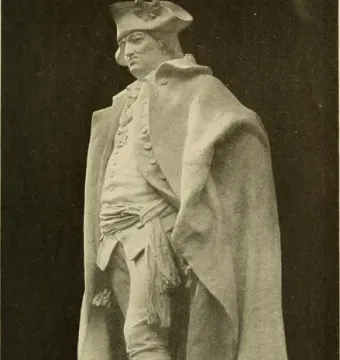
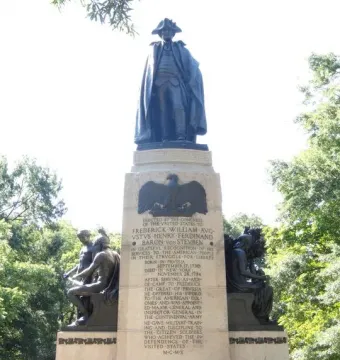
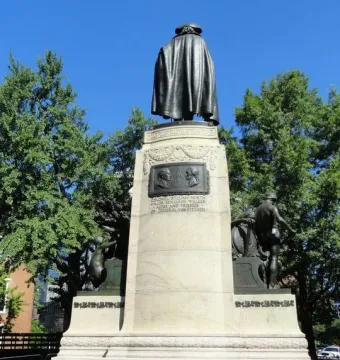
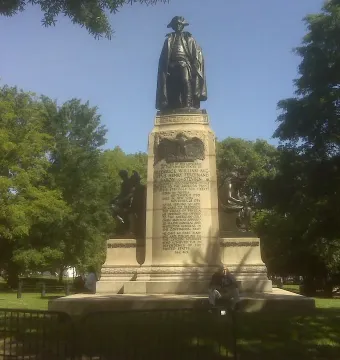
Major General Friedrich Wilhelm von Steuben is a bronze statue of Friedrich Wilhelm von Steuben, the Prussian soldier who assisted the Continental Army during the American Revolutionary War. Erected in 1910 in Lafayette Square, Washington, D.C., it was sculpted by Albert Jaegers, with the base designed by Cass Gilbert and T. R. Johnson. The statue honors Steuben’s role at Valley Forge, the Southern Campaign, and the Siege of Yorktown. Its unveiling drew about 10,000 people, including President William Howard Taft. The monument stands on a tall base with two sets of figures and is part of the American Revolution Statuary in Washington, D.C., as well as a contributing property to the L'Enfant Plan and Lafayette Square Historic District.
1916 © Internet Archive Book Images · No restrictions
June 2012 © Daderot · CC0
June 2012 © Daderot · CC0
May 2009 © Kas Hayes · CC BY-SA 4.0
© NPS Photo · Public domain
Identification | |
| Title | Major General Friedrich Wilhelm von Steuben |
| Depicted subject | Friedrich Wilhelm von Steuben |
| Type | bronze statue |
Historical context | |
| Congressional appointment | In May 1778, at Washington's recommendation, Congress appointed him to an unspecified post |
| Residence and death | Lived in a house at the Society's headquarters near Utica, New York, and died there in 1794 |
| Property granted | About 16,000 acres near Utica, New York, granted by the state |
| Associations | Co-founder of the Society of the Cincinnati |
| Postwar activities | Helped demobilize the army and prepare a defense plan for the new nation |
| Yorktown role | Commanded one of three American divisions and helped prepare reinforcements for the French contingent under Gilbert Lafayette |
| Later campaigns | Served with General Nathanael Greene in the southern campaign in winter 1779–80 and took part in the Yorktown campaign |
| Manual prepared | Regulations for the Order and Discipline of the Troops of the United States ('Blue Book') |
| Training method | Formed a model company of 100 men and introduced progressive training |
| Other military reforms | Improved sanitary standards, camp design, and produced a standard training manual |
| Subject birth and death | Born September 17, 1730, in Prussia; died November 28, 1794, in New York |
| Subject nationality | Prussian; later became a U.S. citizen in 1784 |
| Subject military career | Joined the Prussian army at 17, served in the Seven Years' War, and later served in the Continental Army |
| Subject early education | Graduated from a Jesuit school in Breslau |
| Subject early service | Served on Frederick the Great's staff after work with the Prussian General Staff |
| Subject rank | Captain in the Prussian army; later recommended for promotion to lieutenant general |
| Nickname | Called the 'father of military training' |
| Work at Valley Forge | Arrived at Valley Forge on February 23, 1778, and trained American soldiers using Prussian methods |
| Subject identity | Prussian-American military officer and general in the American Revolutionary War |
| Subject role in the Revolutionary War | Assisted the Continental Army, trained troops at Valley Forge, and helped in the Southern Campaign and the Siege of Yorktown |
| Subject outcome | After the war he was granted land, later lived in New York, and died in 1794 |
| Planning context | Planned in the late 1890s as part of a series of statues in Lafayette Square honoring foreign heroes |
| Authorization | Authorized by an Act of Congress in 1903 |
| Appropriation | $50,000 |
Creator | |
| Sculptor | Albert Jaegers |
| Base designers | Cass Gilbert and T. R. Johnson |
Discovery and provenance | |
| Design approval | Approved by Augustus Saint-Gaudens |
| Replica in Potsdam | An exact copy of the Washington statue was presented by the U.S. Congress to Wilhelm II and the German people and erected in Potsdam's Steuben Square in 1911 |
| Competition for sculptor | A competition held two years after the act selected the sculptor from six submissions, narrowed to three designs and then two models |
History and restoration | |
| Replica fate | Removed by Soviet troops at the end of World War II and melted down by East German officials in 1950 |
| Replica presentation occasion | Presented in 1911 by Representative Bartholdt and Mrs. S. B. Wolfram of New York; Bartholdt described it as a gift from the American people |
| Post-reunification replica | After German reunification, a replica was installed near the former Potsdam location in 2005 as a sign of German-American friendship |
| Lafayette Square Historic District status | National Historic Landmark; listed on the National Register of Historic Places in 1970 and the District of Columbia Inventory of Historic Sites in 1973 |
| L'Enfant Plan listing dates | Listed on the District of Columbia Inventory of Historic Sites in 1971 and on the National Register of Historic Places in 1997 |
| Contributing property status | Contributing property to the L'Enfant Plan and the Lafayette Square Historic District |
| Historic designation | One of 14 American Revolution Statuary in Washington, D.C.; listed on the National Register of Historic Places in 1978 and the District of Columbia Inventory of Historic Sites in 1979 |
| Other related monument | A related Washington monument to Frederick the Great's work was installed at Fort McNair in 1904 |
| West Berlin replica | A replacement was installed in West Berlin in 1987 as part of the city's 750th anniversary celebrations |
| Ceremony details | The unveiling took place in rainy Washington, D.C., followed by a large parade reviewed by the president and other dignitaries |
| Later ceremony | A wreath-laying ceremony was held at the statue in 2019 with representatives of LGBT military veterans present |
| Unveiling and dedication date | December 7, 1910 |
| Contract signed | January 1907 |
| Unveiling attendance | About 10,000 people |
| Unveiling participants | President William Howard Taft and his daughter Helen Taft Manning |
| Installation date | 1910 |
| Main statue completed | July 1909 |
| Base statues completed | December 1908 |
| Working model completed | 1908 |
Physical characteristics | |
| Composition on the base | Two male figures on the northeast side symbolize military instruction, and two female figures on the southwest side symbolize commemoration |
| Base ornamentation | The base has bronze allegorical figures on the sides and reliefs on the front and back |
| Base material | Pink granite |
| Base form | Tall square pedestal |
| Base height | 15 feet (4.6 m) |
| Figure height | 10 feet (3 m) |
Appearance | |
| Left-hand attribute | Leaning on a cane and holding his cloak at the waist |
| Depicted pose | Von Steuben is shown looking into the distance while inspecting Continental Army soldiers in 1778 |
| Depicted attire | Continental Army uniform with sash, boots, tricorn hat, cape, cloak, and waistcoat |
Iconography and meaning | |
| Meaning of side figures | One side group shows a male instructor training a youth in sword use; the other shows a woman and youth symbolizing the grafting of von Steuben's foreign influence onto the American tree of life |
| Honoree status | One of the foreign heroes of the American Revolutionary War honored in Lafayette Square |
| Historical reference | The statue depicts von Steuben inspecting Continental Army soldiers in 1778 during the American Revolution |
| Rear inscription | Colonel William North. Major Benjamin Walker. Aides and friends of General von Steuben |
| Rear decoration | Profiles in relief of Colonel William North and Major Benjamin Walker, described as aides and friends of General von Steuben |
| Front decoration | An American eagle with outstretched wings |
| Front inscription | Erected by the Congress of the United States to Frederick William Augustus Henry Ferdinand Baron von Steuben in grateful recognition of his services to the American people in their struggle for liberty. Born in Prussia, September 17, 1730. Died in New York, November 28, 1794. After serving as aide-de-camp to Frederick the Great of Prussia, he offered his sword to the American colonies and was appointed major general and inspector general in the Continental Army. He gave military training and discipline to the citizen soldiers who achieved the independence of the United States. M.C.M.X. |
Location and ownership | |
| Ownership and maintenance | Owned and maintained by the National Park Service |
| Associated sculptures in the square | Monuments to Comte de Rochambeau, Marquis de Lafayette, Tadeusz Kościuszko, and Andrew Jackson |
| Setting | Lafayette Square |
| Location | Northwest corner of Lafayette Square, across from the White House, Washington, D.C. |
| Lafayette Square context | Lafayette Square was created in 1821 and named in 1824 after Marquis de Lafayette; it is north of the White House between 15th and 17th Streets and covers 7 acres |
| Surrounding monuments | The square's other corners are occupied by monuments to Marquis de Lafayette, Jean de Rochambeau, and Tadeusz Kościuszko; an equestrian statue of Andrew Jackson stands in the center |