
Trains to Life – Trains to Death
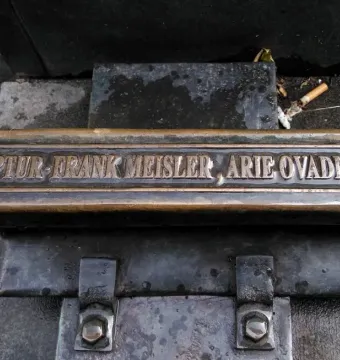
Trains to Life – Trains to Death is the second of five sculptures by Frank Meisler commemorating the Kindertransport history of 1938–39. Created in collaboration with Lisa Sophie Bechner and Kindertransport Organisation Deutschland e. V., it stands at the original departure site for the children, Berlin Friedrichstraße station. The monument shows two differently coloured groups of child figures, broken suitcases and a railway track, symbolising departures into life and into death. It remembers the children who survived through Kindertransport or by hiding, as well as the many children who died in the Holocaust. The memorial was inaugurated on 30 November 2008, 70 years after the first Kindertransport.
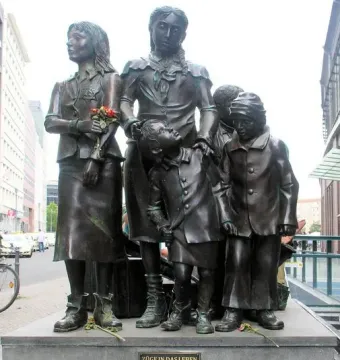
July 2010 © OTFW · CC BY-SA 3.0
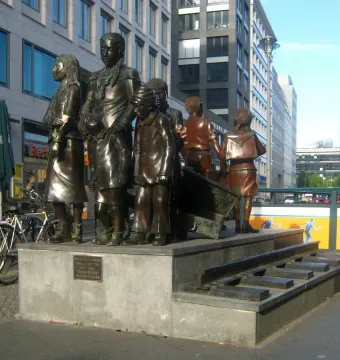
August 2009 © Jörg Zägel · CC BY-SA 3.0
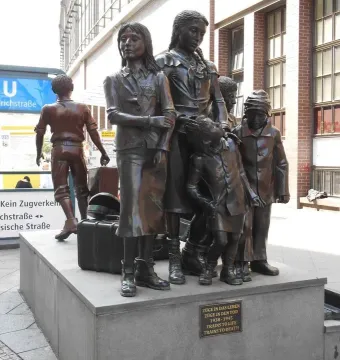
July 2013 © Miriam Guterland · CC BY-SA 3.0
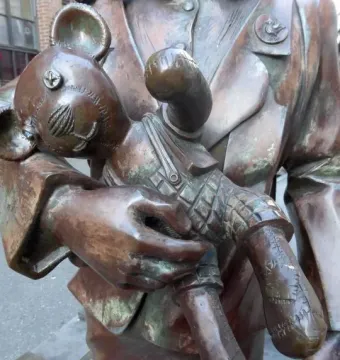
October 2024 © MHM55 · CC BY-SA 4.0
June 2022 © Singlespeedfahrer · CC0
Identification | |
| Title | Trains to Life – Trains to Death |
| German title | Denkmal Züge in das Leben – Züge in den Tod; trains to death – trains to life 1938–1945 |
| Type | Outdoor memorial sculpture |
Historical context | |
| Subject | Kindertransport history, 1938–39 |
| Commemorated rescue action | Kindertransport / children's trains |
| Historical background | The British Parliament decided on 21 November 1938 to accept children without limit from Germany, Austria, and later Czechoslovakia, as well as from Poland; on 22 November 1938, the Belgian Parliament also decided to save 1,000 children; by the start of the Second World War, almost 10,000 child refugees had entered Great Britain via the Netherlands, mostly from Hoek van Holland |
Creator | |
| Artist | Frank Meisler |
| Artist's profession | Architect and sculptor |
| Artist's connection to subject | Eyewitness to the historical events; he survived as a child thanks to the Kindertransport |
| Collaborator | Lisa Sophie Bechner |
| Associated organization | Kindertransport Organisation Deutschland e. V. |
| Artist's origin | Born in Danzig |
Creation and series | |
| Series position | Second of five sculptures in the Kindertransport series |
| Series locations | Berlin, London, Hamburg, Gdańsk, and Hook of Holland |
Location and ownership | |
| Installation location | Outside Berlin Friedrichstraße station at the intersection of Georgenstraße and Friedrichstraße, Berlin, Germany |
| Site significance | The authentic departure place of the children |
Physical characteristics | |
| Depicted elements | Two groups of children, broken suitcases, and a railway track |
| Height | 2.25 m |
Materials | |
| Material | Bronze |
Iconography and meaning | |
| Symbolism | The railway track symbolizes departures into life and into death |
| First group of children | A pair of children symbolizing those saved by the Kindertransport |
| Second group of children | Five children representing children brought by Holocaust trains to concentration camps and later killed there |
| Commemorated children | Children saved by Kindertransports from Nazi persecution; children who survived in hiding; and children who died in the Holocaust, including Jewish and non-Jewish children, Sinti and Roma children, children of communists and social democrats, children of Slavic peoples, and victims of Nazi euthanasia murders |
| Represented number | Five children in the second group; the memorial also refers to about 1.5 million to 1.6 million children who died in the Holocaust |
History and restoration | |
| Date of unveiling | 30 November 2008 |
| Unveiling occasion | 70 years after the first Kindertransport |
| Unveiling official | Petra Pau, Vice President of the German Bundestag |
| Attendees at unveiling | More than 60 eyewitnesses from Germany, Great Britain, Israel, Austria, Switzerland, Belgium, and the USA |
| Earlier installation of bronze figures | The bronze figures had previously been erected by the Berlin police |
| Pedestal cladding | The pedestal cladding was carried out by Güldas, the only Turkish stonemason company in Berlin |
Significance | |
| Distribution | The sculptures are part of the European Route of Kindertransports |
Other | |
| Stylistic note | The related sculptures show similarities as well as differing design details |