
Oscar Wilde Memorial Sculpture
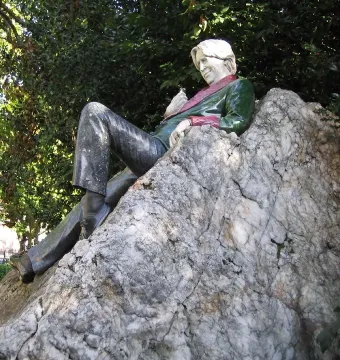
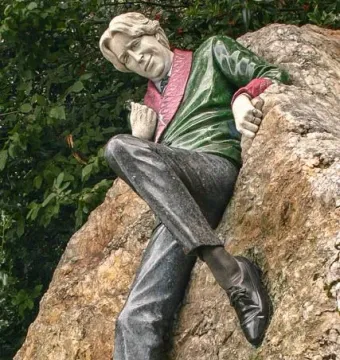
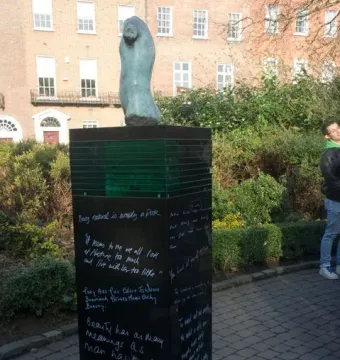
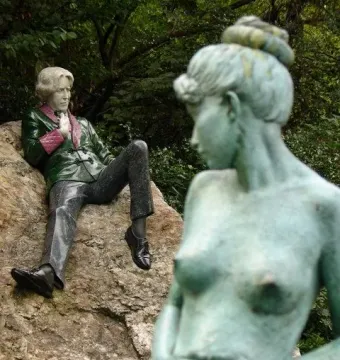
Oscar Wilde Memorial Sculpture is a three-part memorial in Merrion Square, Dublin, commemorating the Irish poet and playwright Oscar Wilde. Designed and made by Danny Osborne, it was unveiled in 1997 by Wilde’s grandson, Merlin Holland. The work features Wilde reclining on a large quartz boulder, flanked by two pillars with companion figures: Constance Lloyd and Dionysus. Osborne used stones from several continents, including green nephrite jade from Canada, pink thulite from Norway, and charnockite from India, along with bronze and granite. The sculpture also includes a porcelain tie and rings referencing Wilde. In 2010, the porcelain head was replaced with a new white jadeite version.
© William Murphy · CC BY-SA 2.0
January 2013 © Frank Kovalchek · CC BY 2.0
November 2009 © Stephen Sweeney · CC BY-SA 2.0
© William Murphy · CC BY-SA 2.0
September 2005 © Raymond Okonski · CC BY-SA 2.0
Identification | |
| Title | Oscar Wilde Memorial Sculpture |
| Type | commemorative sculpture composed of three statues |
| Subject | Oscar Wilde |
Historical context | |
| Purpose | Commemorates Irish poet and playwright Oscar Wilde |
| Historical significance | At its unveiling in 1997, it was the first statue to commemorate Wilde |
Creator | |
| Artist | Danny Osborne |
| Commissioned by | Guinness Ireland Group |
Discovery and provenance | |
| Budget | Initially IR£20,000, revised to IR£45,000 |
| Unveiled by | Merlin Holland, Wilde's nephew |
| Unvealed | 1997 |
Physical characteristics | |
| Overall form | Wilde reclining on a large quartz boulder, flanked by two pillar-mounted figures |
| Pose | Wilde is depicted reclining |
| Base | Large quartz boulder from the Wicklow Mountains, obtained by Danny Osborne |
| Associated figures | Two flanking pillar sculptures: a pregnant nude Constance Lloyd and a male torso representing Dionysus |
| Head | Porcelain head, replaced in 2010 |
| Condition in 2010 | Cracks formed in Wilde's porcelain head, requiring replacement |
Materials | |
| Inscribed pillars | Stone pillars with inscriptions carved from Wilde's poems |
| Dionysus figure | Bronze and granite |
| Constance Lloyd figure | Bronze and granite |
| Head replacement | White jadeite |
| Tie | Glazed porcelain from Trinity College |
| Legs | Norwegian blue pearl granite |
| Torso | Green nephrite jade from British Columbia, Canada, with pink thulite from Norway |
| Main materials | Different coloured stones from three continents, along with bronze, granite, porcelain, jadeite, nephrite jade, thulite, charnockite, quartz, and bronze finials |
| Shoes | Black Indian charnockite with bronze tips |
Appearance | |
| Rings | Wilde's wedding ring plus two scarab rings, one for good luck and one for bad luck |
| Inscriptions | Pillars bear inscriptions carved from Wilde's poems, using handwriting copied from Seamus Heaney, John B. Keane, and Michael D. Higgins |
| Facial expression | A contorted expression with one half smiling widely and the other sombre |
| Color treatment | Uses color as a prominent feature, though the specific colors are not stated |
| Gaze | Directed toward the nude male torso |
Iconography and meaning | |
| Stylistic interpretation | The pose evokes art-historical and popular images of feminized masculinity |
| Stylistic feature | The facial expression disrupts realism |
| Dionysus | Male torso representing Dionysus, the Greek god of drama and wine |
| Interpretive theme | The work is often read as emphasizing Wilde's sexuality |
| Concept represented | Contrasts the witty Wilde of popular memory with the broken man after his two-year incarceration for homosexual acts |
| Constance Lloyd | Pregnant nude representation of Wilde's wife Constance Lloyd |
Location and ownership | |
| Location | Merrion Square, Dublin, Ireland, near Wilde's childhood home at 1 Merrion Square |
| Setting | Placed at the corner of the park on the turn of the outer pathway |
History and restoration | |
| Models | Three local people living near the artist's West Cork studio posed as models for the three sculptures |
| Reception | Received almost unanimous praise for its materials and location |
| Later restoration | Wilde's porcelain head was replaced in 2010 with white jadeite because cracks had formed |
Significance | |
| Contemporary commentary | Commentators noted the long delay in commemorating Wilde in Dublin and linked it to conservative attitudes toward his sexuality |