
Victor Emmanuel II Monument
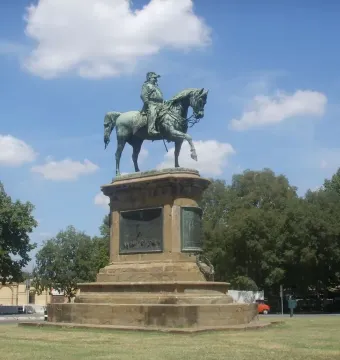
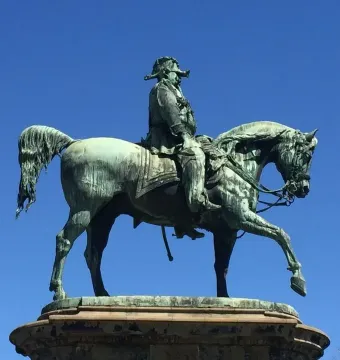
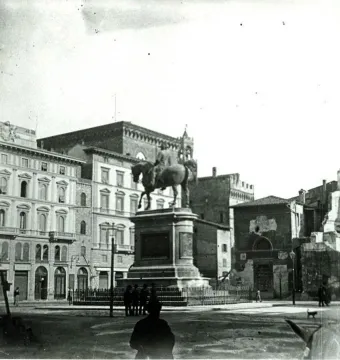
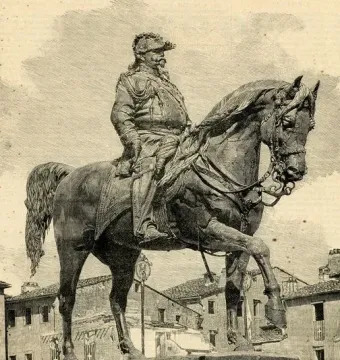
The Victor Emmanuel II monument is an equestrian statue of the former King Vittorio Emanuele II, now located in Piazza Vittorio Veneto at the east end of the Parco delle Cascine in Florence, Tuscany. Designed by Salvino Salvini and later modified by Emilio Zocchi, it was inaugurated in 1890 and moved to its current site in 1932. The project began in 1859, with the final model chosen in 1864 and revived after the king’s death in 1878. The base includes two bronze bas-reliefs showing the king leaving Florence for Rome and receiving news of the Tuscan plebiscite, along with plaques recording the installation and the House of Savoy coat of arms.
© Sailko · CC BY 2.5
April 2018 © Nicola Quirico · CC BY-SA 4.0
© see filename or category · Public domain
1890 © Autore: Emilio Zocchi - Incisore: sconosciuto · CC0
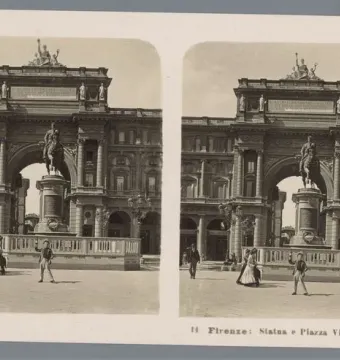
© Rijksmuseum · CC0
Identification | |
| Title | Equestrian monument to Vittorio Emanuele II |
| Type | Equestrian monument |
| Alternative title | Monumento a Vittorio Emanuele II |
Iconography and meaning | |
| Depicted person | Victor Emmanuel II of Savoy, King of Italy |
Creator | |
| Sculptor | Emilio Zocchi |
| Designer | Salvino Salvini |
Historical context | |
| Unrealized early model | A plaster model completed in 1864 and exhibited at the Academy of Fine Arts of Bologna in 1867; the bronze casting was never realized because the municipality refused the cost |
| Revival of project | 1878, after the death of Vittorio Emanuele II |
| Later competition | Held in 1881; Emilio Zocchi’s model was selected in 1882 |
| 1859 competition | A Tuscan Provisional Government competition was held for two equestrian monuments, one to Victor Emmanuel II and one to Napoleon III |
| Winner of 1859 competition | Salvino Salvini |
| First design date | 1859 |
| Context | Post-unification Italy; commemorative monument of the Risorgimento and Florence’s late-19th-century urban reorganization |
Discovery and provenance | |
| Current location | Piazza Vittorio Veneto, at the entrance to the Cascine, Florence |
| Urban-planning context | The current placement corresponds to Giuseppe Poggi’s urban plan for Florence, proposing a more pastoral site and a prominent intersection of avenues leaving the city |
| Relocation rationale | The monument was a significant obstruction to traffic |
| Relocation date | 1932 |
| Associated urban project | Giuseppe Poggi’s grand project for the expansion of Florence |
| Original location | Piazza della Repubblica, Florence |
| Original inauguration date | 20 September 1890 |
| Planned site significance | Linked to the peaceful uprising of 27 April 1859 that led to the expulsion of Grand Duke Leopold II of Lorraine and the annexation of Tuscany to the Kingdom of Sardinia |
| Original planned site | Piazza Maria Antonia, later Piazza dell’Indipendenza |
| Commissioning body | A committee in Florence |
Physical characteristics | |
| Pose of horse | Walking at a slow pace |
| Depiction of the king | Portly, dressed in military regalia, with a sword |
| Style | Marked realism, emphasizing the king’s robust physicality |
| Pedestal | Tall pedestal clad in pietraforte stone |
Materials | |
| Base decoration material | Bronze |
| Base plaques | Four bronze slabs |
Appearance | |
| Inauguration setting | The square was still cluttered with construction sites for the new palaces, partly hidden by stands and grandstands set up for the ceremony |
| Rear plaque | Bears the coat of arms of the House of Savoy |
| Bas-relief 2 | The crowd salutes Victor Emmanuel II as he leaves the city to go to Rome in Piazza dell'Unità Italiana |
| Front plaque | Recalls the installation |
| Bas-relief 1 | The king receives the Tuscan Deputation’s plebiscite for annexation to the Kingdom of Italy at the Royal Palace of Turin |
| Base decoration | Two bronze bas-reliefs, a dedication inscription, the Savoy eagle, and a rear plaque with the coat of arms of the House of Savoy |
History and restoration | |
| Inauguration ceremony | Inaugurated with a large crowd and documented by photography and photoengravings |
| Commemorative medal | A medal was minted for the event, bearing the king’s effigy and a dedication to Victor Emmanuel |
Significance | |
| Reception | Tepid, lukewarm, and harshly criticized; the artistry was considered uninspiring |
| Critical sources | Pietro Franceschini’s publication and articles in Arte e Storia |
| Stylistic references | Recalls the tame steeds in late-Renaissance Florentine monuments to Cosimo I and Ferdinando I, and echoes the calm mastery of rider over horse in the Equestrian Statue of Marcus Aurelius |
| Interpretation | The monument may suggest that the kings of the House of Savoy tended to advance slowly rather than rush into conflict |
Other | |
| Related earlier competition | The Tuscan Provisional Government competition also included a monument to Napoleon III, but no design for it was ever advanced |
| Reason for Napoleon III project’s decline | After the Treaty of Zürich and France’s later protection of Papal territory from Garibaldi’s forces, Napoleon III’s popularity in Italy declined |
| Associated sculptor in Pisa monument | Emilio Zocchi and his son Cesare designed a standing monument for Pisa in 1892 |
| References mention | The source fragment lists articles in Arte e Storia (1882, 1884, 1886, 1888, 1890) and later studies (1996, 2005, 2011, 2015) |