
Angry Boy
Angry Boy is the common English name for a bronze sculpture of an angry little boy by Norwegian sculptor Gustav Vigeland. It stands in Vigeland’s sculpture installation, Vigelandsanlegget, in Oslo’s Frogner Park and is considered one of the city’s best-known landmarks. The sculpture is usually dated to 1928, though Vigeland had already made several miniature versions before then. It has had a turbulent history: it was stolen in 1992, later recovered and reattached, and has since been attacked several more times. Popular with both locals and tourists, it is also frequently touched, especially on the left hand and genitals, which have become visibly shinier from use.
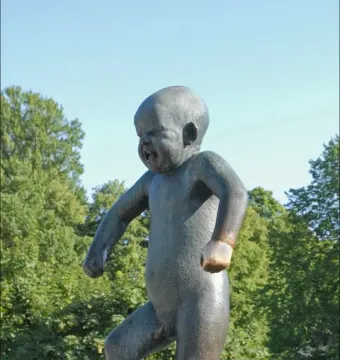
July 2010 © dalbera · CC BY 2.0
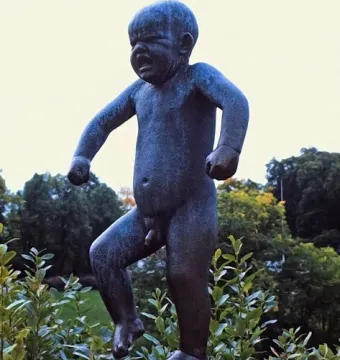
September 1984 © Rüdiger Stehn · CC BY-SA 2.0
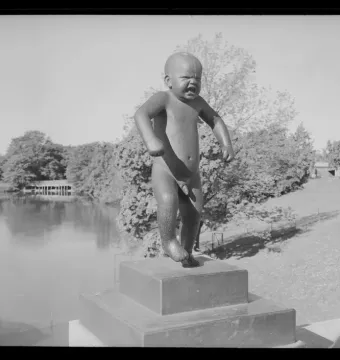
1949 © Unknown authorUnknown author · Public domain
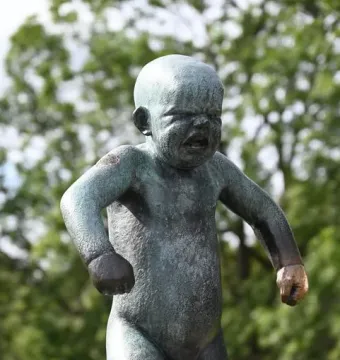
August 2022 © Joetography LLC · CC BY-SA 2.0
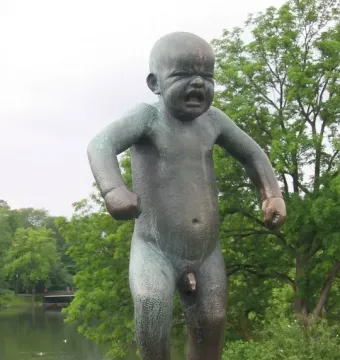
© Olivier2000 · Public domain
Identification | |
| Title | The Angry Boy |
| Alternative names | Der kleine Trotzkopf; Trotzköpfchen; Screaming Boy (skrikende gutt); The Little Temper Tantrum; The little stubborn boy; Sinnataggen |
| Type | Bronze sculpture |
| Subject | A small naked, bald boy |
Historical context | |
| Date modeled | Likely modeled in 1928; the version in Frogner Park is dated 1928, and several miniatures had been created before then |
| Creation period of bridge sculptures | Modeled by Vigeland between 1926 and 1933 |
Creator | |
| Artist | Gustav Vigeland |
| Artist nationality | Norwegian |
Discovery and provenance | |
| Earlier sketch date | Said to have been drawn as early as 1901 |
| Smaller version | Modeled in 1911; at least four castings were made, and Vigeland's son later made at least ten additional unauthorized 'junior casts' |
Physical characteristics | |
| Height | About 1 meter; another source gives 83 centimetres |
| Weight | 45 kilograms |
| Base | Square base plate measuring 30 x 30 cm |
| Pose and expression | Clenching his fists, raising his shoulders and right leg, standing on one foot, and screaming in anger; the face is contorted with rage |
Location and ownership | |
| Number of child figures on the bridge | Four total: two boys and two girls |
| Setting | Installed outdoors on the bridge railing |
| Specific placement | On the railing of the bridge over the Frognerdammene pond, at the corner of the central section facing south, on a small bulge on the left side when coming from the park's main entrance |
| Current location | Vigelandsanlegget in Frogner Park, Oslo |
| Part of | The bridge sculptures in Vigelandsanlegget; one of 58 sculptures on the Bridge |
Appearance | |
| Figure description | A naked, chubby little boy with a bald head |
| Surface wear | The genitals and left hand are frequently touched, so these areas do not have patina and stand out with a metallic shine |
History and restoration | |
| Installation date | Installed in 1940; the first sculptures in the park were installed in 1939 |
| Theft and repair | Stolen on New Year's Eve 1992, cut off above the left ankle, found on 12 January, returned to Frogner Park, and reattached to the left foot |
| Later damage | Has since been attacked several more times with paint or tools; in April 2021 there was another attempt to cut it off at the ankle, after which it had to be removed for repair |
Significance | |
| Associated legend | Touching the sculpture is said to bring good luck |
| Legal status | Because Vigeland died in 1943, his works are now public domain and may be reproduced commercially; Oslo's attempt to secure rights and prevent reproduction failed in 2017 before the EFTA Court |
| Use in protests | Has been used multiple times for protest actions, including against the World Bank and for a youth center |
| Cultural status | A landmark and mascot of Oslo, and a favorite of both residents and tourists |
| Comparisons | Similar in iconic status to The Little Mermaid in Copenhagen and Manneken Pis in Brussels |
| Popularity | Became a popular postcard motif among tourists |
| Notability | One of Gustav Vigeland's best-known sculptures; considered his most famous sculpture |
Other | |
| Artist's titling practice | Vigeland rarely titled his works, allowing for freer interpretation |
| Miniatures and replicas | Vigeland's miniatures of The Little Temper Tantrum were auctioned for large sums; an anonymous buyer offered 1.6 million Norwegian kroner for a 1911 figure in 2017, and a similar sculpture was auctioned 15 years earlier for 1.1 million kroner |
| 2017 auctioned figure description | The 1911 auctioned figure has hair and is more roughly modeled than the version in Frogner Park |
| Stamp appearances | The sculpture in Frogner Park appeared on a Norwegian postage stamp in 2000, and the 1911 sculpture appeared on a Norwegian postage stamp in 2019 for Vigeland's 150th birthday |