
Font d'Hèrcules
Font d'Hèrcules is a sculptural fountain in Barcelona, now located on Passeig de Sant Joan at its intersection with Carrer de Còrsega, in the Gràcia district. Created between 1797 and 1802 by Josep Moret and Salvador Gurri, it is considered the oldest original public statue in the city and is listed as a Local Cultural Asset. The figure of Hercules stands nude, leaning on a club, with his left arm wrapped in the Nemean lion’s skin. Inspired by the Farnese Hercules, the work combines neoclassical composition with a late Baroque taste. Originally set on the Passeig de l'Explanada, it was moved to its current location in 1928.
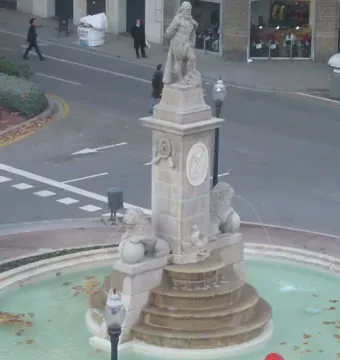
© Jordiferrer · CC BY-SA 3.0
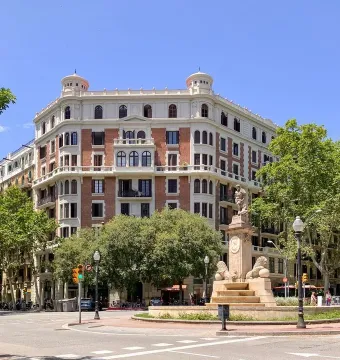
June 2024 © El Mono Español · CC BY-SA 4.0
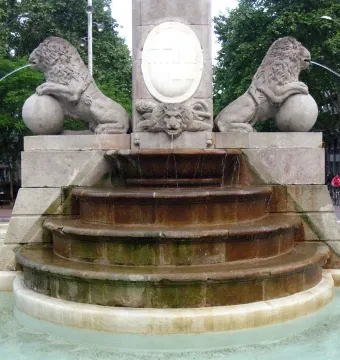
May 2013 © Enfo · CC BY-SA 3.0 es
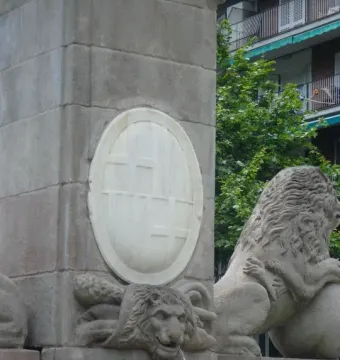
May 2013 © Pere López · CC BY-SA 3.0
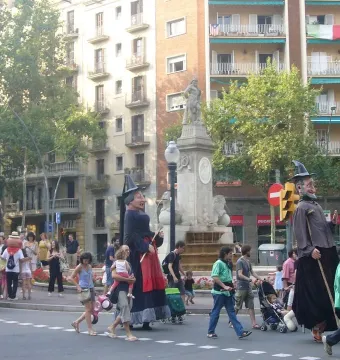
June 2012 © Jordiferrer · CC BY-SA 3.0
Identification | |
| Title | Font d'Hèrcules |
| French name | La Fontaine d'Hercule |
| Type | ornamental monumental fountain with a Hercules statue |
| Title in Spanish | La fuente de Hércules |
Historical context | |
| Date of creation | 1797–1802 |
| Installed | 1797 |
| Official inauguration | 1802 |
| First stone laid | 28 August 1797 |
| Construction duration | Five years |
| Work context | Originated in city water-supply works carried out to solve a serious water shortage |
Creator | |
| Original project by | Salvador Gurri |
| Artists | Josep Moret and Salvador Gurri |
| Sculptor | Josep Moret |
Discovery and provenance | |
| Original installation site | Passeig de l'Esplanada in front of the Fortress of the Citadel, Barcelona |
| Original setting note | Originally stood on a promenade promoted by Captain General Agustín de Lancaster, corresponding today to Passeig de Picasso |
| Associated urban ensemble | Part of a set of four fountains along the Paseo de la Explanada, all dedicated to mythological figures |
| Other fountains in the ensemble | One depicted Forcis fighting a triton; another showed a nereid riding a dolphin; a third was dedicated to Arethusa, a nymph of Diana |
| Purpose | Made to commemorate the visit of King Charles IV and Maria Luisa of Bourbon-Parma |
| Associated people | Charles IV; Maria Luisa of Bourbon-Parma |
Physical characteristics | |
| Pedestal decoration | An oval medallion with portraits of Charles IV and Maria Luisa of Bourbon-Parma |
| Additional sculptural elements | The pedestal is surrounded by two lions |
| Base | Stone base in the middle of a circular basin |
| Material | Montjuïc stone |
Appearance | |
| Subject | Hercules, the Greek demigod son of Zeus and Alcmene |
| Depiction of Hercules | Nude, standing atop the monument, leaning on a club, with the skin of the Nemean lion on his left arm, in a contrapposto stance |
| Style | Neoclassical, with a late Baroque taste associated with Salvador Gurri |
| Composition source | A copy of the Farnese Hercules found in the Baths of Caracalla |
| Decorative companions | Originally flanked by two lions that spouted water from their mouths |
Location and ownership | |
| Protected status | Cultural Property of Local Interest |
| Heritage status | Listed as a Local Cultural Asset (BCIL) in the Catalan Cultural Heritage Inventory |
| State after relocation | Still essentially the same work as in 1802 |
| Relocation year | 1928 |
| Relocation context | Moved when the upper area of Passeig de Sant Joan was urbanized |
| Location | Upper area of Passeig de Sant Joan, at the junction with Carrer de Còrsega, Barcelona, Spain |
| Inventory code | 08019/2652 |
History and restoration | |
| Relocated | 1929 |
| Changes after the royal visit | The pyramid was removed, a taller pedestal was built for the Hercules statue, the royal medallion was installed in the new pedestal, the lions were kept, and a plaque with the history of the Paseo de la Explanada was added |
| Lost element | The plaque narrating the history of the old Paseo de la Explanada was removed during the Second Republic |
| Urban change affecting site | In 1869 the Citadel fortress was ceded to the city and Parc de la Ciutadella was created on its land; the Paseo de la Explanada declined and disappeared during the works for the 1888 Universal Exposition |
| Reason for relocation | Its location became inappropriate and diminished its appearance after the promenade disappeared |
Significance | |
| Historical significance | Considered the oldest original public statue in Barcelona |
| Earlier comparable monument | The Fountain of Saint Eulalia, from 1673, was destroyed during the Civil War and later restored |