
The Golem
The Golem is a monumental sculpture for a kindergarten in West Jerusalem, Israel, commissioned from Niki de Saint Phalle by Mayor Teddy Kollek. Also known more familiarly as Le Monstre or Mifletzet, it was originally controversial because some parents found it frightening. Jean Tinguely acted as assistant in its construction, working as a technician with Rico Weber and Paul Wiedmer, a team Niki de Saint Phalle called her All Stars Swiss Team. The sculpture features a large head with three tongues serving as slides. It gave its name to the Rabinovich Park, now commonly called the Monster Park, and a support committee currently works for both its rehabilitation and the preservation of the park.
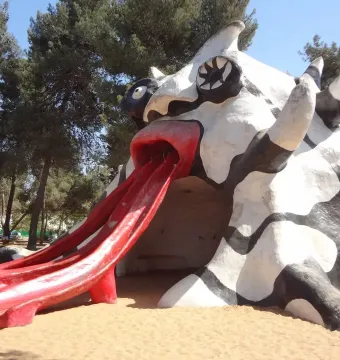
April 2012 © Bachrach44 · CC BY-SA 3.0
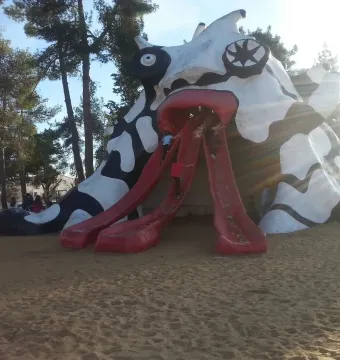
© עפרה לנקרי · CC BY 2.5
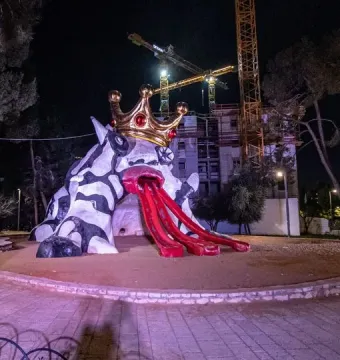
© דוידי ורדי · CC BY 2.5
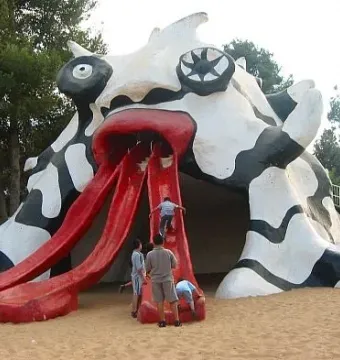
© Niki de Saint Phalle · CC BY-SA 3.0
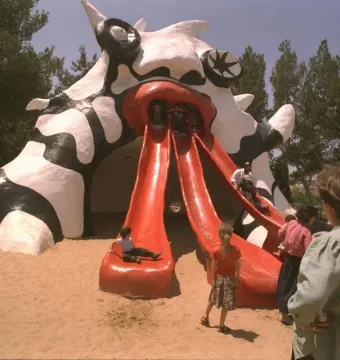
May 1990 © https://www.flickr.com/people/69061470@N05 · CC BY-SA 3.0
Identification | |
| Title | Le Golem |
| Type | monumental sculpture and playground attraction |
| Description | A sculpture described as a monster; a large head with three red tongues serving as slides |
| Alternative names | Le Monstre; Mifletzet; Le Golem de Niki |
Historical context | |
| Date of creation | 1971–1972 |
Creator | |
| Artist | Niki de Saint Phalle |
| Technical collaborators | Jean Tinguely; Rico Weber; Paul Wiedmer |
| Collaborative group nickname | All Stars Swiss Team |
Discovery and provenance | |
| Commissioned by | Teddy Kollek, then mayor of Jerusalem |
| Commissioning context | Commissioned for a children's garden in West Jerusalem; the project faced resistance from concerned parents and the city park commission |
| Approval controversy | When the commission rejected the project, Teddy Kollek asked it to vote again |
| Artist statement | In a 1988 interview, de Saint Phalle said she wanted to place a frightening sculpture in a safe place so children could learn to overcome their fears |
Location and ownership | |
| Accessibility | Publicly accessible |
| Part of | Rabinovich Park, commonly called "the monster park" |
| Setting | A large sandbox in a playground |
| Current location | Rabinovitz Park, Kiryat Yovel district, Jerusalem, Israel |
Physical characteristics | |
| Form | Oversized head |
| Slides | Three red tongues that serve as slides |
| Access to slides | The slides are reached by a stairway at the rear of the sculpture |
| User experience | Visitors climb the steps, pass through the head, and slide down the tongues into the sandbox |
Iconography and meaning | |
| Meaning of name | Mifletzet means "monster," "beast," or "abomination" in Hebrew |
| Subject | Resembles the medieval Golem |
History and restoration | |
| Later relocation plan | In 2014, the sculpture was to be moved to make room for an extension of the Jerusalem light rail line |
| Public reaction to relocation plan | The planned move sparked protests, and more than 3,000 opposing signatures were submitted to the municipal government |
Significance | |
| Status | One of the attractions of the neighborhood |
| Public reception | Initially considered too frightening or sinister for children |
| Support | A support committee exists for its rehabilitation and for preservation of the park that houses it |
| Related statement | According to a 1980 interview cited by Jessica Steinberg, de Saint Phalle said this was one of the monumental sculptures she was most proud of |
Other | |
| Nearby related sculpture | Homage to Jerusalem by Alexander Calder, located at the foot of Mount Herzl |
| Nearby transport | A tramway goes to the area |