
Lions at the Dvortsovaya Pier
Lions at the Dvortsovaya Pier were installed as decoration in 1832. Today the lion sculptures stand on Admiralteyskaya Embankment by the eastern pavilion of the Admiralty, near the Palace Bridge. Local historians consider them the most famous lions in St. Petersburg. After the latest reconstruction, the pier and the nearby bridge form a single architectural ensemble with the bridge’s southern descent. The figures were made in 1832 at the Alexandrovsky Cast Iron Foundry in St. Petersburg using the chasing method from sheet copper. They were created by master I. Prang after a model by sculptor I. P. Prokofiev, and cast-iron pedestals with volutes were made there as well, following a design by architect L. Charlemagne.
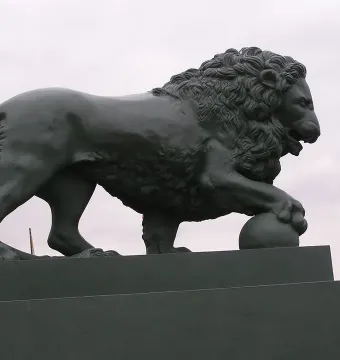
September 2008 © Andrey Butko · CC BY-SA 3.0
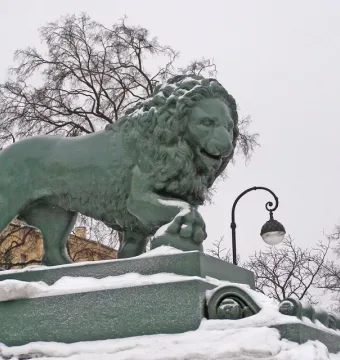
© Andrew Zorin · CC BY-SA 3.0
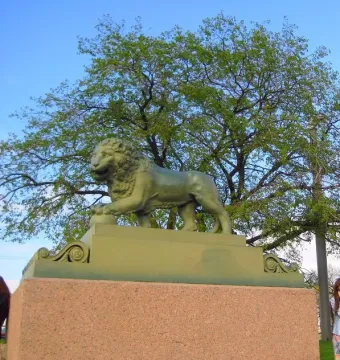
May 2014 © GAlexandrova · CC BY-SA 4.0
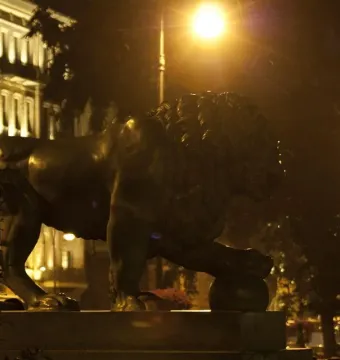
© Ли [A.I.I.P.] · CC BY-SA 3.0
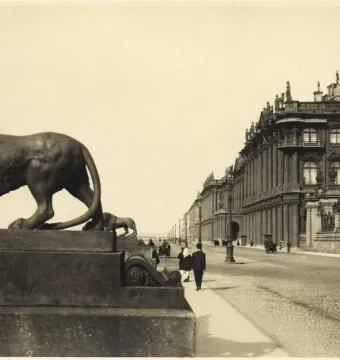
© Unknown authorUnknown author · Public domain
Identification | |
| Title | Lions at the Dvortsovaya Pier |
| Type | Pair of lion statues |
Historical context | |
| Initial concept | Luigi Rusca's 1817 project first proposed placing lions on the pier |
| Production history | The sculpture scheme went through several design variants before the lions were restored as the chosen version in May 1832 |
Creator | |
| Manufacturer | Johan Gottlieb Prang |
| Designer | Ivan Prokofiev |
| Pedestal designer | L. Charlemagne |
Discovery and provenance | |
| Manufacture date | 1832 |
| Manufacturing site | Alexandrovsky Iron Foundry in St. Petersburg |
| Cost estimate | Casting from existing models was estimated at 2,500 rubles per lion; the copper version was estimated at 1,800 rubles per lion |
| Correspondence | In 1828 Karl Rossi, M. E. Clark, and Minister P. M. Volkonsky discussed making the lion statues; Rossi preferred commissioning models from famous artists, and Volkonsky suggested measuring the Triscorni lions at the War Ministry |
| Earlier related works in Saint Petersburg | Marble repeats of the Medici Lions by Paolo Triscorni were already installed in front of the Lobanov-Rostovsky House |
| Relation to model | Copies of the Medici lions |
| Model | Late 16th-century Medici lions in Florence |
Physical characteristics | |
| Number of sculptures | 2 |
| Pedestals | Cast-iron pedestals with volutes |
Materials | |
| Sculpture material | Sheet copper; hollow copper shells |
| Pedestal material | Cast iron |
Technique | |
| Sculpture technique | Repoussé and chasing from sheet copper |
| Pedestal construction | Cast-iron pedestals |
Location and ownership | |
| Ensemble | After the last reconstruction, the pier with the lions forms a single architectural ensemble with the southern descent of Palace Bridge |
| Current location | Admiralteyskaya Embankment near the eastern pavilion of the Admiralty, next to Palace Bridge, Saint Petersburg, Russia |
| Original location | Dvortsovaya Pier, Saint Petersburg, Russia |
| Setting | The pier is surrounded by the Admiralty and the Winter Palace and faces the Neva River |
Iconography and meaning | |
| Subject | Lion figures |
| Intended prototype | The Medici Lions in Florence |
Significance | |
| Notability | Considered by local historians to be the most famous lions of Saint Petersburg |
| Artistic attention | The location attracted artists and was depicted in 19th-century paintings and a 1901 illustration |
| Depictions on currency and stamps | Depicted on 2003 Saint Petersburg commemorative coins and on a 2025 Russian Post stamp for FC Zenit's centenary |
History and restoration | |
| Emergency repair in 2006-2007 | The damaged lion was repaired over about 3 months at a cost of about 300,000 rubles, funded by the Russian Party of Life and supervised by Sergei Mironov; the restoration was staged theatrically and temporary stand-ins were placed on the pedestal |
| Restorers' assessment | The cast-iron pedestals were judged very strong, while the hollow copper shells were vulnerable to human weight |
| 2022 restoration process | The restoration included cleaning, priming, repair of cracks and deformation, and structural strengthening |
| Condition in 2022 | The sculptures arrived dented and crushed; cleaning revealed many layers of paint, holes, and dents, and the surface was deformed by corrosion and by people climbing on the lions |
| Restoration in 2022 | In autumn 2022 the lions and their cast-iron pedestals were restored over about one month by four restorers, and the structure was reinforced with an internal tubular frame using brass tubes |
| Second restoration in 2007 | The second sculpture was repaired in 2007, completed by September, at a cost of 262,000 rubles; a flat copy was placed on the pedestal during the work |
| Wartime condition | During the war the lions remained in place and were not covered; they suffered serious damage from artillery shelling and bombing of Leningrad |
| Damage in 2006 | In June 2006 damage was discovered, apparently caused when tourists climbed the lion nearest Palace Bridge and broke through its back; cracks became visible and urgent repair was required |
| Restoration in 2001 | The first 21st-century restoration was carried out in 2001 with support from Volya Peterburga, which also signed a guardianship agreement to protect and clean the monument |
| Postwar restoration | The sculptures were restored in the early 1950s and returned to the pier |
| Removal and restoration after 1913-1914 | The lions were removed during the construction of Palace Bridge and were later apparently restored |
| Interruption in work | Work on the pier decoration, including the lions, was interrupted from 1828 to 1832 for unknown reasons |
| Installation date | September 1832 |
| Expected durability after reinforcement | After reinforcement the sculptures were expected to be difficult to break unless struck with a 10-kilogram sledgehammer |