
Equestrian Statue of Ambrose Burnside
The equestrian statue of Ambrose Burnside, also known as the Ambrose Burnside Monument, is a monumental sculpture in Providence, Rhode Island. Located in Burnside Park, it was designed by sculptor Launt Thompson and depicts Ambrose Burnside, a Union Army officer during the Civil War who later served as governor of Rhode Island. Burnside died in 1881, and plans for the memorial began soon after. The statue was dedicated on July 4, 1887, in a ceremony attended by notable guests including William Tecumseh Sherman. It was originally installed at Exchange Place, now Kennedy Plaza, and later moved to its current site, where its pedestal was replaced with one designed by William R. Walker.
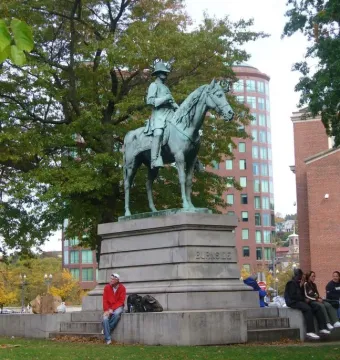
October 2013 © JPRiley · CC BY-SA 4.0
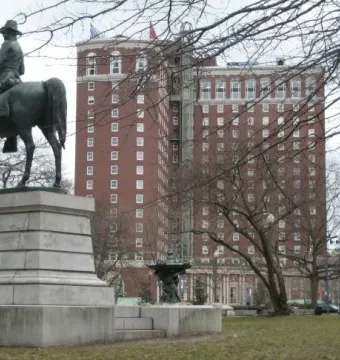
© Loodog · CC BY-SA 3.0
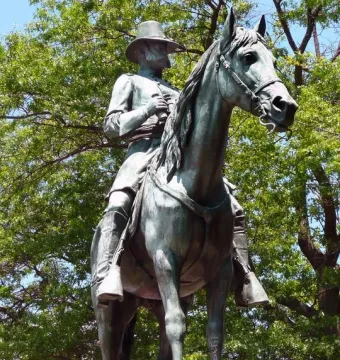
© Hal Jespersen · Public domain
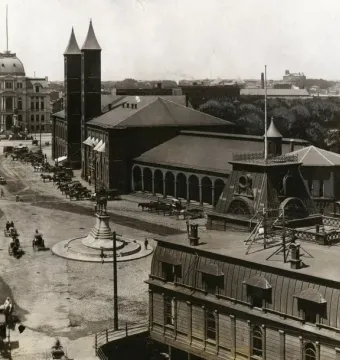
© Unknown authorUnknown author · Public domain
July 2019 © Kenneth C. Zirkel · CC BY-SA 4.0
Identification | |
| Title | Major General Ambrose E. Burnside |
| Type | Bronze equestrian statue |
| Subject | Ambrose Burnside |
| Depicted person | Ambrose Burnside |
| Alternative name | Ambrose Burnside Monument |
Historical context | |
| Subject's identity | Union Army officer during the American Civil War; later governor of Rhode Island |
| Historical context | Commissioned during the Bronze Age of bronze Civil War monuments, roughly the 1870s to the 1920s |
Creator | |
| Sculptor | Launt Thompson |
| Pedestal designer | William R. Walker |
Discovery and provenance | |
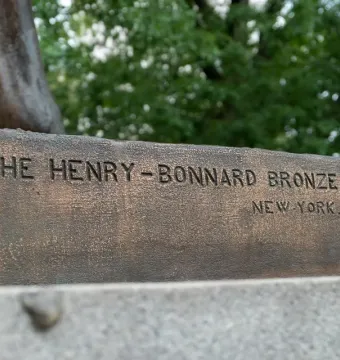
| Casting foundry | Henry-Bonnard Bronze Company, New York City |
| Construction delay | The project took longer than expected |
| Planned completion date | May 20, 1886 |
| Payment terms | Half due when a plaster model was submitted to a bronze foundry; the other half due when the statue was placed on a pedestal |
| Artist's payment | $30,000 |
| Models used for design | Several horses Thompson bought |
| Plaster model submitted | August 1886 |
| Design approval | July 1885 |
| Project inception | Began shortly after Ambrose Burnside's death in 1881 |
| Reason for creation | To honor Ambrose Burnside after his death in 1881 |
| Commission date | May 1883 |
| Commissioned by | Building Committee of the monument project |
Physical characteristics | |
| Pedestal construction | The pedestal is divided into two parts, an upper section and a lower section |
| Figure height | Burnside is represented as approximately a 6-foot-tall man |
| Scale | Approximately 1.5 times life-size |
| Clothing | Burnside is dressed in his Civil War military uniform |
| Horse pose | All four feet are planted on the ground and the horse faces straight ahead |
| Depiction | Burnside on horseback, looking over a battlefield, holding binoculars in his right hand and the horse's reins in his left hand |
Materials | |
| Statue material | Bronze |
| Pedestal material | Marble |
| Pedestal stone source | Frederick L. Mathewson's quarry in Burrillville, Rhode Island |
| Pedestal stone preparation | Cut and prepared by Isaac M. Sweet of Providence |
| Additional contracting work | George Gerhard of East Providence and Franklin L. Mason of Providence |
| Pedestal fabrication | Henry O. Avery of New York City |
Appearance | |
| Base markings | Launt Thompson 1887 Sculptor; The Henry-Bonnard Bronze Co. 1887 |
| Inscription | BURNSIDE |
Location and ownership | |
| Original location | East end of Exchange Place, Providence, Rhode Island |
| Current location | Burnside Park, Providence, Rhode Island, United States |
| Original location name | Exchange Place, later Kennedy Plaza |
| Later relocation site | Northeast corner of nearby City Hall Park, later known as Burnside Park |
| Location selected | Exchange Place in Providence, specifically the east end of the plaza |
History and restoration | |
| Curb addition | The city added a curbed sidewalk to reduce the risk of automobile accidents involving the monument |
| Condition survey | Inspected in 1993 as part of the Save Outdoor Sculpture! project |
| Restoration | In July 2015, Providence spent $13,500 to hire Buccacio Sculpture Studios LLC of Natick, Massachusetts, to restore the statue as part of a larger renovation of Kennedy Plaza |
| Pedestal replacement | The pedestal was replaced during the move |
| Relocation | Moved from Exchange Place to the northeast corner of nearby City Hall Park, later known as Burnside Park |
| Relocation date | 1906 |
| Relocation authorization | December 1902 law of the Rhode Island General Assembly |
| Original intended unveiling date | April 1887, later changed to July 4, 1887 |
| Casting and shipment date | June 1887 |
| Installation date | June 1887 |
| Private funding | The remainder was raised through private donations |
| Music at dedication | Marching Through Georgia; The Star-Spangled Banner; American Hymn |
| Dedication date | July 4, 1887 |
| Public funding | Rhode Island government contributed $10,854.69; the city contributed $5,000 |
| Notable attendees at dedication | General William Tecumseh Sherman; Colonel Robert Hale Ives Goddard; Governor John W. Davis of Rhode Island; Governor Phineas C. Lounsbury of Connecticut; Henry Rodman Barker; Reverend Joseph J. Woolley; General Lewis Richmond; General Horatio Rogers Jr.; Mayor Gilbert F. Robbins; Reverend Christopher Hughes; Launt Thompson |
| Dedication ceremony | Held in a large ceremony at 10:30 a.m. with about 5,000 people in procession; mounted police, event marshals, Rhode Island Militia, and many veterans including members of the Grand Army of the Republic participated |
| Dedication speech | General Horatio Rogers Jr. praised Burnside and recounted his Civil War experiences; Launt Thompson said he was proud to have been selected and hoped the monument would satisfy the people of Providence and Rhode Island |
| Presentation to city | Colonel Robert Hale Ives Goddard offered the monument to the city of Providence on behalf of the Monument Committee, and Mayor Gilbert F. Robbins accepted it |
| Veteran accommodations | All veterans living in Rhode Island were invited and provided free transportation and food |
| Dedication funding | Rhode Island General Assembly appropriated $4,000 for the unveiling ceremony, $1,000 for transporting veterans, and $2,500 for the governor to call out the militia; the city council reserved $2,000 for Independence Day festivities |
| Total cost | About $40,000, excluding sidewalk installation |
Significance | |
| Artist's career significance | Thompson's last major work and the only equestrian statue of his career |
| Style | Realist style, described in 1965 as hard-handed, cast-iron realism |
| Style period | Prevalent between 1865 and 1895 |
| 1887 critical opinion | Samuel Greene Wheeler Benjamin described the statue as a work of considerable merit and compared it favorably with other American equestrian statues, while saying none of the comparable works was first-rank |
| 1891 critical review | The American Architect & Building News called it surprisingly good, sober, dignified, and well composed, but said the modelling was commonplace and hardly worth examining and that it deserved a better site |
| 1891 site criticism | It was described as placed at one end of an irregularly shaped square near the railroad station and surrounded by cars, carriages, and wagons |
| 1891 interpretive comment | Its noisy and unsightly surroundings were said to make the virtues of a quiescent pose in a public statue more visible |