
Mechanics Monument
Mechanics Monument is a bronze sculpture group by Douglas Tilden located at the intersection of Market, Bush and Battery Streets in San Francisco, California. Also known as The Mechanics, Mechanics Statue, or Mechanics Fountain, it originally stood at the center of a pool of water for the first five years after its installation. The work was commissioned as part of a Market Street beautification project around the turn of the 20th century, along with the Admission Day Monument and California Volunteers. Dedicated on May 15, 1901, it was initially called the Donahue Memorial Fountain. After the 1906 San Francisco earthquake, the fountain basin was removed.
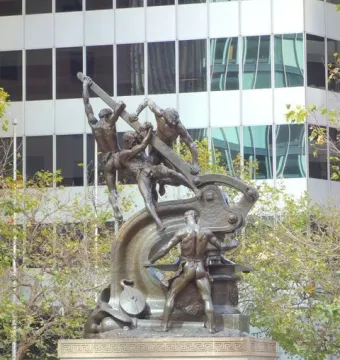
June 2014 © Daderot · Public domain
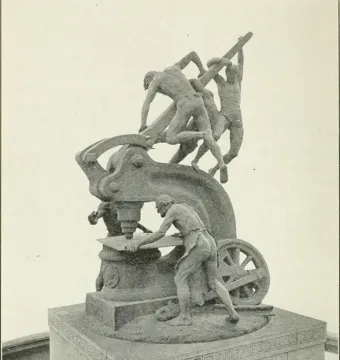
1914 © Internet Archive Book Images · No restrictions
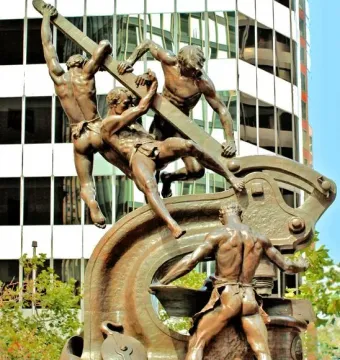
© torbakhopper · CC BY 2.0
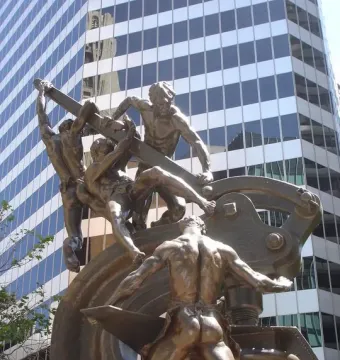
June 2006 © BrendelSignature · CC BY-SA 3.0
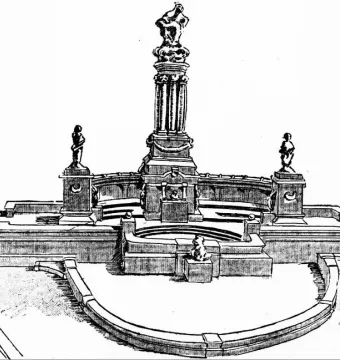
November 1897 © unknown illustrator · Public domain
Identification | |
| Also known as | The Mechanics; Mechanics Statue; Mechanics Fountain; Donahue Memorial Fountain; Donahue Fountain |
| Title | Mechanics Monument |
Historical context | |
| Type | bronze monument and fountain |
| Commission context | Created as part of a Market Street beautification project at the turn of the 20th century |
| Funding | Financed by a $25,000 bequest from James Mervyn Donahue |
| Bequest purpose | To honor Peter Donahue and provide a beautiful ornament for San Francisco |
| Honoree | Peter Donahue |
Creator | |
| Artist | Douglas Tilden |
| Assisting artists | Carlo Moni and Nonette McGlashan |
| Related works | Admission Day Monument; California Volunteers |
Discovery and provenance | |
| Design inspiration | Tilden said the design came to him while walking on Mission Street past a machine shop and seeing a muscular, sweating worker operating a punch press |
| Symbolic concept | The five ages of man |
| Original model | Clay model |
| Commission basis | Commissioned on the basis of Tilden's earlier work on the Admission Day Monument |
| Model presentation date | January 1900 |
| Model presented to | Executors of Donahue's estate |
Physical characteristics | |
| Year created | 1901 |
| Height | 6.4 meters |
| Number of figures | Five |
| Figure attire | Mostly nude; the figures are notably without trousers |
Materials | |
| Base material | Granite pedestal |
| Materials | Bronze and granite |
Technique | |
| Installation | Bronze figures installed on the granite base in March 1901 |
| Composition | Bronze figures on a granite base |
Appearance | |
| Depicted scene | Five men attempting to operate a punch press to punch a hole through a metal plate or boiler plate |
| Base symbols | An anvil for foundries, a ship's propeller for shipping, and a wheel with connecting rod for railroads |
| Original fountain form | Centerpiece of a water basin |
| Original fountain details | Originally planned as a drinking fountain with a basin surrounding the monument |
| Original basin duration | The fountain setting lasted for the first five years |
Location and ownership | |
| Location | Mechanics Monument Plaza at the intersection of Market Street, Battery Street, and Bush Street, San Francisco, California, United States |
| Nearby landmark | Central Plaza is southeast of the sculpture, across Market Street |
History and restoration | |
| Public reaction | The nude figures caused a stir at the unveiling; calls were made to add trousers afterward, but this was not done |
| Earthquake impact | The monument survived the 1906 San Francisco earthquake, after which the basin was eliminated |
| Later event speech title | Expansion and Trade Development and Protection of the Countries Newly Acquired Possessions |
| Later event | President Theodore Roosevelt visited the fountain on May 13, 1903 and spoke to a large crowd with the monument as a backdrop |
| Dedication date | May 15, 1901 |
| Dedication speech | Mayor James D. Phelan made a brief speech accepting the statue |
| Unveiling | Unveiled by Irving M. Scott, manager of the Union Iron Works |
| Dedication incident | President William McKinley was originally expected to attend, but did not because Mrs. McKinley's illness cut short his trip to San Francisco |
| Dedication subject | Dedicated in honor of industrialist Peter Donahue |
Significance | |
| Relative ambition | Tilden regarded it as his most ambitious work |
| Nickname | Donahue's pump |