
Monument to Columbus
Monument to Columbus is a 37-metre-high monument in Huelva, Spain, created by Gertrude Vanderbilt Whitney. Funded by a popular subscription in the United States through the Columbus Memorial Fund Inc., it was built between 1927 and 1929. The monument stands on Punta del Sebo, at the confluence of the Tinto and Odiel rivers, and was inaugurated on 21 April 1929 in the حضور of Prime Minister Miguel Primo de Rivera and US ambassador Ogden H. Hammond. It consists of a mortar structure covered with ashlar masonry in calcarenite. The sculpted man leaning on a Tau cross has been interpreted as a friar from La Rábida, though it was originally identified by the artist as Christopher Columbus.
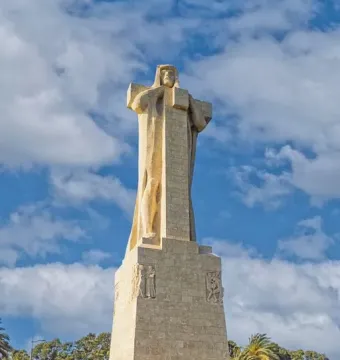
May 2022 © MiguelAngel fotografo · CC BY-SA 4.0
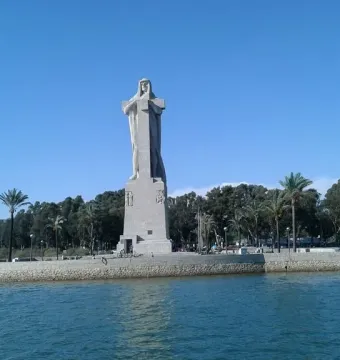
July 2016 © Selima12 · CC BY-SA 4.0
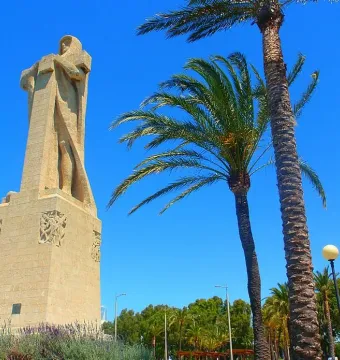
January 2014 © Jose A. · CC BY 2.0
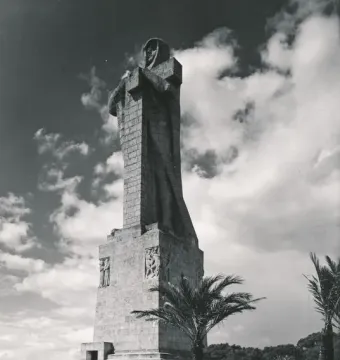
© Biblioteca de la Facultad de Empresa y Gestión Pública Universidad de Zaragoza · CC BY-SA 2.0
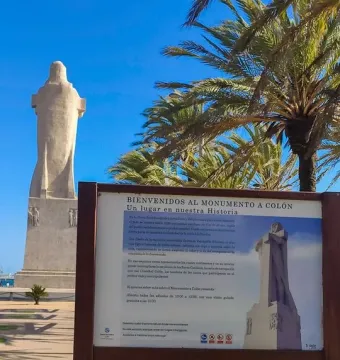
January 2023 © MiguelAngel fotografo · CC BY-SA 4.0
Identification | |
| Title | Monument to Columbus |
| Subject | Christopher Columbus |
| Alternative names | Monument to the Discovering Faith; Monumento a Colón; Monumento a la Fe Descubridora |
| Type | Monument; commemorative sculpture |
Historical context | |
| Idea proposed by | William Hussey Page |
| Idea date | 1917 |
| Idea circumstances | During a business trip to Spain, William Hussey Page traveled to La Rábida in Palos de la Frontera after missing the ship that was to take him back to New York. |
| Commissioned by | Columbus Memorial Foundation |
| Funding | Funded by popular subscription in the United States through the Columbus Memorial Fund Inc.; the Columbus Memorial Foundation financed it largely |
| Donation | Donated by the United States to Spain in 1929 |
| Commissioned year | 1927 |
Creator | |
| Artist | Gertrude Vanderbilt Whitney |
| Artist nationality | American |
| Construction supervisor | Florence J. McAuliffe |
| Construction supervision | On site |
Physical characteristics | |
| Pedestal reliefs | Bas-reliefs representing either the Aztec, Inca, Maya, and Christian cultures, or the four continents of Asia, Africa, Europe, and America |
| Associated sculptural group | Includes a sculptural group representing the Catholic Monarchs |
| Interior | Hollow pedestal with motifs related to the discovery and the names of the discoverers who traveled on the caravels and the members of the Columbus Memorial Foundation |
| Iconographic figure | A human figure leaning on a Tau cross |
| Structure | Mortar structure covered with calcarenite ashlar masonry |
| Height | Approximately 37 metres |
Materials | |
| Materials | Calcarenite ashlar masonry over a mortar structure; built with stones from Niebla, Huelva province |
Technique | |
| Construction period | 1927 to 1929; much of 1928 and early 1929 |
Appearance | |
| Style | Generally classified as Cubist art; some sources say it was inspired by ancient Egyptian sculpture |
| Composition | A human figure standing on a Tau-shaped cross (a Franciscan symbol) |
Iconography and meaning | |
| Interpretation | The sculpted man was originally described, including by the artist herself, as Christopher Columbus; it is sometimes described as a friar from La Rábida. Whitney said it is a statue dedicated to Columbus with broad symbolic significance, and it is commonly identified with Christopher Columbus |
| Naming history | The work is known under two names in different sources, sometimes interchangeably and sometimes with one treated as primary; some sources regard Monumento a Colón as the popular and best-known name in Huelva, while others consider it erroneous and treat Monumento a la Fe Descubridora as the official name or subtitle. Some research argues Monumento a Colón is the original name and Monumento a la Fe Descubridora is secondary, possibly deriving from a 1970 note by José María Segovia; contemporary press at the 1929 inauguration used only Monumento a Colón. |
Location and ownership | |
| Donated to | Spain |
| Site | At Punta del Sebo in the Ría de Huelva, where the Tinto and Odiel rivers meet, about 4 kilometres from the urban center |
| Setting | Placed on an artificial platform built over the former natural beach; erected when the area was still a natural beach space |
| Location | Punta del Sebo, Huelva, Spain, on the outskirts of the city |
History and restoration | |
| Inauguration date | 21 April 1929 |
| Inauguration attendees | Prime Minister Miguel Primo de Rivera and US ambassador Ogden H. Hammond |
| Heritage designation | Inscribed in 2016 in the General Catalogue of Andalusian Historical Heritage as a Site of Cultural Interest, within the Historical Site of the Columbian Sites |
| Cultural designation | Declared or considered a Bien de Interés Cultural |
Significance | |
| Cultural significance | One of the most notable symbols of the city of Huelva |
Other | |
| Interview source | Blanco y Negro |
| Interview timing | One day before the inauguration |