
Mausoleo Martinengo
Mausoleo Martinengo is a funerary monument by Gasparo Cairano, Bernardino delle Croci and probably the Sanmicheli workshop, dated between 1503 and 1518. Made with various marbles and bronze, it measures 465 x 360 x 126 cm and is preserved in the museum of Santa Giulia in Brescia, in the nuns' choir. The monument is considered one of the most emblematic works of Brescian Renaissance sculpture, distinguished by its architectural and artistic purity, refined color effects from ancient marbles, and mythological iconography intended to celebrate the deceased.
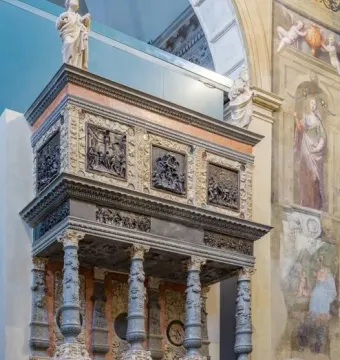
November 2020 · CC BY-SA 3.0
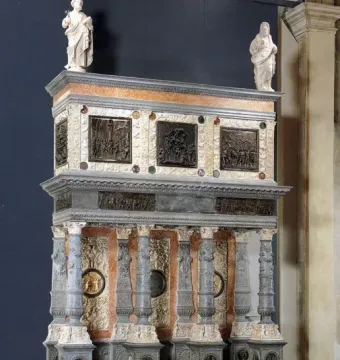
© RobyBS89 · Public domain
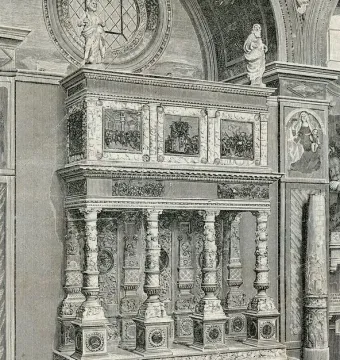
1898 © Franz Robert Richard Brendámour · Public domain
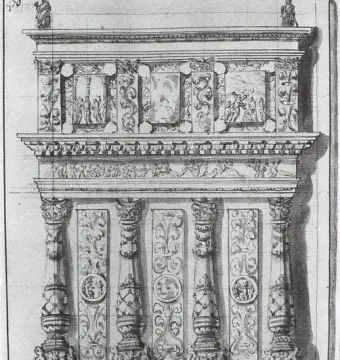
1668 © Anonimo incisore del XVII secolo · Public domain
© RobyBS89 · Public domain
Identification | |
| Title | Mausoleo Martinengo |
| Type | Renaissance family mausoleum |
Historical context | |
| Date | 1503–1518 |
| Artistic tradition | Brescian Renaissance sculpture |
Creator | |
| Artists | Gasparo Cairano; Bernardino delle Croci; probably the Sanmicheli workshop |
Discovery and provenance | |
| Family context | Part of a dynastic burial project of the Martinengo di Padernello family, begun by Antonio I Martinengo di Padernello |
| Agreed price | 500 ducats, with the possibility of increasing to 600 ducats depending on the finished work |
| Planned completion time | Within three years |
| Contract details | The contract specified the monument's appearance, materials, decoration, and a top figure described as 'imagibus ... in forma pietatis'; a preparatory drawing attached to the contract is now lost |
| Intended purpose | To fulfill the testamentary wishes of Bernardino Martinengo di Padernello and gather the Martinengo family burials in one dedicated place |
| Original location | Church of the Santissimo Corpo di Cristo, Brescia, Italy |
| Commission date | 29 May 1503 |
| Commissioned artist | Bernardino delle Croci, a Brescian goldsmith |
| Commissioners | Francesco Martinengo di Padernello and Antonio II Martinengo di Padernello |
History and restoration | |
| Later burial | Marcantonio Martinengo della Pallata was buried in the mausoleum in 1526 |
| Museum placement | First installed in the nuns' choir of the Santa Giulia monastery museum under the central arch of the north wall, later moved to its present position against the west wall of the choir |
| Removal from church | In 1883 the mausoleum was dismantled and transferred to the newly founded Civic Museums of Brescia |
| Napoleonic suppression | In 1810 the Franciscan order was abolished and the convent was confiscated and became state property; the church itself was not secularized |
| Monastery history | The adjoining monastery remained active until 1810, passing from the Jesuati to the Canons of San Giorgio in Alga and finally to reformed Franciscan friars before Napoleonic suppression |
| Condition in 1668 | The central bronze panel was already missing; the crowning was as it is today; the two corner statues were present; the frieze of the Triumphs was still intact in large part; the back clipeus was already empty |
| Watercolor record | A 1668 watercolor, known since 2003 and preserved in the Biblioteca Queriniana, Brescia, shows the monument in frontal view and documents its 17th-century condition |
| Revision of scholarship | Camillo Boselli clarified the monument's history in 1977 by finding documentary evidence |
| Misidentification history | The monument was later mistaken for Marcantonio Martinengo's tomb, and its origin was traditionally dated to 1526 |
| Replacement element | The missing central bronze panel area is now occupied by a wooden Crucifixion, known only from an 1822 engraving |
| Completion status by 1515 | Probably finished at least in its main parts, such as the stone structure |
| Political disruption | The War of the League of Cambrai and the sack of Brescia in 1512 contributed to the shelving of the commission |
| State in 1515 | Antonio II Martinengo's will shows the monument was already advanced enough for him to request burial there and note that his father Bernardino was already buried inside |
| Debt amount | 300 ducats, also recorded as 1,000 lire |
| Cause of delay | Unpaid commitments by the patrons, not default by Bernardino delle Croci |
| Early construction dispute | In 1506 the patrons failed to pay for materials and loans advanced by Bernardino delle Croci, causing a dispute and interrupting the work |
| Renewed contract date | 6 August 1516 |
| Renewed completion deadline | January 1518 |
| Additional compensation in 1516 | Antonio II Martinengo ceded two masonry houses to Bernardino delle Croci in exchange for completion of the monument |
| State in 1516 | The mausoleum was already installed in the church while still unfinished |
Physical characteristics | |
| Dimensions | 465 × 360 × 126 cm |
| Structure | Multi-tiered funerary monument with a severe Renaissance architectural setting and rich sculptural decoration |
| Columns | Four columns on pedestals, with corresponding pilasters on the back side |
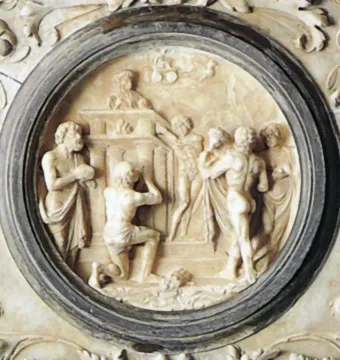
| Rear panels | Three decorative rear panels with central roundels; two marble roundels survive depicting a Sacrifice Scene and a Battle Scene, and the third is lost |
| Sarcophagus | Placed above the entablature |
| Tomb crowns | Statues of Saint Peter and Saint Paul at the corners of the monument |
Materials | |
| Additional bronze decoration | Sixteen additional bronze roundels, largely lost, decorated the pedestals of the columns and pilasters |
| Lower decoration | A large black marble eagle inlaid on the underside of the sarcophagus |
| Sarcophagus decoration | Three square bronze plaques depicting the Flagellation of Christ, the Ascent to Calvary, and the Prayer in the Garden; one further plaque is lost and the central plaque has been replaced by a wooden copy |
| Material source | Many of the ancient marbles were probably salvaged or reused |
| Pedestal decoration | Bronze roundels with figural subjects, mostly lost |
| Column cladding | Columns are clad in marbles from different origins |
| Materials | Various marbles, black marble, bronze, and wood |
Appearance | |
| Stylistic character | Balance of architectural composition, simple well-defined lines, and refined color effects from ancient marbles |
| Frieze | A partially preserved entablature frieze depicting the Triumphs of Faith, Fortitude, and Justice in a long procession |
| Decorative frames | Richly decorated frames combining Christian and classical ornamental motifs |
Iconography and meaning | |
| Iconography | Rich mythological and Christian iconographic program |
| Purpose | Designed to celebrate the deceased and to gather the Martinengo family burials in one specially dedicated place |
| Heraldic meaning | The black marble eagle is the heraldic emblem of the Martinengo family |
Location and ownership | |
| Current location | Museum of Santa Giulia, Brescia, Italy |
| Current location within museum | The nuns' choir |
| Original church location | Church of the Most Holy Body of Christ (Santissimo Corpo di Cristo), Brescia |
Significance | |
| Artistic value | Considered one of the most emblematic and important examples of Brescian Renaissance sculpture |
| Assessment | Its artistic and historical value is undisputed |