
Lorelei Fountain
Lorelei Fountain, also known as the Heinrich Heine Memorial, is a monument on East 161st Street in the Concourse section of the Bronx, New York City, near the Bronx County Courthouse. Designed by German sculptor Ernst Herter, it was created in 1896 out of Italian white marble in Laas, South Tyrol. The fountain was unveiled at its current location in 1899 and is dedicated to German poet and writer Heinrich Heine. Heine had written a poem about the Lorelei, a feminine water spirit associated with the Lorelei rock in St. Goarshausen, Germany. The monument was originally intended for Düsseldorf, but its planned completion there was blocked by antisemitism and nationalist propaganda.
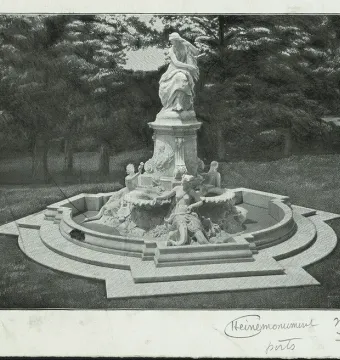
© user:Mutter Erde · Public domain
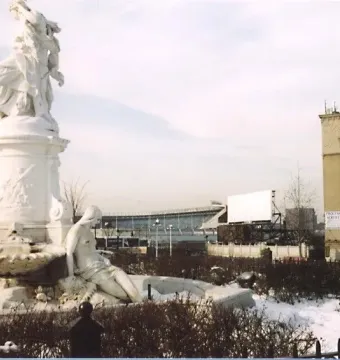
© user:Schreibkraft · CC BY-SA 3.0
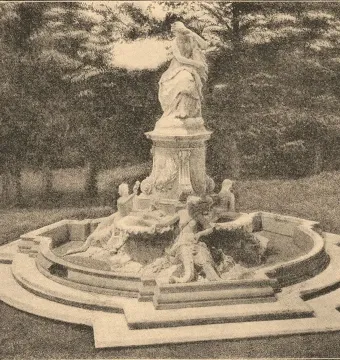
© Unknown authorUnknown author · Public domain
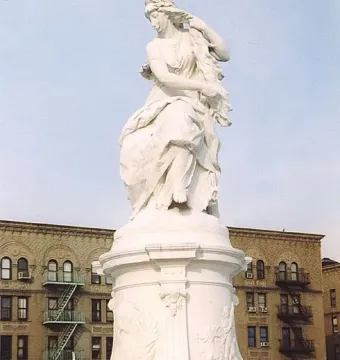
© Schreibkraft · CC BY-SA 2.0 de
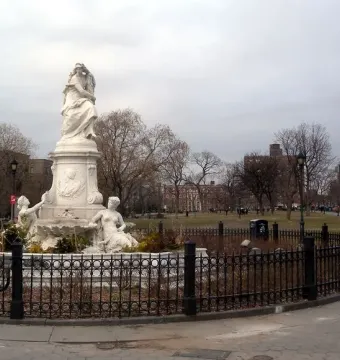
© Jim.henderson · CC0
Identification | |
| Title | Lorelei Fountain |
| Type | Fountain monument |
| Alternative names | Heinrich Heine Memorial; Heinrich Heine Monument; Loreley Fountain |
Historical context | |
| Project origin | Initiated by a Heine memorial committee in Düsseldorf in autumn 1887 during the Heine renaissance |
| Intended dedication date | 1897, for Heinrich Heine's 100th birthday |
| Reason the Düsseldorf plan failed | Antisemitism and nationalist agitation in the German Empire |
Creator | |
| Artist | Ernst Herter |
| Artist nationality | German |
| Artist's residence | Berlin |
Discovery and provenance | |
| Estimated cost by Herter | 32,000 to 40,000 marks |
| Later funding for restoration | About $700,000 in private donations; a 50,000-mark donation from Johannes Rau is also mentioned |
| Contracted work | A pedestal for the monument |
| Contract date | December 1892 |
| Commissioning and funding | Commissioned by the Heine monument committee in Düsseldorf; later supported by the city of New York and New York committees, with a promised 50,000-mark donation from Empress Elisabeth conditioned on Herter executing the monument |
| Initial fundraising | By January 1889, 15,000 marks had been raised in public donations |
| First model/date of design | The first design was available by the time of the successful Düsseldorf vote on 6 March 1888; a design dated December 1887 is also mentioned |
| Date created | 1896 |
| Place of creation | Laas, South Tyrol |
Physical characteristics | |
| Material | Italian white marble (White Laaser marble) |
| Dimensions/form | A life-size Lorelei figure rises above a fountain basin on a pedestal/base supported by three volutes |
| Additional figures | Three female figures in the basin, described as nymphs or mermaids |
| Inscriptions/signature | Dedication inscription: "IHREM GROSSEN DICHTER DIE DEUTSCHEN IN AMERIKA"; artist signature: "Professor / E. Herter, Berlin / fecit / 1897 · Marmorwerke Laas, Tirol"; the poet's name appears below Heine's portrait relief |
Appearance | |
| Water features | Three dolphin heads spouting water into shells between the three auxiliary figures |
| Additional reliefs | A naked boy wearing a fool's cap pointing his pen at a dragon; a sphinx embracing a naked young man in the kiss of death |
| Relief and ornamentation | A profile portrait relief of Heine on the front of the base, between two volutes, encircled by a palm branch and a fir/spruce branch |
| Auxiliary figure appearance | The melancholy figure has long, unadorned hair and looks sadly downward |
| Figure arrangement | The poetry figure is left of the Heine relief and is the only one facing it; the satire figure is to the right and turns her upper body toward Heine; the melancholy figure is at the back |
| Costume | Lorelei wears non-contemporary garb, including a necklace in her décolleté and an embroidered mantle/jacket draped over her hips |
| Main figure | Lorelei seated on the pedestal, combing her golden hair and looking downward in thought rather than singing |
Iconography and meaning | |
| Dedication | Dedicated to the memory of German poet and writer Heinrich Heine |
| Subject association | Heine had written a poem about the Lorelei, a feminine water spirit associated with the Lorelei rock in St. Goarshausen, Germany |
| Figure symbolism | The three auxiliary figures represent poetry, satire, and melancholy |
| Poetry figure meaning | Its rose and direct orientation toward Heine express an especially intimate relationship between poetry and Heine |
| Humor relief meaning | The boy with the fool's cap and dragon symbolizes humor; the dragon may represent prejudice and public opinion that Heine wanted to fight with satirical-critical humor |
| Sphinx relief meaning | The sphinx scene may symbolize the kiss of death because the Riddle of the Sphinx has not been resolved |
Location and ownership | |
| Unveiled location | The Bronx, New York City |
| Other proposed locations | Mainz, Germany; Grand Army Plaza entrance to Central Park at 5th Avenue and 59th Street; Brooklyn; Queens; Baltimore; William Steinway's Bowery Bay Beach park; Starin's Glen Island park |
| Original planned location | Düsseldorf, Germany, including proposals for the Hofgarten and the eastern end of the Botanical Garden |
| Specific site | Southern end of Joyce Kilmer Park, near East 161st Street and the Grand Concourse, opposite the Bronx County Courthouse |
| Current location | Joyce Kilmer Park, Bronx, New York City, United States |
History and restoration | |
| Key dates | 6 March 1888 Düsseldorf approval; 24 January 1893 Düsseldorf withdrawal; 10 July 1893 Mainz authorization; 31 October 1894 Mainz rejection; 10 March 1896 New York City Council vote; 4 March 1896 New York State law; 8 July 1899 unveiling; 1940 relocation and partial repair; 8 July 1999 rededication |
| Unveiling | Unveiled on 8 July 1899 in the Bronx; Ernst Herter was present |
| Unveiling attendance | 4,000 to 6,000 people, with European press claiming 25,000 |
| Initial reception | The monument provoked years of controversy over Heine's worthiness for commemoration, with nationalist and antisemitic opposition |
| Vandalism | Repeatedly vandalized from soon after unveiling; the lyric-poetry figure's head was cut off in 1900, the mermaids' arms were cut off in 1900, later the female figures' heads were broken off again, and the monument was covered with graffiti |
| Protection and maintenance | The monument was guarded by police; Hermann Klaas, a Düsseldorf dentist nicknamed the 'Heine scrubber,' regularly cleaned graffiti |
| Relocation and restoration | Moved to the northern end of the park and partially repaired in 1940; a complete restoration and return to the original site was proposed in 1987 under the Municipal Art Society of New York's 'Adopt a Monument' program and the fountain was ceremonially reopened after the park surroundings were redesigned in 1999 |
| Restoration estimate | Initially estimated at $275,000 in 1987 |
Significance | |
| Critical reception | Critics described the design as dry, weak, unconventional, mediocre, indecent, or pornographic |
| Supporters | Paul Heyse; Empress Elisabeth of Austria-Hungary; Carl Schurz; Friedrich Nietzsche; Frankfurter Zeitung; Börsen-Courier; Berliner Tageblatt; Neue Freie Presse; the New York World; the Arion Society of New York; the Heine Memorial Association; George Ehret; supporters in Frankfurt, Mainz, and New York |
| Opponents | Friedrich Frey; Franz Sandvoß; Georg von Schönerer; conservative newspapers such as Der Reichsbote, Neue Preußische Zeitung (Kreuzzeitung), and Tägliche Rundschau |