
Singing Ringing Tree
The Singing Ringing Tree is a wind-powered sound sculpture set in the Pennine hills overlooking Burnley, Lancashire, England. Completed in 2006, it is one of four sculptures in the Panopticons arts and regeneration project created by the East Lancashire Environmental Arts Network. Designed by architects Mike Tonkin and Anna Liu of Tonkin Liu, the tall structure is made of galvanised steel pipes arranged to resemble a windswept tree. Some pipes are structural and visual elements, while others are cut to produce sound, creating a slightly discordant choral effect across several octaves. In 2007, it received a National Award from the Royal Institute of British Architects for architectural excellence.
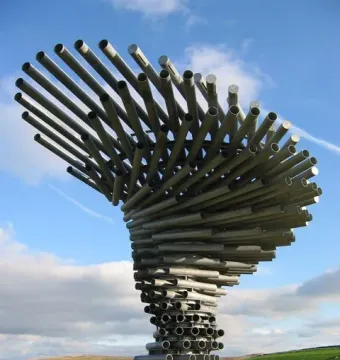
September 2009 © Ian Taylor · CC BY-SA 2.0
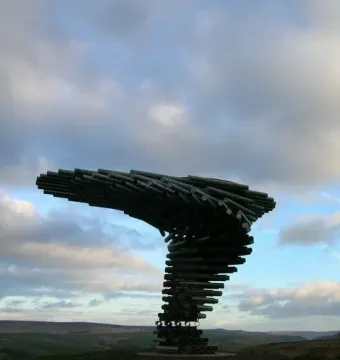
November 2007 © John Darch · CC BY-SA 2.0
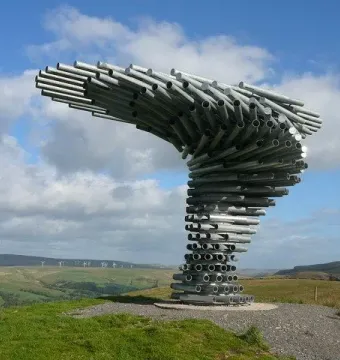
September 2007 © Colin Park · CC BY-SA 2.0
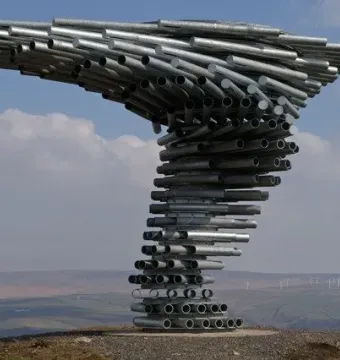
March 2007 © Mr T · CC BY-SA 2.0
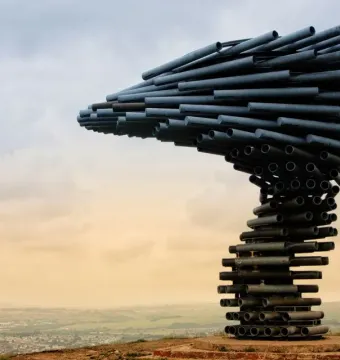
July 2021 © Stephen Gidley · CC BY 2.0
Identification | |
| Title | Singing Ringing Tree |
| Type | wind-powered sound sculpture |
| Translation of title | "The singing, ringing little tree" (English meaning given after the fairy tale of the same name) |
Historical context | |
| Art movement | Environmental art |
| Concept | Art in which the relationship between the artwork and its surroundings is the primary focus |
| Project | Panopticons arts and regeneration project |
| Project organizer | East Lancashire Environmental Arts Network (ELEAN) |
| Project purpose | To create 21st-century landmarks across East Lancashire as symbols of the area's renaissance |
| Number in project | One of four sculptures |
| Intended role | Modern landmarks of the 21st century |
| Intended symbolism | Symbols of the renaissance of the areas across East Lancashire where they stand |
| Description of Panopticons | Sculptures designed to be visible from great distances and erected on geographic elevations |
Creator | |
| Designers | Mike Tonkin and Anna Liu of Tonkin Liu |
Physical characteristics | |
| Form | Resembles a windswept tree |
| Height | 3 metres |
| Structure | A tall construction of galvanized steel tubes |
Materials | |
| Material in Abilene installation | Nearly 27 tons of pipes |
| Material | Galvanized steel tubes |
Technique | |
| Tuning method | The tubes were tuned according to their length by adding holes to the underside |
| Wind source in Abilene | Wind channeled through two nearby underpasses |
| Power source | Wind |
| Sound production | Some tubes are slit or cut across their width to produce sound |
| Construction method | Built from tubes that cut and channel the wind |
| Position optimization | Optimized to maximize wind blowing across the pipes |
Appearance | |
| Sound in Abilene | Mostly silent |
| Tube functions | Some tubes are structural and aesthetic only, while others are designed to produce sound |
| Sound | Slightly dissonant, penetrating choral tones over several octaves |
| Visual analogy | The tubes resemble organ pipes |
Location and ownership | |
| Country | England |
| Original location | The Pennine hill range overlooking Burnley, Lancashire, England |
| Placement in Abilene | East of the Frontier Texas! museum, in the grassy median where Treadaway Boulevard splits and flows into South 1st St. |
| Third sculpture location | Somewhere in Saudi Arabia |
| Second installation location | Outskirts of Austin, Texas, United States, in the rural area of Manor |
History and restoration | |
| Third sculpture involvement | Tonkin Liu also helped create a third sculpture |
| Reason for lack of consistent noise | Unknown |
| Donor | Anonymous owner in the Austin, Texas area |
| Contractor for dismantling and reassembly | JK Welding |
| Installation arrangement | Arranged by the Abilene Cultural Affairs Council |
| Installation and moving costs | Covered by the anonymous donor |
| Donation recipient | City of Abilene |
| Donation date | July 2022 |
| Second installation date | March 2017 |
| Award note | Won together with 13 other candidates |
| Award year | 2007 |
| Award | National Award of the Royal Institute of British Architects (RIBA) for architectural excellence |
| Unveiled by | The mayor of Burnley, Mohammad Najib, together with the designers Mike Tonkin and Anna Liu |
| Completion date | 2006 |
| Unveiling date | 14 December 2006 |
Other | |
| Number of known sculptures | At least three Singing Ringing Tree sculptures are referenced in the fragment |