
Baptistery of Saint Louis
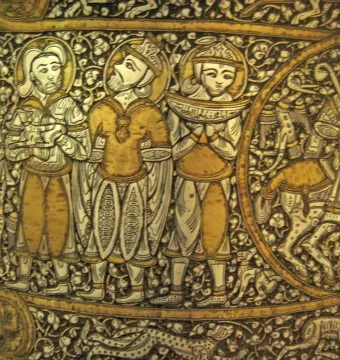
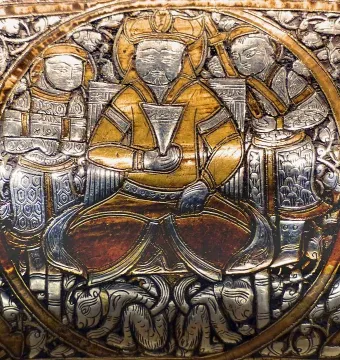
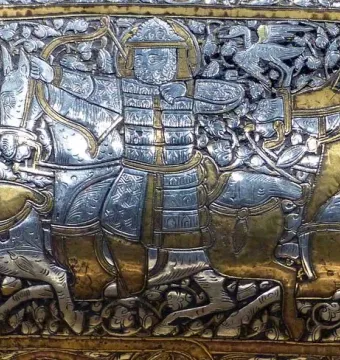
The Baptistery of Saint Louis is an Islamic art object made of hammered brass and inlaid with silver, gold, and niello. Produced in the Syro-Egyptian zone under the Mamluk dynasty by the coppersmith Muhammad ibn al-Zayn, it is now in the Islamic Arts department of the Louvre, inventory number LP 16. Despite its name, it has no connection with King Louis IX of France. The basin was later used as a baptismal font for future French kings, making it significant in both Islamic and French history. Its original purpose, date, location, and sponsorship remain debated by scholars.
© Mohammed ibn al-Zain · Public domain
February 2024 © Green fr · CC BY-SA 4.0
February 2024 © Green fr · CC BY-SA 4.0
December 2013 © Calame · CC BY-SA 3.0
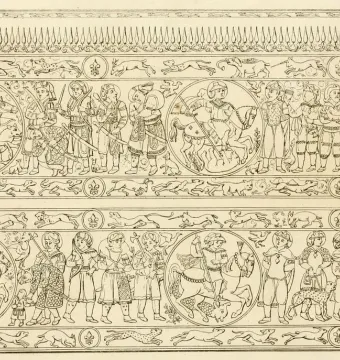
1790 © Internet Archive Book Images · No restrictions
Identification | |
| Title | Baptistery of Saint Louis |
| Object type | Islamic art object; baptismal basin/font |
| Original name | Baptistère de Saint Louis |
| Other name | Baptismal basin of Saint Louis |
Historical context | |
| Production region | Syro-Egyptian region |
| Dynasty | Mamluk dynasty |
Creator | |
| Maker | Muhammad ibn al-Zayn, a dinanderie craftsman |
Physical characteristics | |
| Shape | Carinated-profile basin |
| Material | Hammered brass |
Materials | |
| Inlay materials | Silver, gold, and niello |
Technique | |
| Technique | Engraving and hammering |
Appearance | |
| Fish motif | A radial and concentric fish pattern with additional aquatic creatures |
| Basin bottom | Perimeter frieze of lancets and an interior multitude of aquatic animals |
| Interior medallion themes | Two throne scenes and two coat-of-arms medallions |
| Interior composition | Four series of three horsemen between medallions, with throne scenes and heraldic medallions |
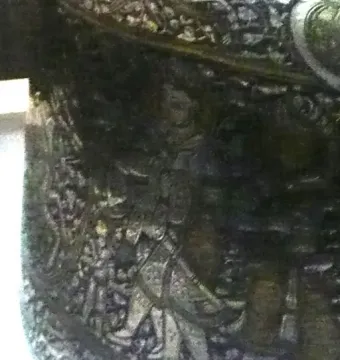
| Exterior composition | Twenty standing figures and four horsemen in medallions, with running-animal friezes and a vegetal arabesque above |
| Background ornament | Vegetal interlace background, with scrolls, palmettes, and flower motifs |
| Signature count | Signed six times by Muhammad ibn al-Zayn |
| Animal motifs | Gazelles, ibexes, hares, boars, lions, bears, foxes, wolves, cheetahs, ducks, wading birds, dromedaries, elephants, horses, griffins, sphinxes, unicorns, and a dragon |
| Heraldic devices | Sixteen circular medallions with coats of arms; some later altered to fleur-de-lis |
| Figural subjects | Standing figures, horsemen, throne scenes, hunting scenes, war scenes, animals, and aquatic creatures |
| Inscriptions | Several cursive Arabic inscriptions, including a large silver inscription under the lip and hidden signatures and inscriptions elsewhere |
| Decoration | Figural and vegetal decoration on both interior and exterior |
| Iconography | Complicated visual program with people, animals, fish, plants, and Arabic inscriptions |
Location and ownership | |
| Historical use | Used as a baptismal font for the baptisms of French royal children, including Louis XIII in 1606, the Duke of Bordeaux in 1821, and Prince Napoléon Eugène in 1856 |
| Current location | Department of Islamic Arts, Louvre Museum |
| Relation to Saint Louis | Despite its common name, it has no connection with King Louis IX of France (Saint Louis) |
| Inventory number | LP 16 |
Discovery and provenance | |
| First recorded mention | Around 1440, in an unpublished inventory of the treasure of the Sainte-Chapelle of Vincennes |
| Reason for the Saint Louis name | It was called Baptistery of Saint Louis because it was once believed to have been brought back from crusade by Saint Louis |
| Appearance in 18th-century sources | Recorded in a 1739 inventory of the sacristy of the Sainte-Chapelle of Vincennes and in Jean-Aimar Piganiol de La Force's 1742 Description de Paris |
| Early inventory status | Not listed in the pre-1380 inventory of Charles V's goods |
| Early dating traditions | Various sources dated it to 897, 1166, or the first half of the 13th century, and one 18th-century dictionary said it was made for the baptism of Philip Augustus |
| Sponsorship | Unknown; sponsorship remains debated |
| Place of creation | Unknown; attributed by Mehmet Aga-Oglu to a Syrian workshop or Syrian workshops |
| Date of creation | Unknown; scholarly proposals range from around 1150 to the first quarter of the 14th century |
| Possible commission | Could have been commissioned by a Christian patron |
| Possible original use | Possibly used as a ritual washing bowl at the Mamluk court |
| Original purpose | Unknown |
History and restoration | |
| Transfer to state collection | Sent to the dépôt des Petits-Augustins on 17 January 1793 and entered the museum collection nine days later |
| Return to Vincennes | Replaced there in 1818 by order of the king |
| Modification in 1821 | Two plaques bearing the arms of France were added |
| Return to the Louvre | Returned to the Louvre in 1852 after a decree by Louis-Napoléon Bonaparte |
| Temporary removal in 1856 | Left the museum temporarily for use at Notre-Dame Cathedral in Paris for the baptism of Prince Napoléon Eugène |
| World War II protection | Taken to safety at the Château de Chambord in 1939 during the German invasion |
Significance | |
| Notability | One of the most famous and enigmatic Islamic objects in the world |
| Historical significance | An important Islamic and French historical object |
| Scholarship status | Its meaning, exact date, exact place of creation, and sponsorship remain debated by scholars |