
Sundial
Sundial is a bronze sculpture by Henry Moore and a functional equatorial sundial created in 1980. It measures about 3.96 m (13 feet) and is located in front of Lake Michigan, beside the Adler Planetarium in Chicago’s Museum Campus. The planetarium is a National Historic Landmark and is listed on the National Register of Historic Places. The sundial was formerly placed a few meters within the planetarium plaza, but it now points directly toward the lake. The work is a late copy of a composition first created in the 1960s for The Times offices at Printing House Square in London, identified by the Henry Moore Foundation as Sundial 1965–66.

January 2014 © Victorgrigas · CC BY-SA 3.0
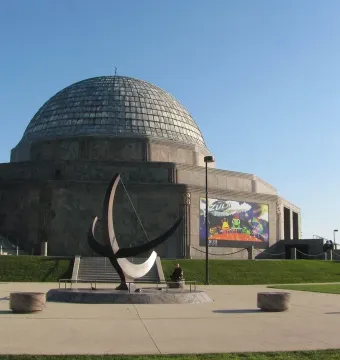
© TonyTheTiger · CC BY-SA 3.0
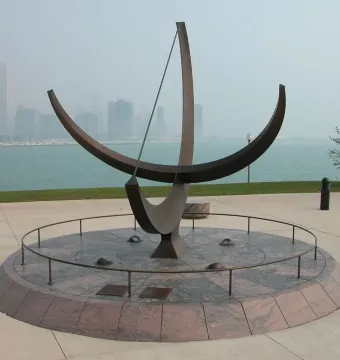
August 2003 © Specious · CC BY-SA 3.0
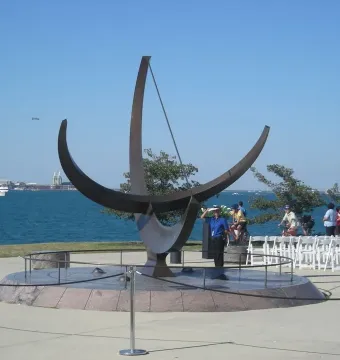
August 2010 © Michael Barera · CC BY-SA 4.0
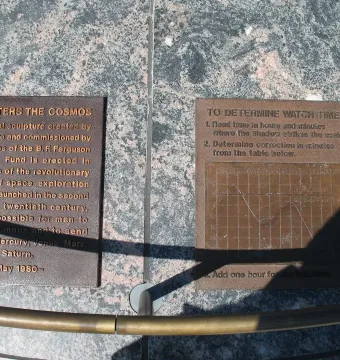
July 2007 © User:TonyTheTiger · CC BY-SA 3.0
Identification | |
| Title | Man Enters the Cosmos |
| Alternate title | Sundial 1965–66 |
| Original Spanish title | Hombre entra al cosmos |
Creator | |
| Artist | Henry Moore |
Historical context | |
| Date created | 1980 |
| Earlier design origin | A composition first created in the 1960s |
| Original commission | For The Times newspaper offices at Printing House Square, London |
| Commission purpose | To recognize the space exploration program |
| Benefactor | B.F. Ferguson Monument Fund |
| Benefactor activity | Commissioned several works of art throughout Chicago |
| Related works commissioned by benefactor | The Fountain of the Great Lakes and other works, many in or on the grounds of the Art Institute of Chicago or elsewhere in Grant Park |
Materials | |
| Material | Cast bronze |
Technique | |
| Construction technique | Modeled rather than directly carved |
Type | |
| Type | Functional bowstring equatorial sundial |
Physical characteristics | |
| Height | Around 3.96 m (13 ft) |
| Components | Two bronze semicircles and a thin bronze rod gnomon |
| Structure | The semicircles are set perpendicular to each other, with the inner semicircle inside the outer one |
| Dial face | The inner semicircle serves as the dial face |
| Gnomon | A thin bronze rod extending between the tips of one semicircle |
| Orientation of gnomon | Parallel to the Earth's axis of rotation |
| Orientation of dial face | Parallel to the Earth's equatorial plane |
Appearance | |
| Form | Two bronze semicircles pointing diagonally upward |
| Name origin | Named for the bowstring-like appearance of the gnomon's shadow |
Function | |
| Solstice and equinox positions | The hand moves along the rod through the year: closest to the top at the summer solstice, closest to the bottom at the winter solstice, and centered at the equinoxes |
| Related sundial types | Bowstring and armillary dials are modified equatorial sundials |
| Why it is called equatorial | The dial face is parallel to the Earth's equatorial plane |
| Function | Marks the time of day by casting a shadow on the dial face |
| Commemorative plaque | The left-hand plaque is commemorative and mentions the benefactor and the purpose of the sculpture |
| Readability | Can be read when there is sufficient sunlight to produce shadows |
| Time correction plaque | The right-hand plaque is an equation-of-time table that corrects time differences caused by Earth's axial tilt and orbital eccentricity, but not daylight saving time |
Location and ownership | |
| Community area | Near South Side, Chicago |
| Original location context | A U-turn in Solidarity Drive runs through the sculpture's former location |
| Former location | Slightly farther south at the edge of the main entrance plaza for the planetarium |
| Site | Adler Planetarium campus |
| Nearby landmark | Adler Planetarium |
| Current setting | On a walkway that replaced the former road around the planetarium |
| Current position | Directly on the shore of Lake Michigan |
| Current location | On the lakefront by the Adler Planetarium, Museum Campus, downtown Chicago, Illinois, United States |
History and restoration | |
| Relocation period | Between 1997 and 1999 |
| Relocation reason | To make way for road changes and the sky pavilion addition during the Adler Planetarium expansion |
| Relocation process | Removed and stored first, then moved to its current position after the new road was built and the old road was replaced by a walkway |
| Relocation by | Adler Planetarium contractors |
| Associated infrastructure project | Part of a $100 million traffic reconfiguration around the Museum Campus that also moved Lake Shore Drive in the mid-1990s |
Significance | |
| Public sculpture status | Public sculpture |
| SIRIS listing | Listed in the Smithsonian Institution's Research Information System (SIRIS) |
| Moore's view of sculpture display | He preferred seeing his sculptures in open landscapes rather than in buildings |
| Related Moore works in Chicago | Nuclear Energy, Large Interior Form, and Reclining Figure |