
The Sun Voyager
The Sun Voyager is a sculpture in Reykjavík, Iceland, created by Jón Gunnar Árnason in 1986. It was selected in a competition held for Reykjavík’s 200th anniversary, and the original aluminium model was presented to the city. The full-size sculpture was later built at its present site and unveiled on 18 August 1990. Made of stainless steel, it stands on the northern coastal road Sæbraut and resembles a Viking ship. Although it was originally intended to face the sunset, it was installed facing north with the artist’s agreement. It is one of the most photographed artworks in Reykjavík, and its metal surface appears to glow in sunrise and sunset light.
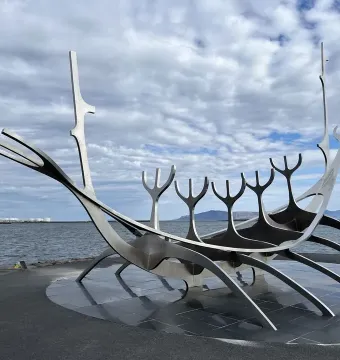
August 2026 © Cloud45Strife
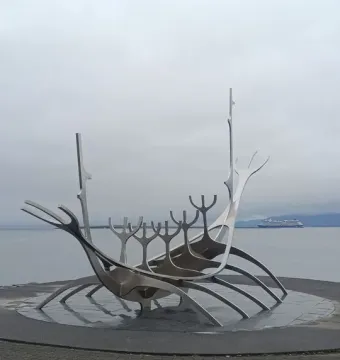
July 2026 © Maite (Tagzania user ID: 5581) · CC BY-SA 4.0
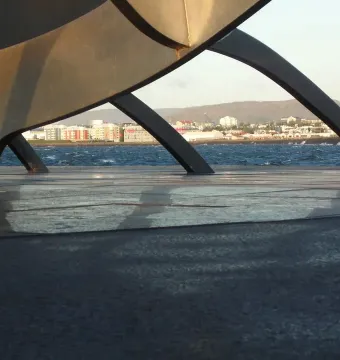
© Syced · CC0
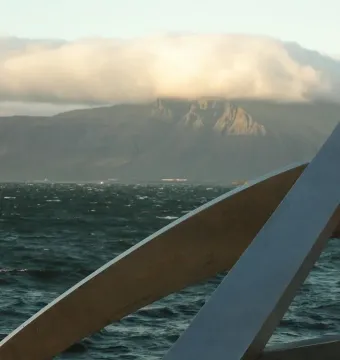
© Syced · CC0
© Jakec · CC BY-SA 3.0
Identification | |
| Title | The Sun Voyager |
| Original Icelandic name | Sólfar |
| Other language titles | Sonnenfahrt (German); Le Voyageur du Soleil (French) |
| Type | Outdoor sculpture |
Historical context | |
| Commission purpose | To commemorate the 200th anniversary of Reykjavík |
| Competition | Won a 1986 competition organized by the district association of the western part of Reykjavík for the city’s 200th anniversary |
Creator | |
| Artist | Jón Gunnar Árnason (1931–1989) |
| Artist name in article | Árnason |
Discovery and provenance | |
| Model recipient | City of Reykjavík |
| Model dimensions | 42.5 × 88 × 36 cm |
| Original model | An aluminum sculpture measuring 42.5 × 88 × 36 cm was handed over to the city of Reykjavík for enlargement |
| Model material | Aluminum |
| Full-size version | A full-size version was built at the current site |
| Year created | 1986 |
Physical characteristics | |
| Material | Stainless steel |
| Base | A circle of polished granite slabs surrounded by so-called town-hall concrete |
| Form | Irregular silhouette evoking a Viking ship |
Appearance | |
| Description | A dream boat and an ode to the sun |
| Orientation | Originally intended to face west toward the setting sun; installed at its final location facing north with the artist’s agreement |
| Visual effect | At sunrise and sunset the metal appears to glow |
| Visual effect | Different light and weather conditions create variety in its appearance |
Iconography and meaning | |
| Motif | Heading toward the setting sun |
| Interpretation | Evokes a territory yet to be discovered, a dream of hope, progress, and freedom |
Location and ownership | |
| Current location | Sæbraut, Reykjavík, Iceland, on a small headland by the sea |
| Former proposed locations | West Reykjavík; Landakot hill; by the harbour in central Reykjavík on a specially constructed base; the coastline by Ánanaust |
| Original intended placement | Landakot hill, with the prow facing the centre of Reykjavík and the stern toward Christ the King Cathedral |
| Later preferred location | The coastline by Ánanaust |
| Final location decision | Sæbraut, with Árnason’s consent |
| Artist’s nickname for the site | Jónsnes ('Jón's Peninsula') |
History and restoration | |
| Location change reason | Changes in Reykjavík town planning ruled out the coastline by Ánanaust |
| Fabrication | Reynir Hjálmtýsson and his assistant |
| Supervision | Kristinn E. Hrafnsson supervised the work; Sigurjón Yngvason supervised the engineering in close cooperation with Árnason |
| Construction method | Built in accordance with Jón Gunnar Árnason’s enlarged full-scale hand-drawn plan |
| Unveiling location | Sæbraut, Reykjavík |
| Unveiling occasion | Reykjavík’s city anniversary / the birthday of the city of Reykjavík |
| Unveiling date | 18 August 1990 |
Significance | |
| Popularity | One of the most photographed artworks in Reykjavík |
| Public dispute | There has been some dispute about the sculpture’s eventual location and whether it should face west toward the setting sun |
| Historical association | The site is associated with Ingólfur Arnarson, said to have established his farm here as the first permanent settler |
Other | |
| Artistic philosophy | All works of art should convey a message that transcends the work itself |
| Role of the observer | The observer is responsible for interpreting the work in his or her own way and becomes a participant in its creation |
| Typical reception of the artist's works | They frequently make demands on observers and give them the opportunity to discover new truths through experience |
| Stylistic features | Ever-flowing lines and poetic movement |
| Spatial relationship | It seems as if the ship is floating on air and reaches out into space so that the sea, the sky, and the observer’s mind become part of the work as a whole |