
Holbeinpferd
Holbeinpferd, also called Holbeinpferdle, is the common name for a horse sculpture in Freiburg im Breisgau’s Wiehre district. Its official title is “Standing Foal in Cast Concrete.” Created in 1936 by sculptor Werner Gürtner, the sculpture is about 1.90 metres high and long and weighs roughly one ton. It belongs to the city of Freiburg. In the 1950s, it was placed on a small grassy area between Holbeinstraße, Hans-Thoma-Straße, and Günterstalstraße, near the Holbeinstraße stop on tram line 2 to Günterstal. The sculpture became well known through numerous anonymous alterations over time.
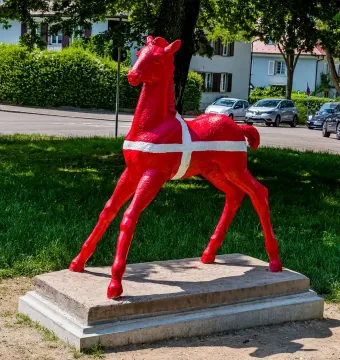
June 2019 © joergens.mi · CC BY-SA 3.0
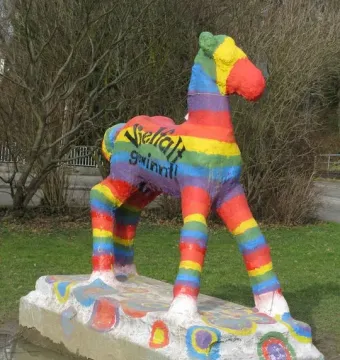
February 2014 © Andreas Schwarzkopf · CC BY-SA 3.0
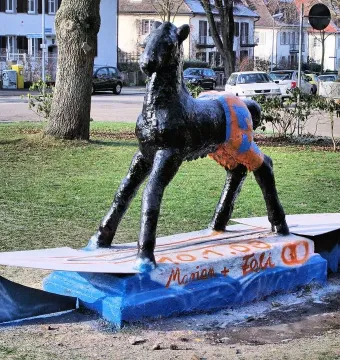
January 2009 © joergens.mi · CC BY-SA 3.0
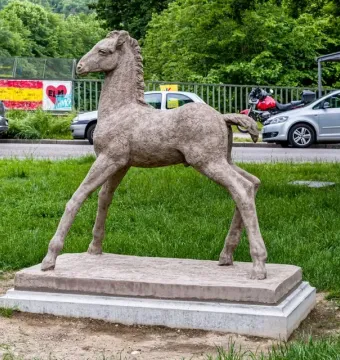
June 2019 © joergens.mi · CC BY-SA 3.0
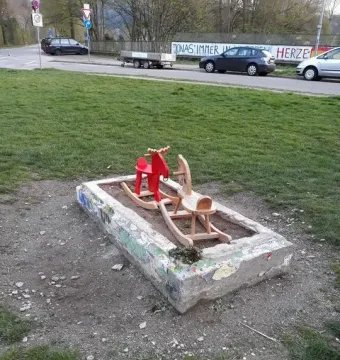
April 2019 © Harvey Kneeslapper · CC BY-SA 4.0
Identification | |
| Name | Holbeinpferd |
| Local name | Holbeinpferdle |
| Original-language name | Stehendes Fohlen aus Betonguss |
| Type | horse sculpture |
| Depicted subject | foal |
| Meaning of name | "Little horse"; "Holbeinpferdle" uses the Alemannic diminutive ending "-le" |
| Nickname meaning | "Holbein horse" |
Historical context | |
| Created | 1936 |
Creator | |
| Artist | Werner Gürtner |
Discovery and provenance | |
| First owner | Walter Cordes |
| Subsequent owner | City of Freiburg (Gardens Department / department responsible for environment and parks) |
| Model used | A foal arranged for Gürtner by Walter Cordes's veterinarian nephew |
| Unsigned at sale | The sculpture was still unsigned when sold in 1936 |
Physical characteristics | |
| Weight | about one ton |
| Dimensions | 1.90 m high and 1.90 m long |
Materials | |
| Material | cast concrete with internal iron square-tube reinforcement |
| Surface treatment | painted multiple times; later covered with layers of paint, plaster, newspaper, and wallpaper |
Location and ownership | |
| Current location | Wiehre district, Freiburg im Breisgau, Baden-Württemberg, Germany |
| Site | at the corner of Holbeinstraße and Günterstalstraße, on a small grassy plot |
| Orientation | Facing toward Günterstal district, at the entrance of Holbeinstraße |
| Nearby transit | Tram line 2 to Günterstal, stop Holbeinstraße |
| Ownership | City of Freiburg |
History and restoration | |
| Final cleaning | 1997, by a stonemason firm using a pressure washer; paid for by photographer Matthias Wolpert |
| Future policy | The city does not intend to tolerate repainting in the future |
| Post-restoration repainting | It was painted again the day after being returned, with the Danish flag |
| Restoration work | About 180 kg of paint, plaster, newspaper, and wallpaper removed; paint stripped with an oscillating saw and high-pressure steam cleaner; severe damage found especially in the legs; rust removed from the internal iron reinforcement; part of the concrete removed and rejoined with epoxy; protective coating applied |
| Restoration | 20 February 2019 to 3 June 2019, at Hellstern stone masonry workshop in Freiburg; more than 80 hours; cost €6,500; paid by the Strather family and the city of Freiburg |
| Condition after 1997 cleaning | Since then, it has accumulated layer after layer of paint and has gradually become more misshapen |
| Early public use | Children repeatedly rode the sculpture, prompting inspections ordered by Mayor Wolfgang Hoffmann |
| Cleanings | The city cleaned it in 1981, 1985, and 1987 |
| Damage event | 29 March 1990: knocked off its pedestal by a car |
| Restorations | Restored three times in the 1980s |
| Painted brown again | June 1987, in accordance with Gürtner's wishes |
| Painted brown | 1954; caused widespread discontent |
| Artist signature added | In the 1950s, at the request of Mayor Wolfgang Hoffmann |
| Installed at current site | 28 May 1951 |
Significance | |
| Possible inspiration | Possibly inspired by Manneken Pis in Brussels |
| Media attention | Early 1990s postcard and photo series were published, and it was reported on TV |
| Decoration examples | Zebra, Milka, Nivea, Uhu, political messages including the Brent Spar boycott, declarations of love, flag patterns, football and cycling jerseys, unicorns, Pegasus, the donkey from the Bremen Town Musicians, a wrapped appearance for Christo and Jeanne-Claude's Reichstag project, and the Danish flag |
| Decoration tradition | Initially painted only at night, later also during the day; usually altered to depict a specific theme |
| Known for | Became well known for frequent anonymous repainting and decoration, especially since around 1980 |
Other | |
| Legal status | Because it is in public space, photographs may be commercially used under Germany's freedom of panorama rule (§ 59 UrhG) |
| Copyright dispute | Elsa Gürtner's heirs sued for disclosure of revenues from images and postcards of the sculpture; the case reached Amtsgericht Freiburg and Landgericht Mannheim in 1996-1997 (LG Mannheim, 14 February 1997, 7 S 4/96, 'Freiburger Holbein-Pferd', GRUR 1997, 364) |
| Court outcome | The claim was dismissed in 1996; the Mannheim court largely upheld the lower court in 1997 but granted disclosure of revenues |
| Court holding | Use under § 59 UrhG does not cease because third parties altered the work, but distributing photographs after phototechnical manipulation that changes the work's actual appearance infringes exploitation rights |
| Photographer involved | Matthias Wolpert |
| Reason photographer was liable | He edited an image to make the sculpture appear to wear a St. Nicholas costume, which it never actually had |