
Der Mahner by Vadim Sidur
Der Mahner is a bronze monument by Soviet underground artist Vadim Sidur, installed in Düsseldorf’s Hofgarten in 1985. Standing 4.8 meters high, it depicts an abstract, solitary human figure stretched upward, with its arms extended sideways and its hands forming a large funnel above a small tilted head. The form suggests a silent cry directed outward to the world and the sky. Created as part of Sidur’s intense cycle “Monuments,” the sculpture was originally conceived as a symbol of freedom of speech and the press, and later came to be read more broadly as a warning against violence and suffering. Sidur said the work was deeply autobiographical, expressing helpless responsibility and a mute appeal to humanity.
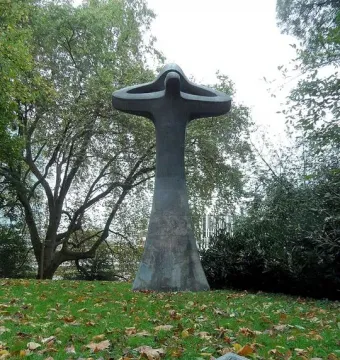
October 2017 © Matthias Nonnenmacher · CC BY-SA 4.0
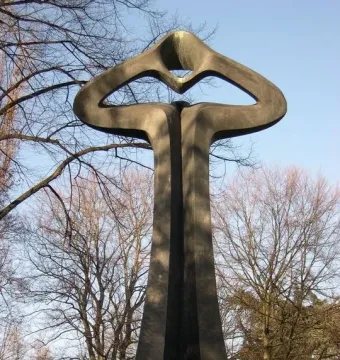
January 2007 © ray_eye · CC BY-SA 2.5
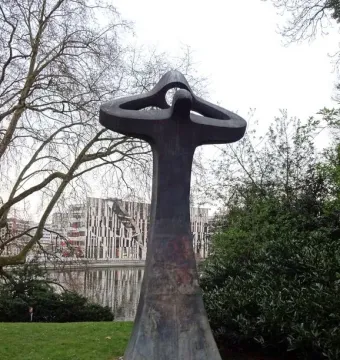
April 2018 © Jula2812 · CC BY-SA 4.0
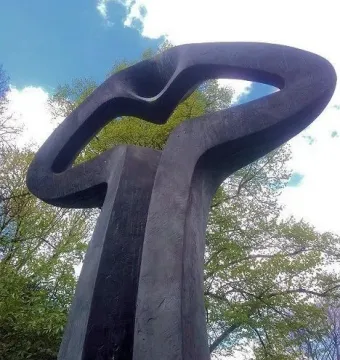
June 2018 © Scoderks · CC BY-SA 4.0
April 2018 © Jula2812 · CC BY-SA 4.0
Identification | |
| Title | Der Mahner |
| Type | monument / sculpture; bronze sculpture; plastic sculpture |
| Alternative name | The One Who Calls Out; The Exhorter (Russian: Взывающий); translated in the fragment as The Caller / One Who Calls |
Historical context | |
| Series | Created as part of the anguished cycle Monuments |
| Subject | Freedom of the press; a call to fight against violence |
| Inspiration | A meeting with journalist Rudolf Augstein, founder of Der Spiegel; suggested in December 1978 by Rudolf Augstein during a private dinner conversation with Vadim Sidur in Moscow |
| Origin of idea | Initially conceived as a symbol of freedom of speech and the press |
| Development of meaning | Later acquired a broader interpretation |
Creator | |
| Autobiographical significance | Very autobiographical for the artist |
| Artist background | Soviet underground artist |
| Artist | Vadim Sidur (Wadim Abramowitsch Sidur) |
Discovery and provenance | |
| Third proposal made by | Udo van Meteren |
| Fabrication | Herbert Schmäke art foundry |
| Funding source | The van Meeteren Foundation |
| Reason for scaling artist | He knew the author and had previously enlarged his works, including Treblinka |
| Scaling artist | An unnamed Swiss sculptor |
| Model transfer | The model was handed over to patron Udo van Meteren in West Germany by Sidur's longtime friend, Slavist Karl Eimermacher |
| Context of Düsseldorf proposal | During a dinner in December 1983 with Vadim Sidur's friends Waldemar and Andrea von Knoop and the German patrons Udo and Irmela van Meteren |
| First project interrupted by | The Soviet invasion of Afghanistan |
| Third proposed location | Düsseldorf |
| Second proposal initiated by | Journalist Nikolaus Ehlert |
| Second proposed location | In front of the office of Deutsche Welle in Cologne |
| Planned location of first project | In front of Der Spiegel's headquarters in Hamburg |
| First public presentation | September 1979, at Vadim Sidur's exhibition in Hamburg, sponsored by Der Spiegel |
| Initial material | Bronze |
| Initial model | Created in 1979 |
Physical characteristics | |
| Front view effect | Creates the impression of two rising strands that merge into the shoulders and then into the megaphone-shaped hands |
| Torso detail | The torso is narrowed and recessed along the central axis from bottom to top; a deep groove opens on the front surface of the chest toward the funnel |
| Head | Small, proportionally reduced, tilted back, and barely visible from the front |
| Hands | Hands join to form a rounded obtuse triangle and a disproportionately large funnel above the tilted small head |
| Arms | Large arms held out perpendicular to the sides like a crossbar of a cross |
| Pose | Back arched, shoulders straightened, body stretched upward and slightly leaning back; hands raised toward the head and shaped like a megaphone to call out a warning or admonition |
| Form | Abstract, oversized, solitary, slender human figure |
| Height | 4.8 metres |
| Body form | Symmetrical figure with a curved torso; the lower part widens as if wrapped in a floor-length mantle |
Appearance | |
| Gesture interpretation | Appears to cry out into open space toward the surrounding world and the sky; a silent cry that seems to tear the metal from within |
Iconography and meaning | |
| Interpretation | Seen as a memorial against totalitarianism and violence |
| Visual association | Evokes the biblical figure of the voice in the wilderness; the 'voice crying in the wilderness' |
| Characterization | A 'screaming hieroglyph' and embodiment of a cry |
| Associated symbolism | Suggests a spiritual authority figure |
| Depicted subject | A philosopher, prophet, or creator |
| Meaning | A human figure calling people to stop violence; a cry for all the killed, mutilated, and suffering; a cry-warning |
| Function/meaning | An admonition or warning addressed to humanity, urging people to distinguish good from evil and use life to do good |
| Original intended meaning | A symbol of freedom of speech and the press |
| Later interpretation | Broader commemorative meaning beyond freedom of the press |
| Artist quotation | 1983: 'I am crushed / by an unbearable burden of responsibility / placed on me by no one / I can offer nothing to humanity / for salvation / I can only freeze / turn into a bronze sculpture / and become forever / silent / crying out' |
Location and ownership | |
| Installation setting | Placed so that the figure appears to be calling across the pond of the Landskrone |
| Location | Ananasberg, Hofgarten park, Düsseldorf, Germany |
| Installation date | 15 October 1985 |
| Donation | Presented as a gift to the city by Udo van Meteren |
History and restoration | |
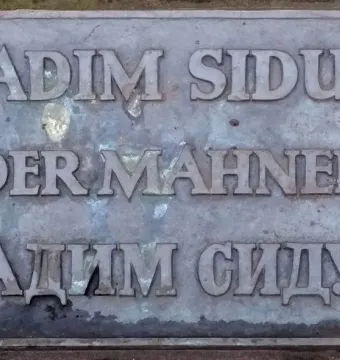
| Plaque | A stone plaque is placed on the ground near the monument |
| Plaque inscription | VADIM SIDUR / DER MAHNER / ВАДИМ СИДУР |
| Plaque text | "♦Der Mahner♦ / Mensch dieser Erde / Wer du auch bist / Woher du auch kommst / Wohin du auch gehst / Bedenke / Gott der Allmächtige / Hat dir dies Leben geliehen / Unterscheiden zu lernen / Das Gute vom Bösen / Nutze dein Leben / Das Gute zu tun" |
| Plaque quote author | Udo van Meeteren, Düsseldorf patron |
| Plaque quote date reference | Stand 24 May 2023 |
| Media coverage | The unveiling was reported in the press, including Deutsche Welle |
| Further proposal | During the 1989 competition for a monument to the victims of political repression in Moscow, many people proposed installing The One Who Calls Out |
Significance | |
| Site description | Ananasberg is a hill in the Hofgarten modeled at the beginning of the 19th century by landscape gardener Maximilian Friedrich Weyhe |
Other | |
| Signature | "Sidur 79" engraved on the lower back side in Cyrillic cursive script |
| Signature placement | Lower back side |
| Signature script | Cyrillic cursive script |