
Equestrian Statue of Charles Devens
The equestrian statue of Charles Devens is a public monument in Worcester, Massachusetts, located on the grounds of the old Worcester County Courthouse. It honors Charles Devens, a Union Army general in the American Civil War who later served as United States Attorney General. The statue was designed by Daniel Chester French and Edward Clark Potter, with the pedestal designed by Robert D. Andrews, and was dedicated on July 4, 1906. Fundraising for the monument began in the 1890s and was revived in 1901 before the commission hired the sculptors in 1902. The statue was moved slightly in 1950 during courthouse expansion and remains in place today near Main Street and Highland Street, overlooking Lincoln Square.
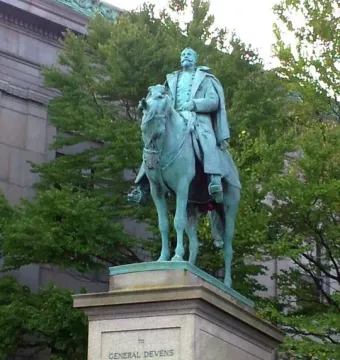
September 2011 © Daderot · CC0
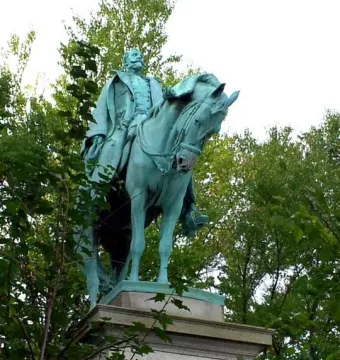
September 2011 © Daderot · CC0
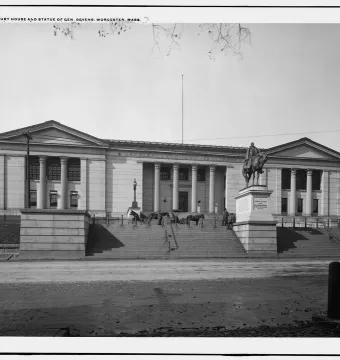
September 2011 © Detroit Publishing Company · Public domain
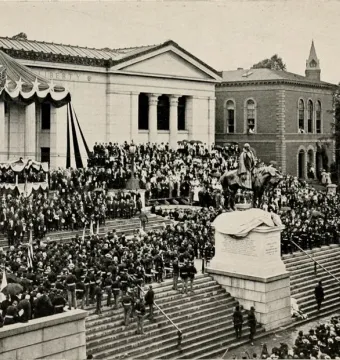
1907 © Internet Archive Book Images · No restrictions
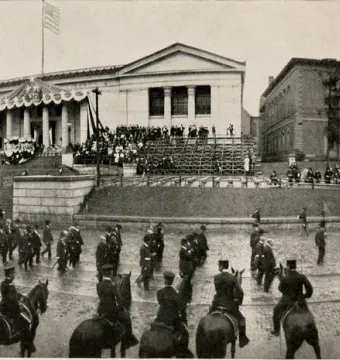
1907 © Internet Archive Book Images · No restrictions
Identification | |
| Title | Equestrian statue of Charles Devens |
| Type | bronze equestrian statue |
| Subject | Charles Devens |
| Alternative name | Worcester County Devens Memorial Statue |
Iconography and meaning | |
| Purpose | Memorial to Charles Devens |
| Inscription content | Front inscription text not provided; the south side lists Worcester County regiments, battalions, and companies, and the north side lists towns and cities with the number of men furnished by each |
Creator | |
| Artists | Daniel Chester French and Edward Clark Potter |
| Roles | French modeled the human figure; Potter modeled the horse |
| Collaborative background | French and Potter had collaborated on several equestrian statues before this work |
| Architect | Robert D. Andrews of Boston |
| Pedestal builder | George D. Webb Granite and Construction Co. |
| Tablet and lettering maker | Jno. Williams, Inc., New York City |
| Foundry | Gorham Manufacturing Company, Providence, Rhode Island |
Historical context | |
| Commission formed | April 4, 1902 |
| Commission name | Worcester County Memorial Devens' Statue Commission |
| Initial committee size | 35 men |
| General committee formed | March 1902 |
| Project revived | Fall 1901 |
| Initial fundraising letter date | November 9, 1891 |
| Monument effort began | Late 1891 |
Discovery and provenance | |
| Public fundraising | Began after the commission was formed |
| Funding | Worcester contributed $7,500; Worcester County contributed $5,000; several other county towns contributed about $4,000 |
| Projected cost | Originally $15,000; later estimated at no more than $30,000 |
| Date sculptors hired | July 12, 1902 |
| Final design accepted | October 17, 1903 |
| Model presented | November 27, 1903 |
| Casting material source | Several condemned cannons appropriated by the United States Congress, valued at about $2,000 |
| Completion status | Work on the monument was nearing completion in December 1905 |
Physical characteristics | |
| Dimensions | The fragment does not give exact height or width measurements |
| Pedestal shape | Rectangular pedestal |
| Pedestal material | Granite |
| Statue material | Bronze |
Appearance | |
| Depicted attire | Union Army uniform from the American Civil War, partially covered by a heavy coat |
| Depicted figure | Charles Devens atop a horse, holding the reins with his right hand |
Materials | |
| Inscription plaque | A bronze tablet is affixed to the rear of the pedestal |
Location and ownership | |
| Original location | In front of the Worcester County Courthouse, Worcester, Massachusetts, United States |
| Current location | Intersection of Main Street and Highland Street on the courthouse grounds, overlooking Lincoln Square, Worcester, Massachusetts, United States |
| Site | Old Worcester County Courthouse |
| District | Institutional District |
History and restoration | |
| Official acceptance | A county commissioner accepted the statue on behalf of the county |
| Preservation status | In 2015 the vacant old courthouse was sold for conversion to apartments with preservation agreements that included the statue; a 2017 article said the statue would remain in place |
| Survey | Inspected in 1994 as part of Save Outdoor Sculpture! |
| Relocation | Moved several feet in 1950 during an expansion of the courthouse |
| Music played | "The Star-Spangled Banner" and "America" |
| Speaker | Stewart L. Woodford |
| Ceremony ordered by | William Franklin Draper |
| Unveiled by | Charles Devens Osborne, Devens's great-nephew |
| Prayer by | Daniel Merriman |
| Officials present | Governor Curtis Guild Jr., Lieutenant Governor Eben Sumner Draper, Secretary of War William Howard Taft, Chief Justice Marcus Perrin Knowlton, Associate Justice Henry Braley, Mayor John T. Duggan, and others |
| Dedication ceremony | A parade was held along Main Street; veterans were seated on courthouse steps and later treated to lunch at the city armory; a speaking platform was set at the top of the steps |
| Dedication attendance | About 10,000 spectators; about 250 militia members and more than 1,000 Civil War veterans were present |
| Dedication occasion | Independence Day |
| Dedicated | July 4, 1906 |
Significance | |
| Art-historical comparison | Michael Richman compared it to a similar equestrian statue of Ulysses S. Grant by French and Potter in Philadelphia, saying it was reminiscent of the Grant without being an imitation |
| Historical interpretation | Thomas J. Brown argued in 2019 that honoring Devens as a military leader reflected a reconfiguration of American priorities |
| Interpretation of subject choice | Brown noted that Devens had failed to achieve much battlefield success, but was represented as a soldier because military character was highly admired |
| Broader interpretation | Brown argued that in French's statues of Devens and Draper, the lawyer and industrialist merged with the army general, celebrating the extraction of obedience through compulsion |
| Historical assessment | By 1906, French and Potter had established an aesthetically pleasing and economically profitable formula for portraying Civil War heroes |
| Artist career note | According to Harold Holzer, French was growing tired of the genre and would not create another equestrian statue of a Civil War figure for six years |