
Reiterdenkmal Friedrichs des Großen (Beuthen)
Reiterdenkmal Friedrichs des Großen in Beuthen was an equestrian monument to King Frederick II of Prussia, erected in 1910 on Kaiserplatz, now in Bytom. Designed by Berlin sculptor Louis Tuaillon in a neoclassical style, the bronze casting was carried out by the Hermann Noack foundry in Berlin. The monument was unveiled on 26 November 1910 in the presence of Emperor Wilhelm II. It commemorated Frederick II’s role in the conquest of Silesia, which had become part of Prussia in 1742. The statue was blown up by the Red Army in 1945, and the pedestal remained in place until around 1960.
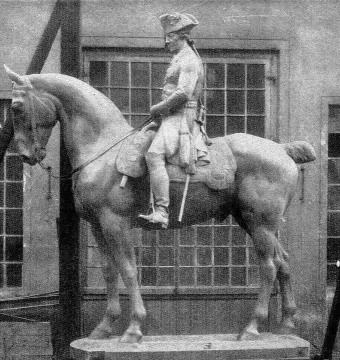
1910 © sculptor Louis Tuaillon / photographer unknown · Public domain
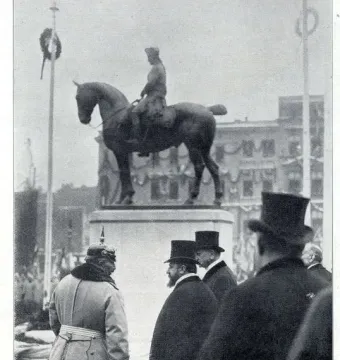
1910 © Photographer not credited · Public domain
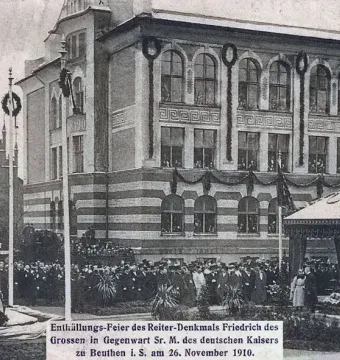
October 2021 © Jake231 · CC BY-SA 4.0
Identification | |
| Title | Reiterdenkmal Friedrichs des Großen (Beuthen) |
| Type | Equestrian monument |
| Subject | Frederick II the Great, King of Prussia |
| Alternative title | Equestrian Monument of Frederick the Great in Bytom |
Historical context | |
| Creation period | 1907–1910 |
| Year erected | 1910 |
| Unveiling date | 26 November 1910 |
| Historical significance | Created in connection with Frederick II's role as commander-in-chief in the conquest of Silesia and Prussian history in the region |
Creator | |
| Artist | Louis Tuaillon |
| Artist base | Berlin |
| Foundry | Hermann Noack's Berlin plant in Friedenau |
Discovery and provenance | |
| Founding charter signatories | Georg Brüning and Ignatz Hakuba |
| Base contents | The foundation contained the founding charter, contemporary circulating coins, and contemporary newspapers |
| Founding charter reference number | MGB/H/2155 |
| Founding charter location | Upper Silesian Museum in Bytom |
| Original intended dedication | A monument to Emperor Wilhelm II, then to Emperor Wilhelm I; neither plan was realized |
| Founding charter date | 29 October 1910 |
| Reason original location was rejected | Planned tram line construction |
| Original planned location | Bulwar, later Kościuszki Square, Bytom |
| Funding | Half funded by the city of Bytom and half by Ignatz Hakuba; total cost 100,000 marks |
| Commission initiated by | Georg Brüning, mayor of Bytom |
Physical characteristics | |
| Scale | Larger than life |
| Pedestal | Light-colored multi-profile pedestal with two steps |
| Composition | Rider and horse shown in a static posture |
| Appearance | In side profile, the depiction appears stylized |
Materials | |
| Horse | Frederick II's riding horse Condé |
| Horse model | The horse belonged to Emperor Wilhelm II |
| Material | Bronze |
Appearance | |
| Hand pose | Left hand holding the reins, right hand resting on the hip |
| Horse tail | Docked tail |
| Stylistic character | Neoclassical austerity |
| Depicted attire | Uniform with tricorn hat |
Location and ownership | |
| Original location | Kaiserplatz, Bytom, next to the Oberrealschule |
| Current location | Destroyed; the monument no longer exists |
| Country at unveiling | German Empire |
| City | Bytom (then Beuthen) |
| Country | Poland |
History and restoration | |
| Donor death | Ignatz Hakuba died 18 days before the unveiling |
| Alternative reproductions | Reduced replicas were sold as statuettes from about 1912 onward |
| Museum copy | A bronze miniature copy titled Friedrich II zu Pferde, dated 1912, is kept in the Municipal Museum in Berlin |
| Honorary citizenship | Ignatz Hakuba reportedly received honorary citizenship of Bytom during the unveiling event |
| Honor granted to Georg Brüning | The right to wear a golden mayoral chain, also funded by Ignatz Hakuba |
| Circumstances of destruction | Destroyed immediately after Soviet troops entered the city |
| Later object on pedestal | A figure of the Warsaw Mermaid made using metalwork technique |
| Site changes | The landscaping around the monument was altered several times in the following decades |
| Pedestal survival | The pedestal remained in place until about 1960 and was then removed |
| Destruction method | Blown up |
| Destroyed by | the Red Army |
| Destroyed | 1945 |
Significance | |
| Related monuments | Other equestrian statues of Frederick II stood in Berlin and Breslau |
| Artist comparison | Unlike earlier equestrian statues of Frederick II made in Berlin and Breslau some decades earlier |
Other | |
| Previous works by the artist | Amazon on Horseback in Berlin; Kaiser Friedrich Monument in Bremen |
| Creation context | Beuthen became part of Prussia in 1742 as a result of the Silesian Wars |