
Commodore John Barry
The statue commemorates Commodore John Barry (1745–1806), the Irish-born sailor known as the “Father of the United States Navy.” Created by John J. Boyle, work on the sculpture and pedestal took place from 1911 to 1913, and the memorial was dedicated in 1914 after a large ceremony in Washington, D.C. The bronze statue stands at the western edge of Franklin Square in downtown Washington, D.C. Barry is shown in military uniform, holding scrolls and resting his right hand on a sword. A female allegorical figure representing Victory appears on the front of the pedestal, holding a laurel wreath with an eagle below her arm.
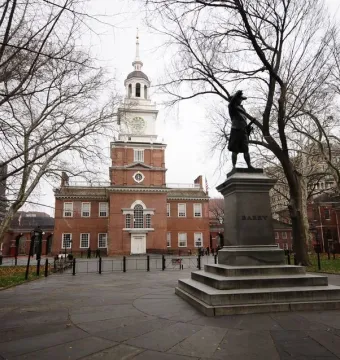
© NPS photo · Public domain
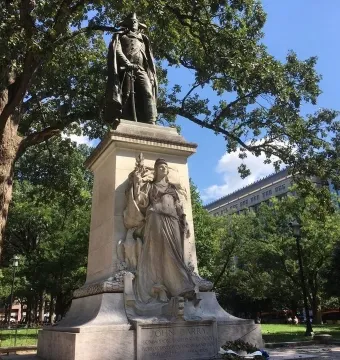
© NPS Photo · Public domain
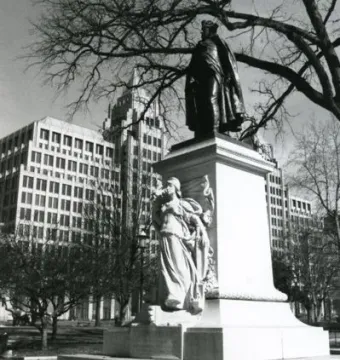
July 2008 © Wikipedia Saves Public Art · Public domain
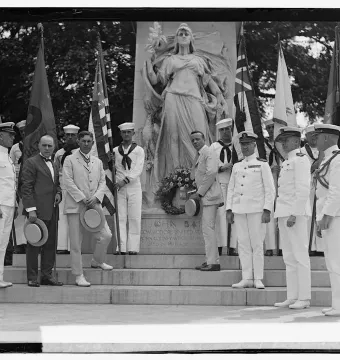
August 1924 © National Photo Company Collection · Public domain
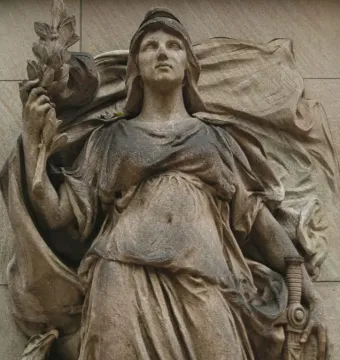
September 2008 © David · CC BY 2.0
Identification | |
| Title | Commodore John Barry |
| Dedicated to | Commodore John Barry |
| Type | memorial statue |
Historical context | |
| Purpose | To honor Commodore John Barry and his contributions to American independence and naval history |
| Memorial planning began | 1902 |
| Funding approved | $50,000 |
| Funding history | Initially approved for $25,000, then increased to $50,000; the bill was also modified to authorize memorials to both John Barry and John Paul Jones, allocating $50,000 for each |
| Law signed | June 8, 1906 |
| Competition date | 1908 |
| Commission | National Commodore John Barry Statue Commission |
| Commission members | Government officials, veterans, and many Irish American groups |
| Supporting organizations | Ancient Order of Hibernians, Daughters of the American Revolution, and Sons of the American Revolution |
Creator | |
| Landscape architects | Irving W. Payne and George Burnap |
| Sculptor identity | Irish-American |
| Sculptor | John J. Boyle |
| Architect | Edward Pearce Casey |
Discovery and provenance | |
| Competition participants | 25 Irish American artists |
| Selected after competition | Chosen after the winning design was rejected and the other top two finalists were eliminated |
| Foundry | Roman Bronze Works |
| Contract signed | November 1911 |
| Model completed | 1911 |
History and restoration | |
| Banquet venue | Willard Hotel |
| Memorial traditions | Department of the Navy officials laid wreaths at the city's navy memorials on Navy Day until 1949; local Irish War Veterans also laid wreaths on Saint Patrick's Day |
| Pre-dedication activity | Many Irish organizations planned a trip to Mount Vernon to visit Washington's tomb the day before the ceremony |
| Parade participants | Irish American groups including the Friendly Sons of St. Patrick, Irish Fellowship Club, American Irish Historical Society, and Ancient Order of Hibernians |
| Parade route | 18th Street NW and Pennsylvania Avenue, past Lafayette Square, north on Madison Place to Vermont Avenue, north to I Street, to 14th Street, ending at Franklin Square and then a few blocks north at Thomas Circle |
| Dedication ceremony funding request | $2,500 appropriated for the dedication ceremony in a 1913 report |
| Parade decorations | U.S. flags and green flags depicting the harp of Erin |
| Dedication ceremony | Included a large parade through Washington, D.C.; approximately 10,000 people attended; President Woodrow Wilson, members of Congress, military leaders, and Supreme Court justices were present; the United States Marine Band played; Bishop Alfred Harding gave the invocation; Representative James A. Hamill spoke; Asa Bird Gardiner gave an additional tribute; and Elise H. Hepburne, a descendant of Barry, unveiled the statue |
| Dedication postponed until | May 1914 |
| Dedication date | May 16, 1914 |
| Plaza and foundation completed | December 1913 |
| Casting completed | 1913 |
| Construction period | 1911 to 1913 |
| Design approved | 1911 |
Location and ownership | |
| Location | Western edge of Franklin Square, Washington, D.C., United States |
| Specific placement | Center of the western edge of Franklin Square, facing 14th Street, between I and K Streets NW |
| Setting | Centered in a rectangular marble plaza |
| Associated site features | Marble bench and small iron fence behind the memorial; marble steps connect the plaza to the sidewalk along 14th Street |
| Part of | American Revolution Statuary in Washington, D.C. |
| Historic designation | Listed on the National Register of Historic Places as part of a group of fourteen American Revolution statues on July 14, 1978 |
| Historic designation | Added to the District of Columbia Inventory of Historic Sites on March 3, 1979 |
| Historic designation | Contributing property to the L'Enfant Plan; added to the National Register of Historic Places on April 24, 1997 |
Physical characteristics | |
| Pedestal width | Approximately [width not specified in fragment] |
| Pedestal height | Approximately [height not specified in fragment] |
| Figure height | Approximately [height not specified in fragment] |
Materials | |
| Figure material | Bronze |
| Pedestal material | Knoxville pink marble |
| Base steps material | Pink granite |
Appearance | |
| Inscription - pedestal west face | J.J. BOYLE |
| Inscription - base right | JOHN J. BOYLE; SCULPTOR; EDWARD P. CASEY; ARCHITECT |
| Inscription - base front | JOHN BARRY; COMMODORE UNITED STATES NAVY; BORN COUNTY WEXFORD IRELAND 1745; DIED IN PHILADELPHIA 1803 |
| Victory figure attributes | Right arm raised holding a laurel wreath; eagle resting under her right arm; left hand resting on the top of a sword; long hair on her shoulders; long robe tied at the chest and waist |
| Pedestal front sculpture | Female allegorical figure representing Victory |
| Figure pose | Left arm at his side; right hand holding a stack of papers resting on a sword; left leg extended forward, giving the appearance of walking |
| Depicted clothing | Military uniform with a large cloak and a three-cornered hat |
| Depicted figure | John Barry |
Iconography and meaning | |
| Subject | John Barry (1745–1803), Irish-born sailor and naval officer, known as the "Father of the United States Navy" |
| Subject's historical significance | Joined the American colonists in the fight for independence from the Kingdom of Great Britain; became the first officer commissioned by the Second Continental Congress; first American to capture an enemy ship; promoted to commodore by President George Washington in 1794; head of the United States Navy until his death |
| Subject's wartime service | Captain of several ships during the American Revolutionary War; fought in both the Continental Navy and the Continental Army; his last ship, the United States, fought in the Quasi-War |
| Subject's rank | Commodore, United States Navy |
| Birth and death | Born in County Wexford, Ireland, in 1745; died in Philadelphia in 1803 |