
Monument to Giuseppe Gioachino Belli
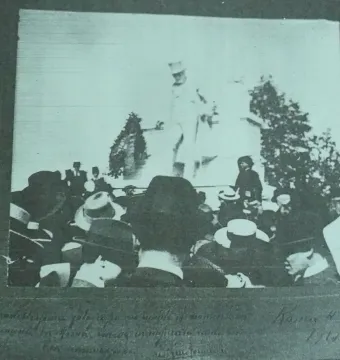
The Monument to Giuseppe Gioachino Belli is a marble memorial dedicated to the 19th-century poet who wrote mainly in Romanesco, the Roman dialect. It stands just off the Lungotevere in Trastevere, across from the entrance to Ponte Garibaldi over the Tiber. Public donations funded the project, which began in 1910 through the efforts of Domenico Gnoli, Ferdinando Martini, and Leone Caetani. A competition chose Michele Tripisciano’s design in 1911, and the monument was inaugurated in May 1913 for the 50th anniversary of Belli’s death. The sculpture shows the poet in a top hat and with a walking stick, posed above reliefs of Roman symbols and satirical motifs.
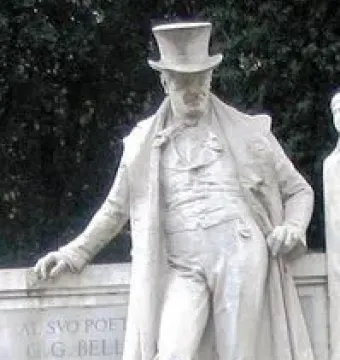
October 2005 © mac_xill · CC BY-SA 2.0
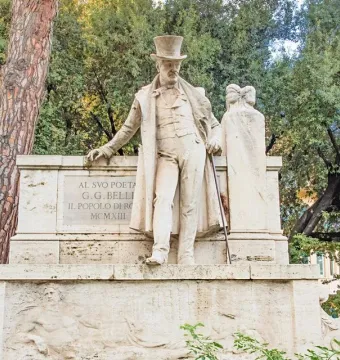
November 2019 © Rabax63 · CC BY-SA 4.0
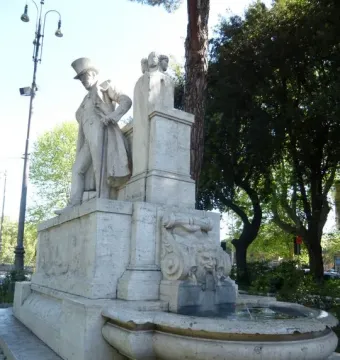
© Lalupa · CC BY-SA 3.0
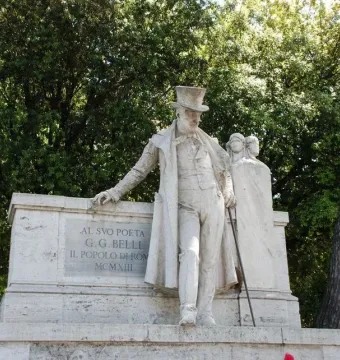
May 2011 © Yellow.Cat · CC BY 2.0
September 2013 © OppidumNissenae · CC BY-SA 3.0
Identification | |
| Title | Monument to Giuseppe Gioachino Belli |
| Type | Sculptural group |
| Work type | Memorial monument |
| Original title | Monumento a Giuseppe Gioachino Belli |
Historical context | |
| Project selected | 22 April 1911 |
| Inauguration date | 4 May 1913 |
| Completion occasion | The fiftieth anniversary of the poet's death |
| Completion date | 1913 |
| Competition announced | 31 January 1911 |
| Idea proposed | Circa 1910 |
| Literary language of the subject | Romanesco, the Roman dialect |
| Dedication | In honor of Giuseppe Gioachino Belli, the 19th-century Roman poet known for the Sonetti romaneschi |
Creator | |
| Artist | Michele Tripisciano |
Discovery and provenance | |
| Cost | The total amount is not specified in the source |
| Later site name | Piazza Giuseppe Gioachino Belli, renamed in 1942 |
| Former site name | Piazza d'Italia |
| Chosen site | Piazza d'Italia, near Ponte Garibaldi |
| Site selection | A committee of admirers and connoisseurs of the poet was formed to identify a suitable site |
| Sculptor's remuneration | Tripisciano renounced his fee |
| Municipal approval | The municipality gave a favorable opinion and fundraising began |
| Recipient of proposal | Mayor Ernesto Nathan of Rome |
| Promoters | Domenico Gnoli, Ferdinando Martini, and Leone Caetani |
| Fundraising initiatives | A subscription for readers promoted by Luigi Cesana, director of Il Messaggero, and performances at the Adriano, Valle, and Quirino theaters |
| Selection method | Design selected by competition |
| Funding | Funded by public donations |
| Fundraising start | 1910 |
Materials | |
| Primary material | Marble |
| Original accessory material | Wood |
| Replacement accessory material | Iron |
Physical characteristics | |
| Base | Low square plinth; rectangular base identified as the parapet of the Ponte Fabricio, with a herm of the Quattro Capi |
| Composition | A statue of Belli with decorated base elements |
| Current accessory fixing | Fixed with cement |
| Current accessory appearance | Painted black to imitate ebony |
Appearance | |
| Water features | Water is poured from allegorical mascarons representing Poetry and Satire |
| Inscription | To their poet G.G. Belli the People of Rome MCMXIII |
| Composition reference | Ponte Fabricio is referenced in the sculpture's composition |
| Base decoration | The short sides have two fountains made of marble basins with molded rims |
| Iconography on base | The front long side shows the river god Tiber with the Capitoline Wolf and Romulus and Remus; the rear long side shows a Roman crowd gathered around Pasquino |
| Pose | Shown aloof on the plinth, while affectionately gazing at fellow pedestrians |
| Depicted figure | Giuseppe Gioachino Belli, shown as an elegantly dressed man wearing a top hat and holding a cane in his left hand, with his right hand resting on a reconstruction of the Ponte Fabricio banister |
Iconography and meaning | |
| Mask meaning | The grotesque mask feeding the fountain represents Poetry and Satire, features of Belli's work |
Location and ownership | |
| Current location | Piazza Giuseppe Gioachino Belli, Trastevere, Rome |
| Current location reference | Just off the Lungotevere in Trastevere, across from the entrance to the Ponte Garibaldi over the Tiber |
History and restoration | |
| Original walking stick | Wood |
| Replacement walking stick | Iron rod, replacing the original wooden stick after several thefts |
| Museum with related material | Tripisciano Museum, Palazzo Moncada |
| Monument room | Sala del Belli |
| Contents of monument room | Various proofs and copies of details of the work, and the original model of the statue |
Significance | |
| Original model significance | The original model was the one Tripisciano used to win the competition for the monument |
Other | |
| Model sketches preserved in | Caltanissetta, the sculptor's hometown |
| Inauguration attendees | Mayor Nathan was present at the inauguration |