
B-P's footprint
B-P's footprint is a casting, usually made in bronze or brass, of the right foot of Lord Baden-Powell, founder of the Scout Movement. The idea was for people to place their foot into the casting and say they had “walked in the footsteps of B-P.” Its history is tied to the 1928 Scouting World Conference in Hungary, where a concrete impression was made after Baden-Powell’s visit to Hárshegy Training Park. Bronze copies were later made and sent to Hárshegy, Baden-Powell, Gilwell Park, and B-P House in London. The Hungarian original and one bronze copy are no longer known to survive.
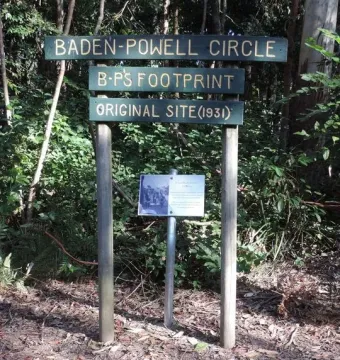
May 2015 © Q8682 · CC BY-SA 4.0
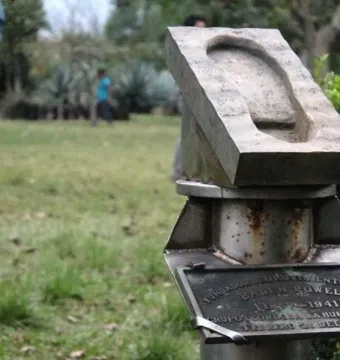
April 2013 © Elgrueso2004 · CC BY-SA 3.0
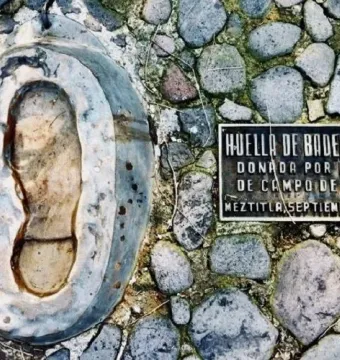
2019 © evrik · CC BY-SA 4.0
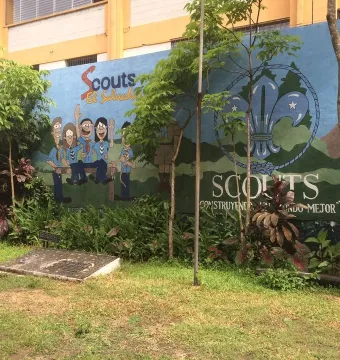
July 2016 © J. Makali Bruton · CC BY-SA 4.0
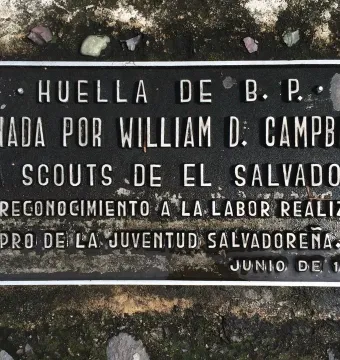
July 2016 © J. Makali Bruton · CC BY-SA 4.0
Identification | |
| Title | B-P's footprint |
| Alternative title | Baden-Powell's footprint |
| Type | footprint casting |
Historical context | |
| Subject | Robert Baden-Powell's right footprint |
| Associated person | Robert Baden-Powell (B.-P.), founder of the Scouting and Guiding movements |
| Associated historical note | Baden-Powell's sister founded the Guides movement |
| Purpose | intended for people to place their foot in the casting so they can say they have followed in B.-P.'s footsteps |
| Commissioning context | Based on an imprint taken in Hungary after Baden-Powell visited the Hárshegy area |
| Related event | The 1928 World Scout Conference in Budapest |
| Conference opening date | 4 May 1928 |
| Hárshegy rally date | 6 May 1928 |
| Date of original imprint event | 7 May 1928 |
| Related rally attendance | 9,647 Scouts out of 25,000 in Hungary, plus up to 20,000 members of the public |
Materials | |
| Source mould material | plastic |
| Later casting material | brass |
| Original casting material | bronze |
| Original imprint material | concrete |
| Material | bronze or brass |
Physical characteristics | |
| Depicted body part | right foot |
| Depicted person | Robert Baden-Powell |
| Type description | a mold or cast of a footprint; also described as a bronze statue or bronze copy of a footprint imprint |
Appearance | |
| Inscription on right side | The Footprint in the Sands of Time |
| Inscription on left side | To Gilwell Park the home of Scoutcraft from Hárshegy Training Park /Hungary/ in memory of the visit of the Chief Scout |
| Dedication | in memory of the visit of the Chief Scout |
Location and ownership | |
| Norwegian mounting location | In front of the house at the Norwegian Gilwell Training Ground, Sverveli, Telemark, Norway |
| Brownsea Island significance | the cradle of Scouting |
| Brownsea Island installation location | Beside an existing bust of Lord Baden-Powell |
| Hungarian 1991 installation location | New Scout Training Park in Hungary |
| Norwegian later use | part of the equipment used at the annual Norwegian Trefoil-Gilwell training courses |
| Later copy location before World War II | Gilwell Park |
| Norwegian gift recipient | The Norwegian Boy Scout Organization |
| One bronze copy location | Hárshegy Training Park |
| Original copy recipient | Baden-Powell, who passed it to the British Scout Headquarters |
| Original location | Hárshegy Training Park, Hungary |
| Other bronze copy location | British Scout Headquarters in London |
History and restoration | |
| Brass casting foundry | Østlandske Lettmetall foundry, Elverum, Norway |
| National Trust opening of Brownsea Island | 1963, in a ceremony conducted by Olave Lady Baden-Powell, the World Chief Guide |
| Brownsea object unveiled by | Gill Clay, one of B.-P.'s grandchildren and daughter of Betty Clay |
| Brownsea installation occasion | Celebrations marking the 50th anniversary of the opening of Brownsea Island to the public |
| Brownsea installation date | 13 May 2013 |
| Brownsea gift recipient | the warden for that weekend, Claire |
| Brownsea gift presenter | Øystein Gonsholt |
| Brownsea donation occasion | Dinner to close the 67th Norwegian Trefoil-Gilwell Training course on the island |
| Brownsea donation date | 3 August 2012 |
| Norwegian removal date | June 2010, when Sverveli was sold |
| Brass casting date | June 2012 |
| Associated object with Norwegian gift | a Kudu horn |
| Norwegian gift presenter | Camp Chief John Thurman |
| Norwegian gift date | Summer 1959 |
| Gilwell wartime status | Gilwell was requisitioned by the War Ministry from 1940 to 1945 as a local command, training, and ordnance centre, but the footprint was left undisturbed |
| Hungarian bronze fate | The 'original Hungarian bronze' has not been seen since 1948 |
| Original imprint fate | The original concrete footprint has not been seen since 1948 after the Communists took power, Scouting was banned, the training camp was confiscated, and houses were built on the land |
| Additional later copies | A further copy was requested by Queensland Scouters in Australia in November 1928, and Baden-Powell made another imprint of his right shoe into concrete in Australia on 26 March 1931 |
| Number of bronze copies made from the original cast | Two |
Significance | |
| Symbolic meaning | a tribute to B.-P., his Scouting idea, and Brownsea Island; a symbol of gratitude and of the Baden-Powell spirit |
Other | |
| Associated figures | his wife Olave; Lord Hampton; Count Pál Teleki |
| Additional nickname | B.-P. |