
Table of Silence
Table of Silence is a monumental sculpture by Romanian sculptor Constantin Brâncuși. It is located in the Romanian city of Târgu Jiu, in Gorj County, and is part of the Constantin Brâncuși Sculptural Ensemble together with the Endless Column and the Kiss Gate. Made of tiza, it represents the table before going to fight. The passage of time is symbolized by the chairs, which are shaped like hourglasses. The ensemble is a tribute to the heroes who fell in the First World War, and its three parts are arranged on a west-to-east line measuring 1,275 meters.
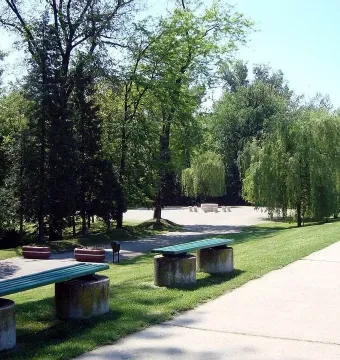
May 2010 © Tomoniu N. Nicolae · CC BY-SA 3.0 ro
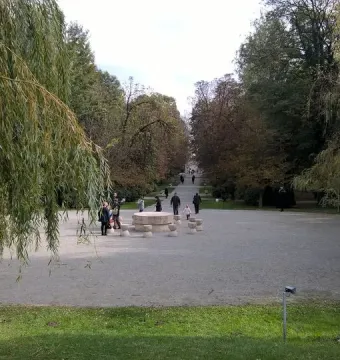
October 2016 © Leontin l · CC BY-SA 3.0 ro
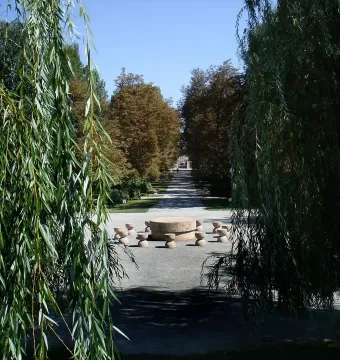
August 2012 © Miehs Cristian-Mihail · CC BY-SA 4.0
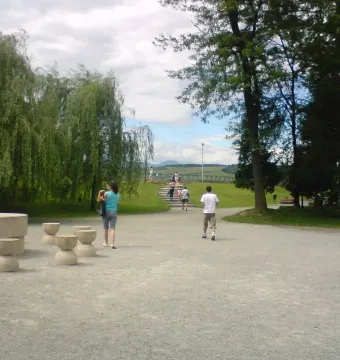
© Costel Munteanu · CC BY-SA 3.0
Identification | |
| Title | Table of Silence |
| German title | Der Tisch des Schweigens |
| Type | Monumental sculpture |
| Original title | Masa tăcerii |
Historical context | |
| Creation period | 1935–1938 |
Creator | |
| Artist | Constantin Brâncuși |
| Artist nationality | Romanian |
| Artist residence at time of creation | Paris |
| Artist workshop location at time of creation | Paris |
Discovery and provenance | |
| Dedication | A homage to the heroes fallen in the First World War |
| Commemorated event | Fallen soldiers of the first Battle of the Jiu Valley in October 1916, especially the fighting in and around Târgu Jiu on 27 October during World War I |
| Part of ensemble | The Constantin Brâncuși Sculptural Ensemble (Calea Eroilor / The Road of Heroes) |
| Related works in commission | The Gate of the Kiss; The Endless Column |
| Commissioned by | Communist Women's League of Gorj |
Physical characteristics | |
| Composition | Two large cylindrical stone discs forming a table, with twelve stone hourglass-shaped stools arranged in a circle around it |
| Upper disc diameter | 2.15 m |
| Upper disc height | 43 cm |
| Lower disc diameter | 1.60 m |
| Lower disc thickness | 45 cm |
| Stool diameter | 45 cm |
| Stool arrangement | Circle, evenly distributed about 1 m from the table |
Materials | |
| Production material | Limestone |
| Material | Transylvanian travertine from Banpotoc |
Technique | |
| Production site | Stone workshops in Deva |
Appearance | |
| Symbolism | The stools symbolize hourglasses |
Iconography and meaning | |
| Depicted subject | The table before going to fight |
| Interpretation | Everything arises in silence |
Location and ownership | |
| Current location | Târgu Jiu, Gorj district, Romania, at the western end of the split park near the Jiu River |
| Part of site | Calea Eroilor (The Road of Heroes) |
| Ensemble layout | The three pieces are arranged in a line from west to east |
| Total layout length | 1,275 meters |
History and restoration | |
| Original stool arrangement | The stools were originally symmetrically arranged in pairs around the smaller table, about 40 cm away |
| Later modification | Brâncuși had a second stone disc made and placed on the original table, creating the current form |
| 1938 reaction | When Brâncuși returned to Târgu Jiu in 1938, he demanded the inscription and decorations be removed |
| 1937 alteration | After Brâncuși exhibited the work in 1937 and returned to Paris, city leaders carved an explanatory lead-filled inscription with the sculptor's name and round depressions into the top surface |
| Original form | Initially only the lower stone disc formed the table |
Significance | |
| UNESCO World Heritage inscription | Inscribed on the UNESCO World Heritage List in July 2024 |
| UNESCO reference number | GJ-III-s-B-09463 |
Other | |
| Associated park | A park over one kilometer long, planned by the artist for the originally intended 12 sculptures; today only fragmentarily preserved |
| Photographic works title | La Table du silence |
| Brâncuși's role as photographer | He also worked as a photographer |
| Presentation in photographs | Staged photographically and transformed through the inclusion of light and space |
| Artistic effect in photographs | Some image artworks derived from the sculptures became independent works of art through defamiliarization |
| Repository of photographs | Centre Pompidou in Paris, among others |
| Banpotoc note | Banpotoc was incorporated into Hărău in 1966 |