
National Police Memorial
The National Police Memorial is a memorial in central London commemorating about 4,000 police officers killed in the course of their duties in the United Kingdom. Designed by Lord Foster of Thames Bank and Per Arnoldi, it stands on the corner of The Mall and Horse Guards Road, directly outside the Old Admiralty Building. The site had previously been occupied by an air shaft for the Bakerloo line. Groundbreaking took place in July 2004, and the memorial was formally unveiled in April 2005 by Queen Elizabeth and Tony Blair. It was completed under budget and won a Royal Institute of British Architects award in 2006.
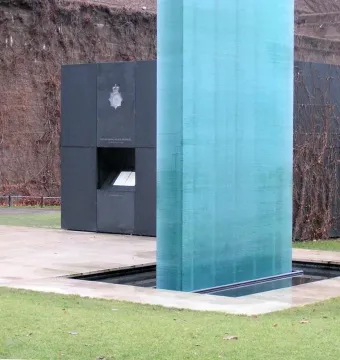
© Canthusus · CC BY-SA 3.0
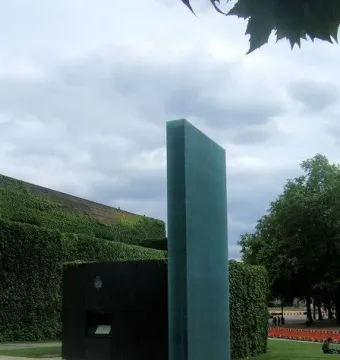
July 2008 © Kevin Gordon · CC BY-SA 2.0
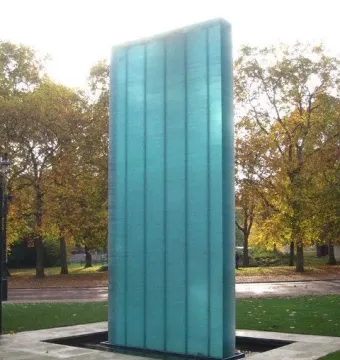
October 2009 © Rod Allday · CC BY-SA 2.0
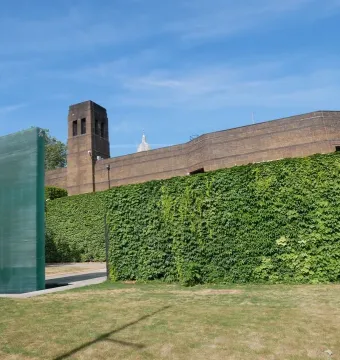
June 2023 © Doyle of London · CC BY-SA 4.0
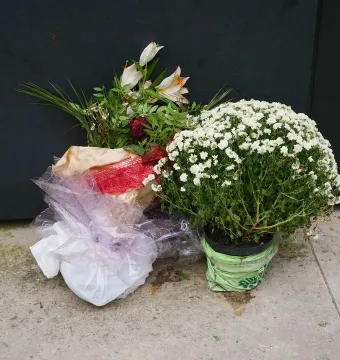
September 2020 © Ethan Doyle White · CC BY-SA 4.0
Identification | |
| Title | National Police Memorial |
| Type | memorial sculpture |
Historical context | |
| Planning permission date | October 2002 |
| Other attendees at unveiling | Michael Howard and Charles Kennedy |
| Formally unveiled by | Queen Elizabeth and Tony Blair |
| Reason those police forces were represented | they were the two forces with the highest number of officers killed in the line of duty |
| Groundbreaking performed by | Prime Minister Tony Blair, Michael Winner, and officers from the Metropolitan Police and Greater Manchester Police |
| Symbolic groundbreaking date | 22 July 2004 |
| Formal unveiling date | 26 April 2005 |
| Planning permission granted by | Westminster City Council |
| Later activity of the trust | lobbied and raised funds for a national memorial from the mid-1990s |
| Initial focus of the trust | erecting smaller monuments at the points where officers had died on duty |
| Founded after | the shooting of Yvonne Fletcher in 1984 |
| Founded by | film director Michael Winner |
| Campaigning organization | Police Memorial Trust |
| Commemorates | about 4,000 police officers killed in the line of duty in the United Kingdom |
| Campaign duration | ten years |
Creator | |
| Designed by | Norman Foster and Per Arnoldi |
| Project architect for Foster | Peter Ridley |
Discovery and provenance | |
| Construction cost | £400,000 under budget |
| Reason for lower construction cost | in part because a number of the contractors carried out their work free of charge |
| Winner's donation | £500,000 of his own money |
| Funding for remaining cost | met by a public collection |
| Total cost | £2.3 million |
Physical characteristics | |
| Column weight | 28.6 tonnes |
| Glass sheets | 622 stacked sheets of glass |
| Column purpose | intended to screen the vitrine from passing traffic on The Mall |
| Column lighting | internally illuminated by fibre optic cables with a faint blue light |
| Column setting | sited in a reflecting pool |
| Column location | immediately north of the block |
| Displayed item | a vitrine displaying the Roll of Honour |
| Enclosure function | surrounds the air shaft and forms a single block |
| Enclosure surface | creeper-covered |
| Enclosure shape | black rectangular enclosure |
| Main elements | two distinct architectural elements linked by a terrace of Purbeck stone |
| Enclosure northern face | kept free of creepers |
Materials | |
| Terrace material | Purbeck stone |
| Column material | glass |
Iconography and meaning | |
| Inscription on northern face | the police badge of office and the text 'The National Police Memorial: Honouring Those Who Serve' |
| Lighting symbolism | symbolises the blue lamp traditionally hanging outside police stations in the United Kingdom |
Location and ownership | |
| Scope of roll | listing all officers who have died in the line of duty |
| Location | corner of The Mall and Horse Guards Road, directly outside the Old Admiralty Building, London, England, United Kingdom |
| Contains | UK Police Roll of Honour behind a glass panel |
| Former site occupation | the site was occupied by an air shaft on the Bakerloo line of the London Underground |
History and restoration | |
| Objections from Irish republicans | some Irish republicans were concerned that the memorial includes the names of RUC officers killed in The Troubles |
| Depicted related date | 1910 |
| Objections before construction | objections were raised by the London Historical Parks Group and the local residents' association |
| Criticism from families of officers | some families of officers killed in the line of duty criticized the memorial for its high cost and because the roll of honour lists only officers killed during arrests or as a result of criminal acts, rather than all officers killed in the line of duty |
| Roll of honour limitation | lists only those officers killed during arrests or as a result of criminal acts, not all officers killed in the line of duty |
| Book display issue | the book is behind glass, so friends and relatives of the deceased are not able to view the relevant page |
| Compiled from | approximately 4,000 names recorded by the Police Roll of Honour Trust |
| Depicted related people | Sergeants Tucker and Bentley and PC Choate |
| Depicted related date | 1867 |
| Depicted related person | Manchester Police Sgt Charles Brent |
| Earliest entry cause of death | died of injuries |
| Earliest entry date | 1680 |
| Earliest entry | Watchman Isaac Smith |
| Names recorded | approximately 4,000 officers killed while on duty, in the course of effecting an arrest, or while carrying out hazardous duties |
Significance | |
| Award | Royal Institute of British Architects award for 2006 |
Other | |
| Queen's statement about the memorial | she said it was appropriate that it should be positioned in The Mall, and hoped people would pause and reflect on the proud traditions it represents; she said the courage and personal sacrifice recorded here would serve as an inspiration to all |
| Guard of honour | 56 officers wearing the uniforms of each of the UK's police forces |