
Molinere Underwater Sculpture Park
Molinere Underwater Sculpture Park is a collection of ecological underwater contemporary art located in the Caribbean Sea off the west coast of Grenada, West Indies. Created by British sculptor Jason deCaires Taylor, it opened for public viewing in May 2006 as the world’s first underwater sculpture park. Taylor designed the works to engage local people with the underwater environment around them, using life casts of members of the local community. The installation consists of concrete figures placed on the ocean floor, including solitary human forms and a ring of children holding hands, all facing into the oceanic currents.
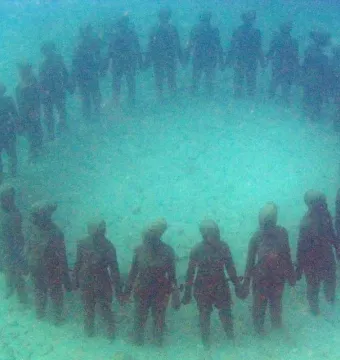
November 2007 © SunCat · CC BY 2.0
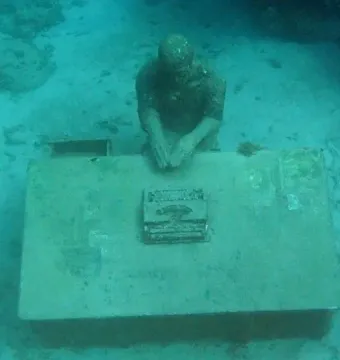
November 2007 © SunCat · CC BY 2.0
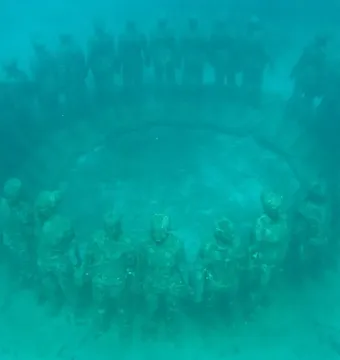
December 2015 © Boris Kasimov · CC BY 2.0
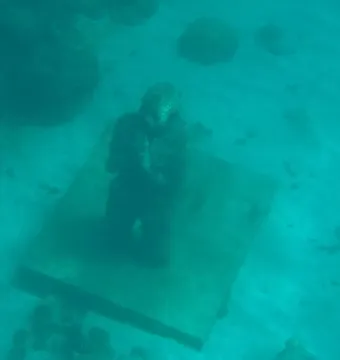
December 2015 © Boris Kasimov · CC BY 2.0
November 2007 © SunCat · CC BY 2.0
Identification | |
| Title | Molinere Underwater Sculpture Park |
| Vicissitudes | Vicissitudes |
| The Lost Correspondent | The Lost Correspondent |
| Original-language name | Parque de Esculturas Subaquáticas Molinere |
| The Unstill Life | The Unstill Life |
| Grace Reef | Grace Reef |
| Tam CC Project | Tam CC Project |
| The Fall From Grace | The Fall From Grace |
| Type | underwater sculpture park |
Historical context | |
| Historical context | Created after Hurricane Ivan (2004) destroyed many of Grenada's coral reefs; Hurricane Emily (2005) also contributed to reef damage |
Creator | |
| Creator occupation | sculptor and environmentalist |
| Creator | Jason deCaires Taylor |
| Creator nationality | British |
Discovery and provenance | |
| Construction began | 2006 |
| Added works | In 2010, a local artist added new works to the park |
| Restoration | The park underwent restoration in 2021, including repairs, cleaning, removal of some sculptures, and relocation of others |
| Public opening | May 2006 |
| Installation authorization | Authorized by Grenada's Ministry of Tourism and Ministry of Agriculture, Forests and Fisheries |
Significance | |
| Historical significance | The world's first underwater sculpture park |
| Recognition | Considered one of National Geographic's 25 Wonders of the World |
Purpose | |
| Purpose | To help recover marine fauna and flora, promote coral growth, create a sanctuary for small marine life, and reduce tourist and diver pressure on natural reefs |
Physical characteristics | |
| Water depth | varied depths, up to 12 meters |
| Visitors | Visited daily by scuba divers, snorkelers, and glass-bottom boats |
| Accessibility | Accessible by boat from St. George's or Grand Anse Bay |
| Weight | around 15 tonnes in dry cement |
| Number of sculptures | over 65 |
| Area covered | over 800 square meters |
| Location | Molinere Bay, Grenada, in the Molinere Beauséjour Marine Reserve, off the Caribbean coast of Grenada in the West Indies |
| Placement | Installed on the ocean floor in sandy, barren Molinere Bay |
Materials | |
| Materials | Concrete, steel, and pH-neutral, long-lasting cement |
Technique | |
| Technique | Made as life casts on the surface, washed to remove chemical residue, transported on lifting platforms, submerged, and bolted to the seabed |
| Surface treatment | Textured surfaces designed to be stable and permanent and to promote coral attachment |
| Installation timing | Placed in the ocean at the correct time of year to coincide with coral spawning |
Appearance | |
| Representation | Life-size |
| Structure | Circular arrangements |
| Orientation | Figures face into the ocean currents |
| Depicted forms | Mostly human figures, including solitary figures and groups |
Iconography and meaning | |
| Social message | Highlights the importance of creating a sustainable, well-managed environment for future generations |
| Themes | Growth, chance, natural transformation, and the impact of time and environment on the body |
| Symbolism | Unity, resilience, and life's ongoing cycle |
| Interpretive focus | A unique space that highlights environmental processes and the relationship between art and its environment |
| Source of figures | Life casts of local community members |
| Public debate | Some have interpreted the park as a dedication to enslaved Africans lost in the Middle Passage, but the artist says this was never his intention |
| Historical reference | The Middle Passage from West Africa to the Americas |
Location and ownership | |
| Installation site authorization | The park site was authorized in an area that had suffered substantial storm damage |
| Nearby attraction note | Flamingo Bay is the most visited snorkeling destination on the island |
| Nearby water sports area | Flamingo Bay |
History and restoration | |
| Vicissitudes | Installed in 2007 at 14 feet depth; a life-size ring of 26 children holding hands and facing outward into the current, made in six months and weighing 15 tonnes in dry cement; designed to withstand strong currents and tidal motion; Taylor's most recognized work in the park; symbolizes children's adaptability and the concept of life's ongoing cycle; also highlights environmental sustainability for future generations |
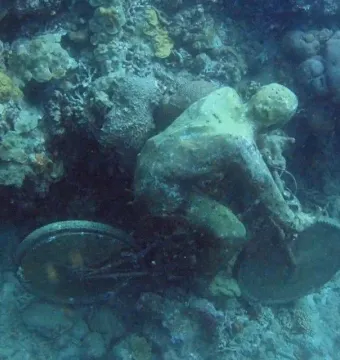
| The Fall From Grace | Installed in 2007 at 21 feet depth; depicts a life-size male figure riding a bicycle; after 8 months in the ocean, aquatic life was already inhabiting it |
| The Lost Correspondent | Installed in 2006 at 22 feet depth; depicts a lone concrete figure at a desk over a typewriter with newspapers from the 1970s on the desk, some of political significance from Cuba before the revolution; interpreted as a modern-day Vesuvius disaster |
| Grace Reef | Installed in 2006 at 12 feet depth in hurricane-damaged Molinere Bay; consists of 16 concrete statues cast from a local Grenadian woman, lying on the sea floor; after 14 months the figures had begun to distort due to marine life |
| The Unstill Life | Installed in 2006 at 25 feet depth; depicts a classical still life with a table, vase, and fruit bowl in simple modern-day forms; its appearance has continually changed through natural processes |
| Related comparison | Comparable to artificial reef constructions by Reef Ball |
| Change over time | Some sculptures had begun to distort or become inhabited by marine life within months to 14 months |
| Expected long-term change | Coral and tides will gradually alter the sculptures' appearance and bring new marine inhabitants |
| Observed marine life | Flounder, parrot fish, branded coral shrimp, and fire worms |
| Future reef loss prediction | Up to 60% of natural coral reefs may be depleted by 2050 |
| Coral growth timeframe | Hard coral can take 10 to 80 years to develop |
| Seabed conditions | Only 10–15% of the seabed has a substratum solid enough for natural reefs to grow on |
| Environmental issues addressed | Reef damage from storms and human pressures including pollution, acidification, and overfishing |
| Tam CC Project | Installed in 2007 at 6 feet depth; consists of 18 concrete heads fixed to a rock face in shallow water, cast from students' faces at T. A. Marryshow Community College in Grenada |