
Survival of the Fattest
Survival of the Fattest is a bronze sculpture made in 2002 by Jens Galschiøt and Lars Calmar. It depicts a starved African boy carrying a huge fat woman from the West, with the woman holding a pair of scales as a symbol of justice. Her closed eyes echo the blindfolded Lady Justice while suggesting an unwillingness to see obvious injustice. The work was created as a symbol of the uneven distribution of the world’s resources and as a message to the rich part of the world about unjust global trade. In 2006, the sculpture was acquired by the city of Ringkøbing in Central Denmark Region and placed in the harbour.
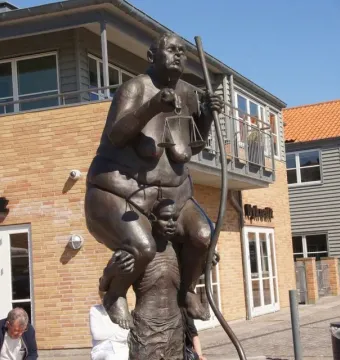
© rob Stoeltje · CC BY 2.0
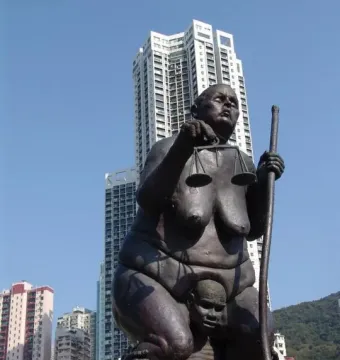
© Galchiøt · CC BY-SA 3.0
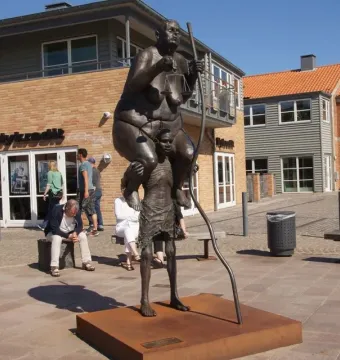
© rob Stoeltje · CC BY 2.0
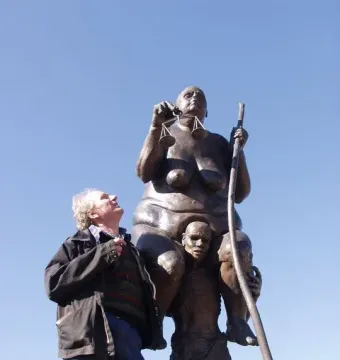
March 2003 © Jens Galschiøt · GFDL
Identification | |
| Title | Survival of the Fattest |
| Type | Bronze and plastic sculpture |
| Series | SevenMeters |
Historical context | |
| Date made | 2002 |
Creator | |
| Artist | Jens Galschiøt and Lars Calmar |
Physical characteristics | |
| Height | 3.5 meters |
| Eyes | Closed |
| Object held | A pair of scales |
Appearance | |
| Depicted figures | A fat woman from the West sitting on the shoulders of a starving African boy |
Iconography and meaning | |
| Inscription | "I'm sitting on the back of a man. He is sinking under the burden. I would do anything to help him. Except stepping down from his back." |
| Intended message | A message to the rich part of the world |
| Theme | Imbalanced global distribution of resources, including Western overconsumption, hunger in the Third World, and unjust world trade |
| Interpretation of closed eyes | A suggestion that justice has degenerated into self-righteousness and a refusal to see obvious injustice |
| Symbolism of scales | A symbol of justice |
| Reference in depiction | An ironic allusion to the Darwinist expression "Survival of the Fittest" and a reference to the traditional depiction of Lady Justice wearing a blindfold |
Location and ownership | |
| Acquired by | The city of Ringkøbing, Central Denmark Region |
| Year acquired | 2006 |
| Current location | The harbour in Ringkøbing, Central Denmark Region |
| Location status date | As of 2022 |
History and restoration | |
| Exhibited at | the 15th Climate Change Conference (COP15) in 2009 |
| Installation location | the harbour of Copenhagen, next to The Little Mermaid statue, installed in water |
| Purpose of placement | to ensure the sculpture's provocative message would receive international attention |
| Interpretation of placement | to suggest that the intentions and goals of wealthy countries at the UN Climate Conference in Copenhagen were nothing more than fairy tales |
Significance | |
| Associated landmark | The Little Mermaid statue, seen by an estimated one million tourists per year |
| Description | Probably the most moving work in the SevenMeters series |