
Lion in Monrepos
Lion in Monrepos was a granite sculpture created as the Monument to the Independence of Finland and installed in 1927 in Vyborg’s Petrovsky Park, on the site of the former Peter I monument. The composition featured a lion standing on a four-metre granite pedestal, with the coat of arms of Viipuri Province in its right paw, along with a granite stairway and two large stone spheres. The monument was thrown from the cliff after the Winter War, breaking on impact, and its fragments were later reinstalled in 1941. After the area returned to Soviet control, the largest surviving fragment was buried in Monrepos and rediscovered in 1989; it now stands in front of the Monrepos administration building. A fragment of the pedestal is held by the Vyborg Castle museum.
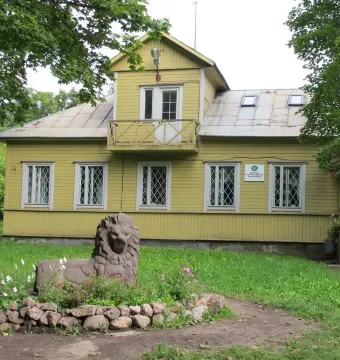
August 2011 © Андрей Романенко · Public domain
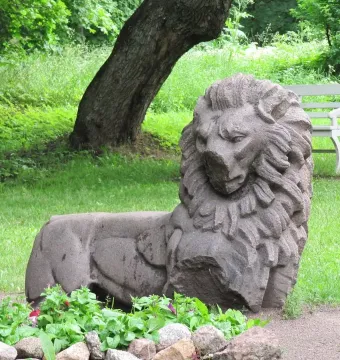
June 2011 © Pavlov · Public domain
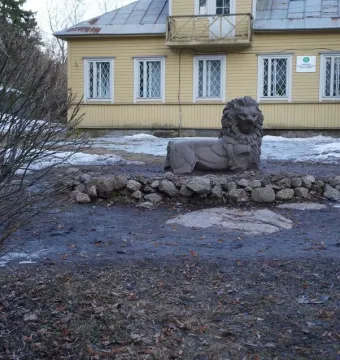
April 2016 © Tatiusa · CC BY-SA 4.0
January 2021 © Erzianj jurnalist · CC BY-SA 4.0
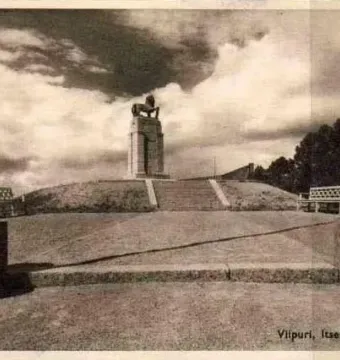
© Unknown authorUnknown author · Public domain
Identification | |
| Title | Monument of the Independence of Finland |
| Alternative title | Lion in Monrepos |
| Type | Monument / commemorative sculpture |
Historical context | |
| Subject | Lion as a symbol of Finland's independence |
| Date erected | 1927 |
| Occasion | 10th anniversary of the proclamation of Finland's independence |
Creator | |
| Proposed by | Major General V. A. Teslev (Tesleff), a native of Vyborg |
Discovery and provenance | |
| Donor | V. A. Teslev (Tesleff) |
| Donation amount | about 100,000 Finnish marks |
Location and ownership | |
| Original location | On the top of a rock in Monrepos Park, Vyborg, at the site of a demolished statue of the Russian emperor |
| Former location | Petrovsky Park, Vyborg, on the site of the monument to Peter I |
| Current location | Largest fragment in front of the Monrepos park administration building; pedestal fragment in the Vyborg Castle museum |
Physical characteristics | |
| Additional elements | Granite staircase and two large granite spheres on both sides of the road to the monument |
| Composition | The lion rests its right paw on the coat of arms of Vyborg Province (Finnish Karelia), showing two hands rising from below: an armored right hand holding a straight sword, a left hand in mail holding a curved sabre, with a crown above |
| Pedestal height | 4 meters |
| Base | High pedestal |
| Depicted figure | Lion |
Materials | |
| Material | Granite |
Technique | |
| Inscription | SUOMEN ITSENÄISYYSJULISTUKSEN MUISTOKSI 6 · XII · 1917 |
| Inscription translation | In memory of the declaration of independence of Finland, 06.12.1917 |
History and restoration | |
| Installation period at original site | 1927–1940 |
| Removal and damage | After the Soviet-Finnish War (1939–1940), Soviet troops returned the monument to Peter I to its historical site and the Independence monument was thrown from the cliff, breaking apart and losing its paws |
| Reinstallation | In 1941 the fragments were reinstalled by Finnish servicemen after Finnish troops captured Vyborg and again threw the Peter I monument off the site |
| Later fate of largest fragment | After Soviet troops returned to the city during the Vyborg operation, the largest fragment was buried in Monrepos Park |
| Rediscovery | The largest fragment was found by park staff in 1989 |
Significance | |
| Symbolism | Symbol of Finland's independence |
Other | |
| Copy in another location | An author's copy without the pedestal was installed in Hyvinkää |
| Associated photographs | Photographs show the 1927 opening, a copy at the Kytäjä manor in 1934, the fragments in 1942, the fragment in Monrepos Park in 2013, and a 2023 photo near the Gardener's House in Monrepos Park |