
The Whirling Ear
The Whirling Ear is a 1958 sculpture by Alexander Calder installed in Brussels. Made of sheet metal and paint, it is motorized and was originally commissioned to stand in a water basin in front of the American pavilion at the 1958 Brussels World Exhibition. The work was built by Gowan & Knight Co. in Watertown, using an enlarged version of Calder’s model, with an steel base and a rotating section of welded aluminum sheets. After the Expo, it was left rusting and forgotten before being recovered and restored. Since 2000, it has been installed on Rue Montagne de la Cour, between Mont des Arts and Place Royale.
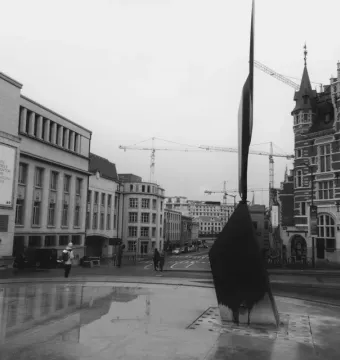
© Micha Pajocel · CC BY-SA 3.0
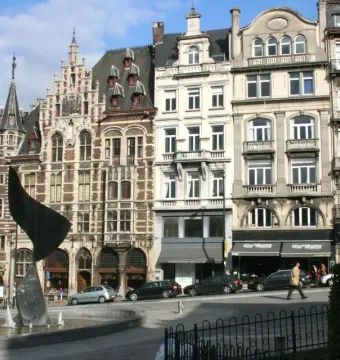
2009 © Michel wal · CC BY-SA 3.0
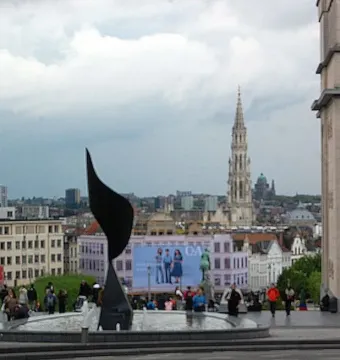
May 2026 © Lucyin · CC BY-SA 4.0
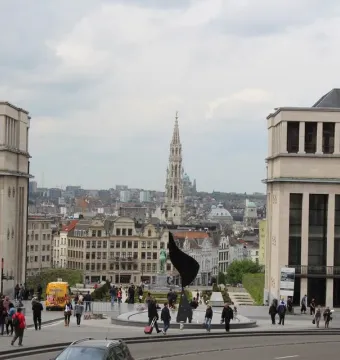
© tiger rus · CC BY 3.0
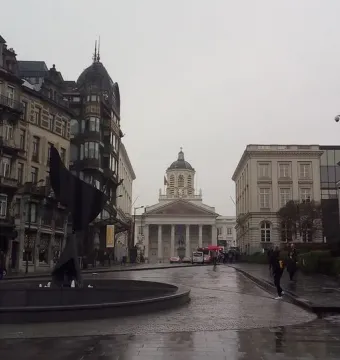
April 2019 © MatteoNL97 · CC BY-SA 4.0
Identification | |
| Title | The Whirling Ear |
| Type | Monumental sculpture |
| French title | L'Oreille tournoyante |
Creator | |
| Artist | Alexander Calder |
Historical context | |
| Year of creation | 1958 |
| Commissioned for | the American pavilion basin at the 1958 Brussels World's Fair (Exposition universelle de Bruxelles de 1958) |
| Site-specific status | Calder's only monumental piece created for a Belgian site |
Physical characteristics | |
| Movement | Motorized rotating sculpture |
Materials | |
| Materials | Sheet metal and paint |
| Base material | Steel |
| Rotating part material | Welded aluminum sheets |
| Scale | 24 times larger than the wooden model |
Discovery and provenance | |
| Original project submission | A brief handwritten description and a static wooden model |
| Fabricator | Gowan & Knight Co., Watertown |
Location and ownership | |
| Current location | Rue Montagne de la Cour, at the top of the Mont des Arts stairs, Brussels, Belgium |
| Original location | Brussels, Belgium |
| Original location context | Installed in a basin of water in front of the American pavilion at the Brussels Expo |
History and restoration | |
| Post-Expo condition | Became motionless when the Expo ended and the fountains stopped |
| Donation | The United States donated the sculpture to Belgium |
| Condition after donation | Left in place and rusted in a dry basin |
| Public neglect | Forgotten in Brussels and not mentioned during a 1960 artist exhibition at the Palais des Beaux-Arts |
| Recovery request | The Musées de Beaux-Arts asked the ministers of culture for permission to retrieve it |
| Transfer approval | The request was approved |
| Removal from pedestal | Unbolted from its concrete pedestal |
| Temporary storage | Transferred to the reserves of the Royal Museum of Modern Art in Brussels |
| Transfer ratification | Ratified in 1970 |
| Restoration and reinstallation proposal | In 1995, the King Baudouin Foundation proposed moving it from storage to the museum square, in place of the statue of Charles de Lorraine |
| Final placement after restoration | Installed on Rue Montagne de la Cour after restoration |
| Inauguration | Inaugurated on an unspecified date |