
La madre del emigrante
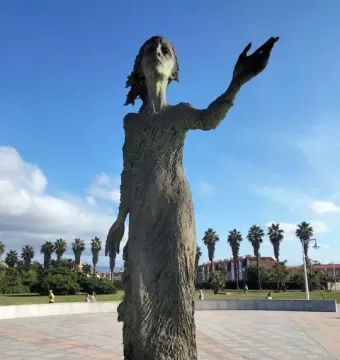
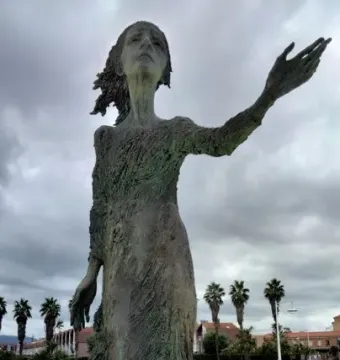
La madre del emigrante is a sculpture by Ramón Muriedas located in Somió, on the seafront promenade of Gijón, where it commemorates Asturian emigration around the world. It is regarded as the first work of modern sculptural language in the city. Planned for years through public initiatives and competitions, it was finally assigned to Muriedas in 1967 and inaugurated on 18 September 1970 at the Rinconín. The work was later criticized for its modern style, damaged by an explosion in 1976, repaired in 1995, and restored again in 2004 and 2012 after further deterioration and vandalism.
August 2024 © Piwiki314 · CC BY-SA 4.0
August 2024 © Piwiki314 · CC BY-SA 4.0
© Francisco Rodriguez · CC BY 3.0
September 2007 © drusbi · CC BY 2.0
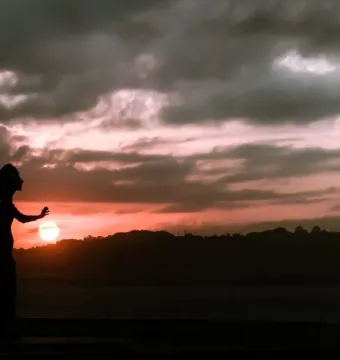
September 2014 © Maribel Gijon (Ayalga) · CC BY-SA 2.0
Identification | |
| Title | La madre del emigrante |
| Type | Sculpture, monument |
| Popular names | La loca del Rinconín; La mujerona |
Creator | |
| Artist | Ramón Muriedas Mazorra |
Historical context | |
| Inauguration context | Inaugurated during the V World Congress of Asturian Societies |
| Inauguration date | 18 September 1970 |
| Final location decision | Rinconín, near the Rosario Acuña area, because Cerro de Santa Catalina was still a military area |
| Funding decision | In 1969 the Gijón city council decided to finance the project with its own funds; the budget was approved on 2 September 1969 and ratified the next day |
| Expected style | A traditional Asturian mother in long gathered or pleated skirt, headscarf, shawl, and madreñas/albarcas |
| Initial reception of designs | The preliminary designs were criticized as excessively modern |
| Presentation of sketches | At the IV World Congress of Asturian Societies |
| Planned site in 1967 | Cerro de Santa Catalina, a military area expected to be recovered |
| Project delay | The project was postponed because of funding, location, and selection-rule uncertainties |
| Project resumed | 1967 |
| Exhibition of entries | During the III Congress of Asturian Societies, almost one hundred models and sketches received for the competition were exhibited |
| Competition publicity | Publicized through Mundo Asturiano, the official publication of the World Federation of Asturian Societies and the Office of America |
| Competition | An open competition for Hispano-American artists was announced in March 1964, open until May 1964, with a decision planned for June 1964 |
| Initial proposal | Proposed in 1958 by Mayor Cecilio Olivier Sobera for El Musel or another place in Gijón |
| Commissioned by | The City Council of Gijón, together with the Cuban consulate |
| Commissioned in connection with | The I Congress of Asturian Societies in 1958 |
| Subject | A tribute to the mothers of emigrants |
| Project uncertainties | The project lacked funding, the site was uncertain, and no selection criteria had been drafted |
Physical characteristics | |
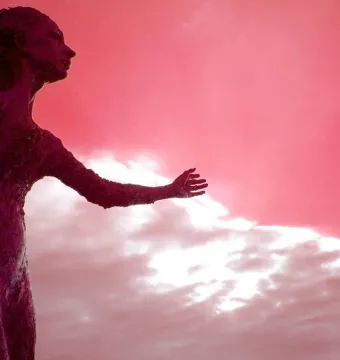
| Pose | One hand extended in a farewell gesture |
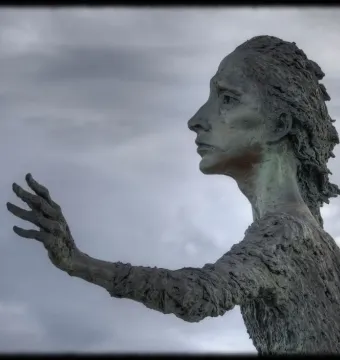
| Gaze | Looking toward the sea |
| Clothing | A dress clinging to her body because of the wind |
| Hair | Frizzy or curled hair, windblown |
| Depicted figure | A woman |
Materials | |
| Material | Bronze |
Iconography and meaning | |
| Narrative interpretation | The woman looks toward the sea where her children disappeared and waits for their return |
| Symbolic meaning | The sea is the place through which her children disappeared |
| Emotional state | Waiting for her children’s return while suffering |
Location and ownership | |
| Current setting | Exposed to the elements of the Cantabrian Sea |
| Current location | Somió, on the seaside promenade of Gijón, at Rinconín near the Rosario Acuña area |
| Site status at inauguration | Placed on a simple pedestal intended as a temporary location |
History and restoration | |
| Repair in 1995 | Francisco González Macías repaired the monument, rebuilding the figure’s feet, increasing stability with larger axes and a base, and modifying the head and left hand |
| Repair in 2012 | The monument was repaired after vandalism mutilated the middle finger of the right hand |
| Condition before 2004 restoration | Damaged, with several missing fingers on the right hand, cracks in the feet, and an oxidized internal structure |
| Restoration in 2004 | An integral restoration was carried out from February to July 2004 |
| Reinstalled setting | It was placed in a small slightly elevated square reached by a short staircase |
| Pedestal replacement | Between 1995 and 1996 the pedestal was replaced |
| Return to Rinconín | It was placed again in Rinconín at the beginning of the 1980s, when the first democratic city government was elected |
| Storage after repair | After the repair it was moved to a storage facility |
| Reason for criticism | It was expected to be a more classic sculpture and was considered too modern |
| Repair request | No repair was prepared until a citizen asked the City Council to sell him the structure |
| Storm damage | A strong storm in Asturias and Cantabria tilted the already damaged monument |
| Damage in 1976 | An explosion damaged the lower part of the structure, which was painted over afterward |
| Contemporary criticism quote | It was called 'that monstrosity' and said not to be able to represent mothers of emigrants to America |
| Public reception | It received multiple criticisms after inauguration; La Nueva España headlined on 10 September 1970: 'A monument that is not liked' |
| Site provisionality | At the inauguration, the mayor said the site was provisional and the sculpture might be moved to the top of La Providencia |
| Inauguration attendees | Ignacio Bertrand Bertrand, Juan Manuel Mateu de Ros, Aurelio González González, and Gonzalo García Passigli |
| Pedestal inscription | Originally a simple inscription, later replaced by the poem Al son del agua by Alfonso Camín |
Significance | |
| Stylistic significance | First sculptural work in a modern language located in the city |