
Rothéneuf Sculpted Rocks
Rothéneuf Sculpted Rocks is a singular work of art in the village of Rothéneuf, a seaside resort on the Côte d’Émeraude in Saint-Malo, in north-eastern Brittany, France. Also known as the stone spirits, it consists of more than 300 figures of various kinds carved into granite outcrops. The carvings were made by Adolphe Julien Fouéré, known as Abbé Fouré, a former priest who suffered from a severe disability. He created the work between 1894 and 1910.
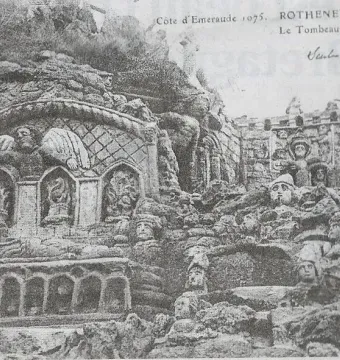
1908 © Adolphe Julien Fouré · Public domain
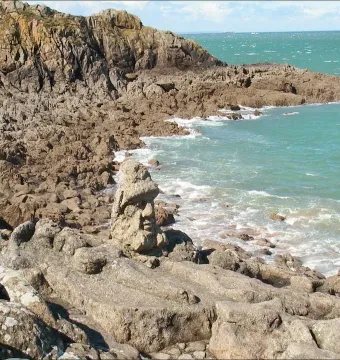
April 2004 © Jean-Pierre Dalbéra · CC BY 2.0
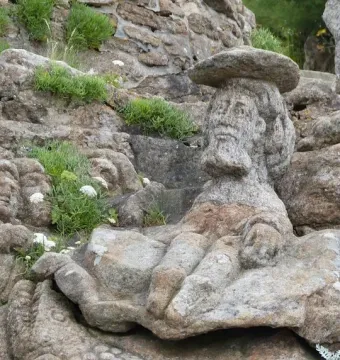
July 2018 © Thérèse Gaigé · CC BY-SA 4.0
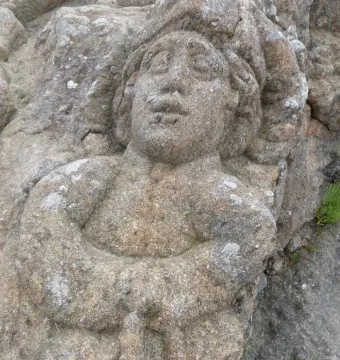
July 2018 © Thérèse Gaigé · CC BY-SA 4.0
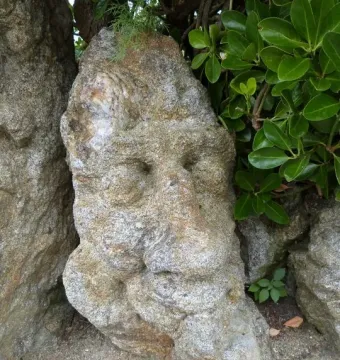
July 2018 © Thérèse Gaigé · CC BY-SA 4.0
Identification | |
| Title | Rochers sculptés de Rothéneuf |
| Original-language name | rochers sculptés de Rothéneuf |
| Type | sculpted rock ensemble |
| Alternative name | The stone ghosts |
Historical context | |
| Art movement | art brut |
| Creation period | late 1894 to 1907 |
| Historical period | late 19th century to early 20th century |
Creator | |
| Creator | Abbé Adolphe Julien Fouéré (Abbé Fouré) |
| Creator's lifespan | 1839–1910 |
| Artist's occupation | Former priest |
| Artist's condition | After a stroke in 1893, he became almost completely deaf-mute; in 1907 he was struck by paralysis and speech difficulty |
Discovery and provenance | |
| Sources of knowledge | Seminary studies and newspapers such as Le Salut and L’Ouest-Éclair |
| Historical trigger | He left his post as rector at Langouët in 1894 and retired to Rothéneuf |
| Inspiration | Likely local legends about the pirate family of Rothéneuf, combined with his knowledge of history and geography; also inspired by the shapes of the rocks and by walks along the beaches |
Physical characteristics | |
| Location | Rothéneuf, Saint-Malo, Ille-et-Vilaine, Brittany, France |
| Site setting | A group of granite rocks overlooking the sea |
| Area | About 500 m² |
| Figures | More than 300 figures |
Materials | |
| Material | Granite rock |
Technique | |
| Carving method | Directly cut into the rocks |
| Surface treatment | Originally polychrome; some figures had features outlined in tar |
| Environmental exposure | Open-air work exposed to marine erosion |
Appearance | |
| Style | Some figures are shown in comic situations |
| Subjects represented | Animals, monsters, devils, and various kinds of people |
| People depicted | Pirates, smugglers, fishermen, sailors, peasants, carpenters, clowns, warriors, and others |
| Forms represented | Figures range from bas-relief to fully detached faces |
Iconography and meaning | |
| Themes | Historical, colonial, religious, legendary, political, mythological, and everyday scenes and figures |
| Religious themes | Scenes largely inspired by the life of Saint Budoc, with Breton saints such as Saint Budoc and Saint Yves |
| Historical references | Scenes and figures related to contemporary events and history-geography knowledge, including the Boer War with President Krüger and Colonel de Villebois-Mareuil |
| Colonial theme | Colonial subjects of the period, possibly as propaganda for the evangelization of peoples conquered by France |
| Other subjects | Gargantua, Mother Michel and her cat, Andrea the charmer, an oyster seller, and others |
| Geographic references | Scenes evoking China, Russia, and Japan |
| Internal division | The scenes are divided into two chapters: Paradise and Hell |
| Jacques Cartier | A preferred theme of Abbé Fouré, represented in the rocks and in wood in the nearby hermitage |
Location and ownership | |
| Heritage status | Not listed or registered as a historic monument |
| Public access | Private site; paid admission |
| Location | Rothéneuf, Saint-Malo, France |
History and restoration | |
| Condition | Increasingly eroded by salt, wind, water spray and runoff, mosses, lichens, and repeated visitor traffic; a 2012 inspection reportedly judged the state of preservation poor |
| Risk forecast | In 2010, Jean Jéhan warned that without action the sculptures might no longer be recognizable within a few decades |
Significance | |
| Notability | Among the best known in Brittany |
Other | |
| Associated chapel | A chapel on site is dedicated to Saint Budoc |
| Associated works | Fouré also created numerous wooden sculptures in his house in Rothéneuf, known as Haute Folie, Hermitage de Rothéneuf, Maison de l'Ermite, and later Musée Bois; these works later disappeared |
| Wooden sculpture museum layout | Visitors passed a crenellated enclosure wall guarded by a dragon and laughing heads, then saw galleries called 'infernal' and 'mystic' among other works |
| Wooden sculpture subjects | Totems, political figures, saints, mythological figures, and animals |
| Wooden sculpture style | Usually interpreted from forms perceived in the raw material, with naïve captions |
| Wooden sculpture documentation | Old postcards and period photographs document the now-disappeared museum, the hermitage, Abbé Fouré, and his sculptures |
| Burial place | Rothéneuf cemetery |