
Equestrian statue of Francisco Pizarro
The Equestrian statue of Francisco Pizarro is a work by the American sculptor Charles Cary Rumsey (1879–1922). It now stands on a granite pedestal in the main square of Trujillo, the city where Pizarro was born, though this was not its original location. The statue was first shown at the 1929 Spring Painting and Sculpture exhibition at the Grand Palais in Paris, where Rumsey was honored with a retrospective after his recent death. Because of its large size, it was displayed in the dome hall, which had not been used to exhibit art for thirty years. Later in 1929, it was taken to Spain and inaugurated in Trujillo in the presence of Miguel Primo de Rivera, Prince Alfonso of Orleans, and the U.S. ambassador to Spain.
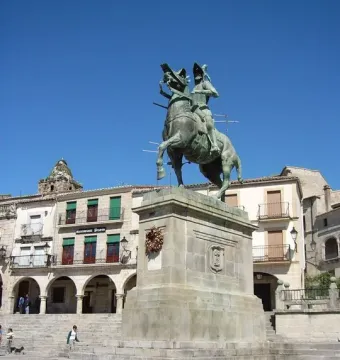
© Manuel González Olaechea · CC BY 3.0
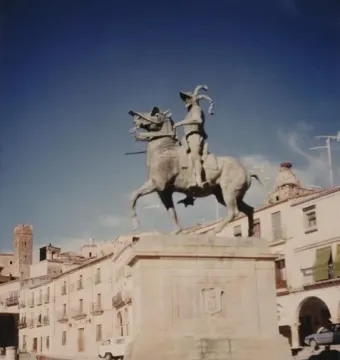
© Gordito1869 · CC BY 3.0
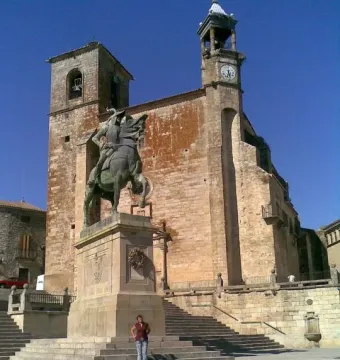
August 2008 © Congouno · CC BY-SA 3.0 es
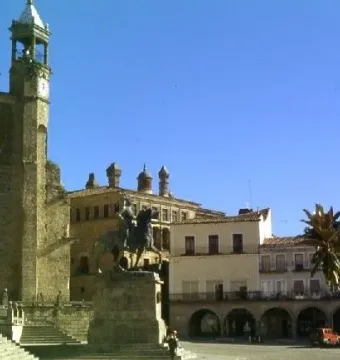
© Rafaelji · CC BY-SA 3.0
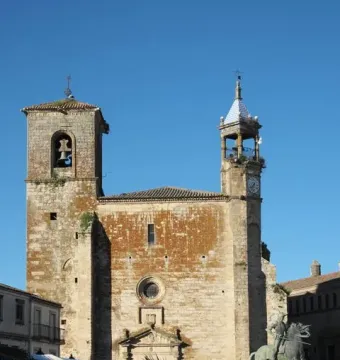
April 2016 © GFreihalter · CC BY-SA 3.0
Creator | |
| Sculptor | Charles Cary Rumsey |
| Sculptor nationality | American |
| Sculptor lifespan | 1879-1922 |
Materials | |
| Pedestal material | Granite |
Location and ownership | |
| Current location | Trujillo, Spain |
| Pedestal location | Main square (Plaza Mayor) of Trujillo, the city where Francisco Pizarro was born |
History and restoration | |
| Original exhibition | Spring Exhibition of Painting and Sculpture at the Grand Palais, Paris |
| Year first exhibited | 1929 |
| Exhibition context | The 1929 Grand Palais exhibition paid extensive tribute to the recently deceased Rumsey with a retrospective of his work |
| Exhibition placement | Placed in the Grand Palais dome hall, which had not been used to exhibit works for thirty years because of the sculpture's colossal size |
| Moved to Spain | In 1929, the statue traveled to Spain to take up its current location in Trujillo |
| Date of inauguration in Trujillo | 1929 |
| Inauguration attendees | Miguel Primo de Rivera; Prince Alfonso of Orleans; the then-United States ambassador to Spain |
Iconography and meaning | |
| Horse-rider posture interpretation | A raised front leg in an equestrian statue means the person died from battle wounds |
| Interpretation applies to Pizarro | Francisco Pizarro did not die from battle wounds |