
Japanese American Memorial to Patriotism During World War II
Japanese American Memorial to Patriotism During World War II is a national memorial in Washington, D.C., honoring the loyalty, courage, heroism, and sacrifice of Japanese Americans during World War II, despite the internment of Japanese American citizens. It stands northwest of the United States Capitol on a triangular site bounded by Louisiana and New Jersey Avenues NW and D Street NW. The memorial was initiated in 1988 by the Go For Broke National Veterans Association Foundation, later the National Japanese American Memorial Foundation, and authorized by federal law in 1992. The site was transferred to the National Park Service in 1996, the memorial was dedicated in 2000, and ownership passed to the federal government in 2002. Its centerpiece is a bronze crane entangled in barbed wire by Nina Akamu, along with a bell, a water feature, and inscriptions by Japanese American writers and journalists.
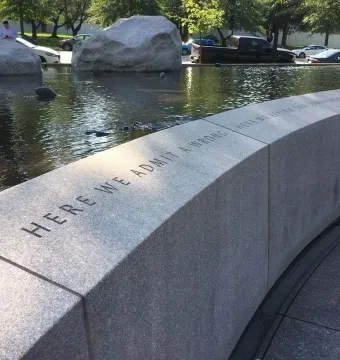
© NPS Photo · Public domain
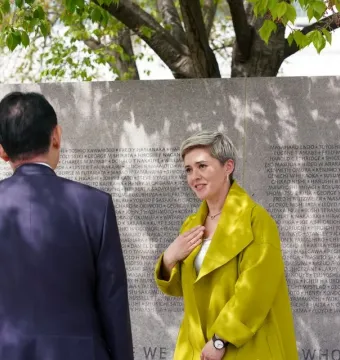
April 2024 © U.S. Department of the Interior · Public domain
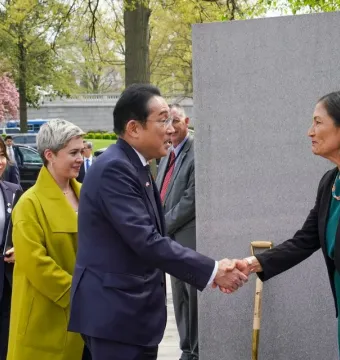
April 2024 © U.S. Department of the Interior · Public domain
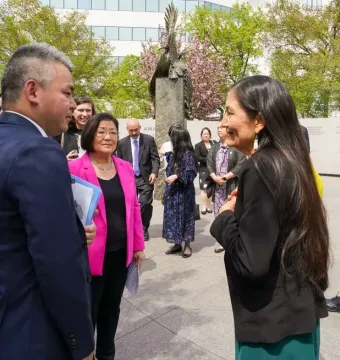
April 2024 © U.S. Department of the Interior · Public domain
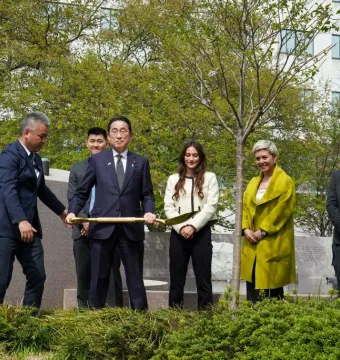
April 2024 © U.S. Department of the Interior · Public domain
Identification | |
| Title | Japanese American Memorial to Patriotism During World War II |
| Type | National memorial |
| Memorial status | National memorial |
| Alternative name | Zenbei Nikkei Beikokujin Kinenhi |
Location and ownership | |
| Ownership transferred to | The United States Government |
| Panel content 1 | The names of Japanese Americans who died fighting in World War II |
| Panel content 2 | Inscribed writings by Japanese American writers such as Bill Hosokawa |
| Panel content 3 | Quotes by presidents Harry S. Truman and Ronald Reagan |
| Honor Wall inscription | Lists the names of the 800-plus Japanese Americans in the U.S. Armed Forces who died in service during World War II |
| Wall inscriptions | The names of the ten major internment camps where over 120,000 Japanese Americans were confined |
| Maintenance responsibility | National Park Service |
| Ownership transfer year | 2002 |
| Included inscriptions | Writings by American writers and journalists of Japanese descent, such as Bill Hosokawa |
| Position in city | Northwest of the United States Capitol |
| Setting | Landscaped plaza |
| Location | Washington, D.C., United States |
| Site boundaries | A triangular plot bounded by Louisiana Avenue NW, New Jersey Avenue NW, and D Street NW |
| Site area | 3100 m2 |
Historical context | |
| Recognition purpose | Recognition of dedicated service during World War II |
| Army official cited | Chief of Staff of the Army General Raymond T. Odierno |
| Legislation mentioned | President Barack Obama signed legislation to grant the Congressional Gold Medal, collectively, to the 100th Infantry Battalion and 442nd Regimental Combat Team |
| Legislation date mentioned | October 5, 2010 |
| Quotation from Deputy Secretary of Defense | He noted that one of the great ironies of World War II was that Japanese Americans of the 522nd Field Artillery Battalion were among the first Allied troops to liberate several sub-camps of the Dachau concentration camp complex, while some of them had family members kept in internment camps in the United States |
| People mentioned at dedication | Deputy Secretary of Defense Rudy de Leon; United States Attorney General Janet Reno; President Bill Clinton (via a letter read by Reno) |
| Inaugurated | 2000 |
| Attendance at dedication | An estimated 2,000 people attended |
| Dedication description | Described by the U.S. Department of Defense as occurring in drizzling rain mixed with tears streaming down the faces of Japanese American World War II heroes and those who spent the war years imprisoned in isolated internment camps |
| Preparation by sculptor Nina Akamu | Traveled to the International Crane Foundation in Baraboo, Wisconsin, where she studied and sketched the cranes used for the memorial's centerpiece |
| Letter from President Bill Clinton | We are diminished when any American is targeted unfairly because of his or her heritage. This memorial and the internment sites are powerful reminders that stereotyping, discrimination, hatred and racism have no place in this country |
| Military unit mentioned | 522nd Field Artillery Battalion |
| Groundbreaking date | October 22, 1999 |
| Related historical event | Liberation of several sub-camps of the Dachau concentration camp complex by Japanese American troops |
| Project initiated in | 1988 |
| Authorized by | Federal law PL 102-502 |
| Approved by | President George H. W. Bush |
| Approval date | 24 October 1992 |
| Land transferred to National Park Service | 1996, by the Architect of the Capitol |
| Completion celebration date | June 29, 2001 |
| Dedication date | November 9, 2000 |
| Internment reference | More than 120,000 men, women, and children were put in desolate internment camps in the United States during World War II |
Creator | |
| Artist connection to memorial location | The erection of a Japanese American war memorial near her home in Massa, Italy inspired a strong connection to the memorial and its creation |
| Artist personal connection to location | Akamu grew up for a time in Hawaii and fished with her father at Pearl Harbor |
| Artist family connection to internment history | Akamu's grandfather on her mother's side was arrested in Hawaii during the internment program, sent to a relocation camp on Sand Island in Pearl Harbor, and died of a heart attack three months into his imprisonment after suffering from diabetes |
| Artist role | Former vice president of the National Sculpture Society |
| Artist nationality/ethnicity | Third-generation Japanese American |
| Principal designers | Architect Davis Buckley and sculptor Nina Akamu |
| Sculptor | Nina Akamu |
Discovery and provenance | |
| Organization later renamed | National Japanese American Memorial Foundation (NJAMF) |
| Concept initiated | 1988 |
| Project initiated by | "Go For Broke" National Veterans Association Foundation (later renamed National Japanese American Memorial Foundation, NJAMF) |
Physical characteristics | |
| Honor Wall | Central within the memorial |
| Additional panels | Three panels |
| Additional elements | A bell modeled after a Japanese temple bell and a kare-san-sui water basin with boulders representing the Japanese islands |
| Pedestal surface detail | Incised with grooves suggestive of drill cores used to extract stone from quarries |
| Pedestal shape | Tall, square pedestal |
| Central sculpture name | Golden Cranes |
| Central sculpture | Bronze sculpture of two Japanese cranes caught in barbed wire |
| Associated wall | A semi-circular granite wall curves around the sculpture |
Materials | |
| Central sculpture material | Cast bronze |
Appearance | |
| Cranes' posture | One wing points upwards and the other downwards, mirroring each other |
| Interaction of the cranes | Press their bodies against one another and seem to hold onto the barbed wire |
| Cranes | Rise above the rest of the memorial and are visible from beyond the memorial walls |
Iconography and meaning | |
| Hawaii confinement statistic | Of the nearly 160,000 citizens of Japanese descent living in Hawaii, fewer than 2,000 were confined |
| Additional memorial meaning | Reminds viewers of battles fought to overcome ignorance and prejudice and the meaning of an integrated culture, once pained and torn, now healed and unified |
| Depicted subject | Two Grus japonensis birds caught in barbed wire |
| Centerpiece feature | Cranes |
| Symbolic meaning of the cranes | Celebrate the ability to rise beyond limitations |
| Cranes' symbolic meaning | Represent the duality of the universe |
| Interpretation of the cranes' interaction | Shows individual effort to escape restraint together with the need for communal support and interdependence |
| Symbolic scope of the memorial | Symbolic not only of the Japanese American experience, but also of the extrication of anyone from deeply painful and restrictive circumstances |
| Broader presentation of the Japanese American experience | Presented as a symbol for all peoples |
| Historical reference | Over 120,000 Japanese Americans were confined in the ten major internment camps |
| Themes | Patriotism, loyalty, heroism, sacrifice, discrimination, stereotyping, hatred, racism, and remembrance of internment |
| Purpose | Honors the loyalty and courage of Japanese Americans during World War II and commemorates their heroism and sacrifice despite the internment of Japanese Americans |
| Commemorates | Japanese American war involvement, veterans, and patriotism during World War II |
| Also commemorates | The patriotism and endurance of those held in Japanese American internment, incarceration camps, and detention centers |
| Historical focus | Japanese American military service during World War II |
| Subject honored | Japanese American veterans who served in the 100th Infantry Battalion, the 442nd RCT, the Military Intelligence Service, and other units |
| Related unit | 100th/442nd Regimental Combat Team |
| Related unit distinction | Most decorated unit of the war for its size and length of service |
Significance | |
| Memorial context | The sculpture became the center feature of the Japanese American Memorial to Patriotism During World War II |