
1.26
1.26 is a public-art sculpture by Janet Echelman made from high-strength nets for the first American biennial in Denver in July 2010. The work copies a three-dimensional model of a tsunami in the Pacific Ocean created by NOAA after a powerful earthquake in Chile. That earthquake increased the planet’s rotation speed and shortened the length of the day by 1.26 milliseconds, which gave the sculpture its name. Echelman was inspired to create the piece after reading a NASA Jet Propulsion Laboratory announcement about the earthquake and then studying NOAA’s tsunami model. The sculpture was created as a monument reflecting the connections between 35 countries in the Western Hemisphere.
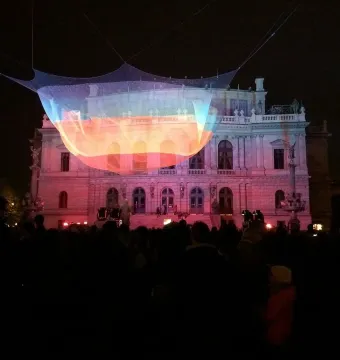
October 2015 © Shadster · CC BY-SA 4.0
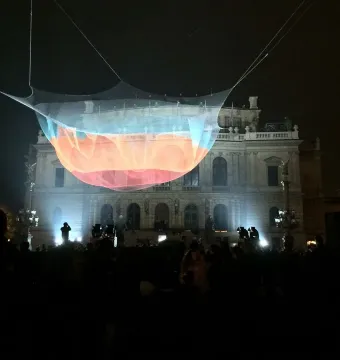
October 2015 © Shadster · CC BY-SA 4.0
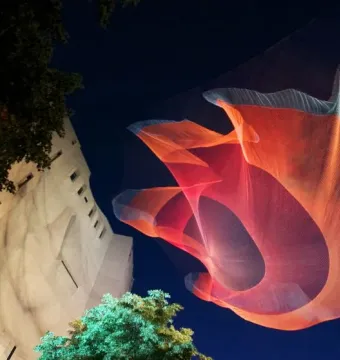
July 2010 © Janet Echelman · CC BY-SA 2.0
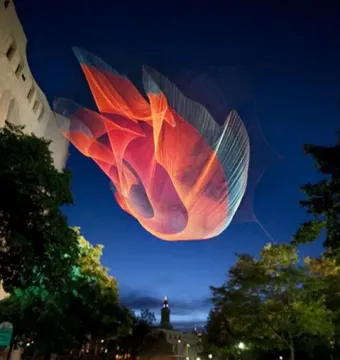
July 2010 © jechelman · CC BY-SA 2.0
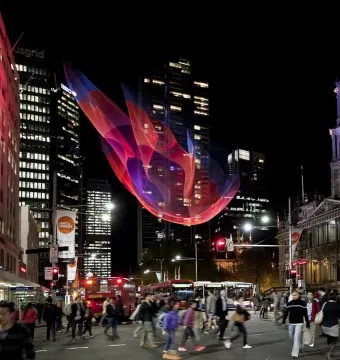
2011 © Marinco Kojdanovski, Studio Echelman · CC BY-SA 4.0
Identification | |
| Title | 1.26 |
| Title | Earthtime 1.8 |
| Type | net sculpture |
| Title | Earthtime 1.8 Renwick |
| Design name | Earthtime 1.78 |
| Type | sculpture |
| Type | large aerial net sculpture |
Creator | |
| Artist | Janet Echelman |
| Artist | Janet Echelman |
History and restoration | |
| Created for | the City of Denver's Biennial of the Americas celebration, the first American biennial in Denver |
| Commissioned by | Denver Art Association |
| Commissioning context | requested by the city as a large, temporary work |
| Date created | July 2010 |
| Intended effect | to make the space more interactive |
| Created for | the reopening of the Renwick Gallery in Washington, D.C. after a two-year renovation |
| Commissioned by | Smithsonian American Art Museum |
Location and ownership | |
| Installation method | tethered to existing architecture |
| Location | Denver, United States |
Materials | |
| Material | high-strength nets |
Physical characteristics | |
| Form basis | a three-dimensional NOAA tsunami model created after the February 2010 Chile earthquake |
| Behavior | undulates in the wind and weather |
| Transportability | can be transported and installed for exhibitions |
| Lighting | colored light is projected onto the sculpture at night |
| Public interaction | the viewing public can alter the projected light via a smartphone app |
| Type | public art |
| Appearance | a three-dimensional model of a tsunami in the Pacific Ocean |
Iconography and meaning | |
| Title meaning | the title refers to the shortening of the day by 1.8 millionths of a second |
| Title meaning | the title refers to the period, in microseconds, that the day was shortened by the 2011 Tōhoku earthquake and tsunami |
| Theme | interconnectedness of the 35 nations of the Western Hemisphere |
| Title meaning | the title refers to the 1.26-millisecond shortening of the day caused by the increase in Earth's rotation speed after the February 2010 Chile earthquake |
Historical context | |
| Geographic reference | the Pacific Ocean |
| Event referenced in inspiration | the Tōhoku earthquake and tsunami that rippled across the Pacific Ocean toward Japan |
| Inspiration | data recorded after the Tōhoku earthquake and tsunami |
| Basis of design | scientific data |
| Year created | 2015 |
| Scientific event referenced | the Tōhoku earthquake and tsunami |
| Earthquake effect | it increased Earth's rotation speed by 1.26 milliseconds |
| Event origin | Japan |
| Referenced event | the 2011 Tōhoku earthquake and tsunami |
| Inspirational basis | data sets of the tsunami's wave height rippling across the Pacific Ocean |
| Associated event | the February 2010 Chile earthquake |
| Geologic effect described | the event shifted the Earth on its axis and shortened the day by 1.8 millionths of a second |