
Leopold II Equestrian Statue
The Leopold II Equestrian Statue is a monument erected in 1926 near the Royal Palace of Brussels in memory of King Leopold II, the second King of the Belgians. The work was created by sculptor Thomas Vinçotte in 1914 and completed in 1926 by architect François Malfait, when it was also inaugurated in honor of the king. Decades later, the statue became the subject of controversy because Leopold II is now chiefly associated with Belgian colonial history and the Congo Free State, over which he exercised de facto sovereignty from 1885 to 1908. The monument’s presence in central Brussels has since sparked debate.
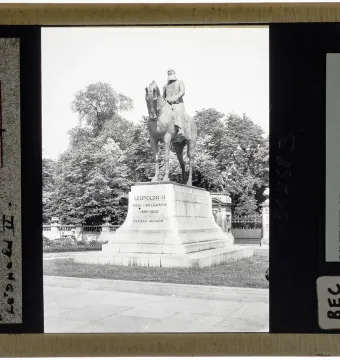
© Vinçotte, Thomas (artist) · Public domain
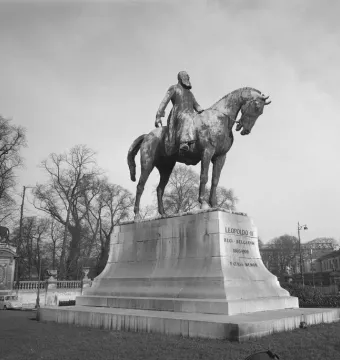
January 1957 © Nationaal Archief · CC0
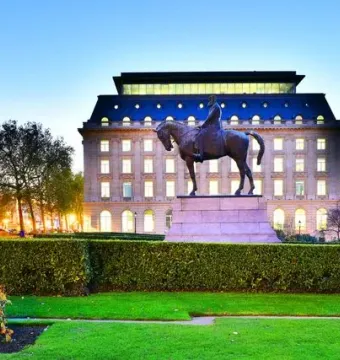
November 2017 © Edison McCullen · CC BY-SA 4.0
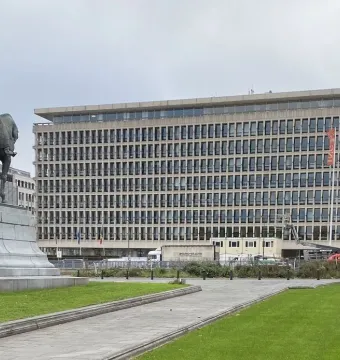
October 2023 © Boubloub · CC BY-SA 4.0
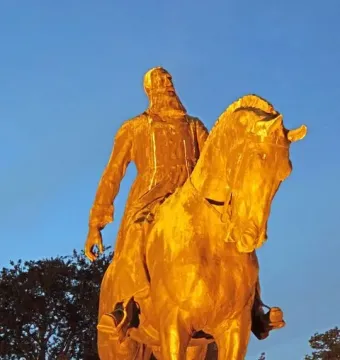
© Dennis G. Jarvis · CC BY-SA 2.0
Identification | |
| Title | Equestrian statue of Leopold II |
| Type | Bronze equestrian statue |
| Subject | Leopold II, King of the Belgians |
Location and ownership | |
| Placement design | Planned by François Malfait so the monument would be centrally placed in a frame of balanced size, well oriented to light, and surrounded by vegetation |
| Nearby area | Near Matongé, the African district of Brussels, in Ixelles |
| Location | Place du Trône, Brussels, Belgium, southeast of the Royal Palace of Brussels, near the junction of Rue Ducale and Boulevard du Régent (Small Ring), a few dozen metres from the Royal Stables of Brussels |
Historical context | |
| Initiative | Launched by the Belgian authorities in 1914 |
| Purpose | Erected in memory of Leopold II and in his honour, to praise him as a builder-king and colonizer and express national gratitude |
| Fundraising | The Belgian state collected more than 625,000 Belgian francs through a public appeal published on 31 May 1914 in Le Moniteur belge and the press; support came from King Albert I, aristocrats, the military, colonial companies, some citizens, and the king himself |
| Colonial context | Leopold II exercised de facto sovereignty over the Congo Free State from 1885 to 1908 |
| Replica | An exact replica exists in the outskirts of Kinshasa; it was later moved to the presidential park of Mont-Ngaliema, near statues of Albert II and Henry Stanley |
| Delay in completion | Delayed by the First World War; work resumed after the war |
Creator | |
| Sculptor | Thomas Vinçotte |
| Architect | François Malfait |
| Foundry | Compagnie des Bronzes de Bruxelles |
| Material supplier | Union Minière du Haut-Katanga, which supplied the raw material |
Physical characteristics | |
| Plaque | A small bronze plaque on the back of the base, about 20 cm long, states that the copper and tin came from the Belgian Congo and were supplied free of charge by Union Minière du Haut-Katanga |
| Signature | Signed by Thomas Vinçotte |
| Pedestal shape | Rectangular-section pedestal |
| Inscription | The east face of the pedestal bears a Latin dedication: "LEOPOLDO II / REGI BELGARUM / 1865–1909 / PATRIA MEMOR" |
| Pedestal material | Blue stone blocks |
| Material | Bronze |
Appearance | |
| Depiction | Leopold II on horseback |
| Style | Clean, simplified style, avoiding an overly massive, ugly, or allegorical effect |
| Horse treatment | The horse was treated in a Greek style and criticized for lacking naturalism |
| Bust treatment | The bust was reproduced exactly from an earlier bust by Thomas Vinçotte |
History and restoration | |
| Pedestal date | The pedestal displays the date of construction |
| Replica history | The replica was inaugurated by King Albert II in front of the Palace of the Nation in Kinshasa, reappeared on Boulevard du 30-Juin in 2010, and was knocked down again after 24 hours |
| Removal petition | In June 2020, a petition for removal was signed more than 45,000 times within several days |
| Vandalism and protest | The statue has repeatedly been vandalised or defaced with red and white paint, inscriptions, tarps, and other actions; Théophile de Giraud smeared it with red paint in 2008, and activists later tried to cover it with black tarps |
| Restoration note | The monument was redesigned and finalized after the First World War |
| Designer credit on pedestal | François Malfait is named on the pedestal as its designer |
| Creation date | 1914 |
| Construction notes | Vinçotte interrupted work several times because of illness and exhaustion; he was old, and he died after finishing the monument |
| Site selection | Place du Trône was chosen because Leopold II had given many speeches there and it was near the place where he swore his oath; the site was approved by the Royal Commission for Monuments and Sites |
| Inauguration attendees | The Belgian royal family and the authorities, arriving in procession |
| Inauguration occasion | The feast day of the dynasty and the patronal feast of Leopold II |
| Inauguration date | 15 November 1926 |
| Finalization date | 1926 |
| Completion date | 1925 |
Discovery and provenance | |
| Source of metal | Copper and tin from the Belgian Congo |
| Supplier of metal | Union Minière du Haut-Katanga |
| Original commission and funding appeal | The Belgian authorities launched the project in 1914, with an appeal for donations published on 31 May 1914 |
Significance | |
| Controversy | Its presence in central Brussels has become increasingly controversial because Leopold II is now mainly associated with Belgian colonial history and the Congo Free State |
| Criticism | The statue has been criticized as an emblem of Leopold II's colonial policy and Belgian colonial crimes |
| Political response | A majority in the Brussels Parliament wants to recontextualise or remove all Leopold II statues in Brussels, including this one |
| Urban significance | Because it is close to Brussels's African Quarter, the statue is a focal point in debates about Belgian colonial memory and part of the city's architectural heritage |
| Broader context | The statue is discussed within wider global debates over colonial monuments, including defacements and removals of statues, place names, signs, and folklore |