
Diana the Huntress Fountain
Diana the Huntress Fountain is a sculpture in Mexico City, located in the roundabout at the intersection of Paseo de la Reforma and Río Misisipí and Sevilla streets. It sits on the border of the Colonia Cuauhtémoc and Colonia Juárez neighborhoods. Designed by Italian architect and sculptor Enrique Alciati, the fountain was unveiled in 1942. Its centerpiece is a bronze statue of Diana, the Roman goddess of the hunt, standing atop a stone pedestal. Nearby skyscrapers include the Corporativo Reforma Diana, also known as Torre Reforma Diana, and Torre Diana.
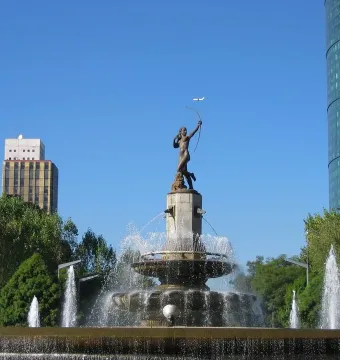
November 2004 © * CliNKer * · CC BY-SA 2.0
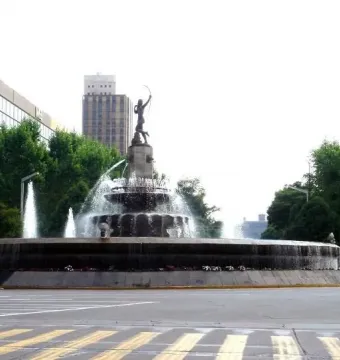
May 2010 © Jorge Láscar · CC BY 2.0
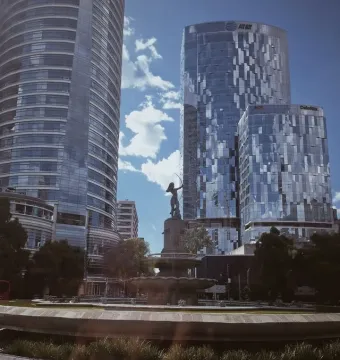
August 2025 © Danoneqfb · CC BY-SA 4.0
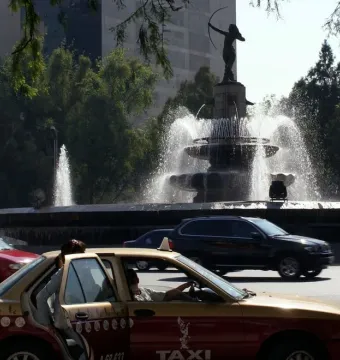
© Carl Campbell · CC BY-SA 2.0
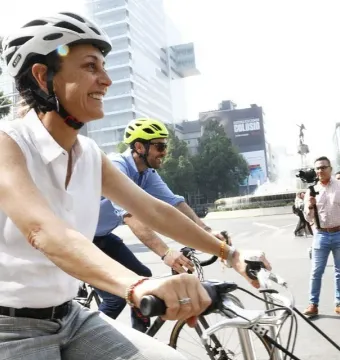
April 2019 © Gobierno de la Ciudad de México · CC BY 4.0
Identification | |
| Title | The Huntress Diana Fountain |
| Type | Monumental fountain and sculpture |
| Spanish name | Fuente de la Diana Cazadora |
| Popular name | La Diana Cazadora |
| Original name | La Flechadora de las Estrellas del Norte |
Historical context | |
| Purpose | Public-space beautification |
| Historical context | Part of beautification projects carried out by Mexico City authorities between the 1930s and 1960s, in tune with the mural movement and the aesthetic influence of socialist realism |
Creator | |
| Sculptor occupation | Sculptor |
| Commissioned by | President Manuel Ávila Camacho through Javier Rojo Gómez, regent of the Federal District |
| Commissioned for | A fountain for the roundabout on Paseo de la Reforma near the entrance to Chapultepec Forest |
| Sculptor | Juan Fernando Olaguíbel |
| Designer occupation | Architect |
| Designer | Vicente Mendiola Quezada |
Creation and unveiling | |
| Unveiled | 10 October 1942 |
| Inaugurated by | President Manuel Ávila Camacho |
| Creation period | April to September 1942 |
Discovery and provenance | |
| Model | Helvia Martínez Verdayes |
| Model age | 16 years old |
| Model occupation | Secretary in the offices of Petróleos Mexicanos |
| Model relationship to Vicente Mendiola | She worked in an office directed by Vicente Mendiola, a friend of the sculptor |
| Modeling arrangement | She posed nude for the sculptor without pay, on condition that her identity remain anonymous |
| Model identified | 1992 |
| Model later recognition | She received recognition from the Mexican Senate and the Government of Mexico City in 2016 |
Physical characteristics | |
| Pedestal | Stone pedestal |
| Weight | About two tons |
Materials | |
| Material | Bronze |
Appearance | |
| Depicts | Diana, the Roman goddess of the hunt, identified with Artemis in Greek mythology |
Iconography and meaning | |
| Iconography | Instead of hunting animals, Diana points her arrow toward the stars of the northern sky |
| Name origin | Named after Diana, referring to shooting the stars |
Location and ownership | |
| Current location | Intersection of Paseo de la Reforma with Río Mississippi and Sevilla streets, Mexico City |
| Original intended location | The roundabout on Paseo de la Reforma near the entrance to Chapultepec Park, Mexico City |
| Nearby landmarks | Corporativo Reforma Diana (also known as Torre Reforma Diana) and Torre Diana |
| Relocation history | Removed in 1974 because of construction of the Circuito Interior, stored for two years, moved in 1976 beside the former Chapultepec cinema in Jardín Ródano or Parque del Ariel, and moved in 1992 to its current site, replacing the Fuente del Cutzamala (popularly known as "Las regaderas") |
| Current status | It has remained at its current site since 1992 |
History and restoration | |
| Restoration consequence | The statue was damaged during the removal, and a new flawless piece was cast to replace it |
| Damaged piece location | Donated to Ixmiquilpan, Hidalgo, the regent's hometown, where it has remained since 1970 |
| Damaged removed piece | Sold by the artist to the regent to prevent destruction |
| Censorship incident | In 1943 the Liga de la Decencia demanded censorship and the Mexico City government ordered a bronze loincloth to be added |
| Nudity restored | In 1967 the bronze loincloth was removed and the statue returned to its original appearance |
| Earthquake damage | The monument suffered damage in the 1957 earthquake |
| Censorship detail | Juan Olaguíbel attached the bronze loincloth with only three solder points so it could be removed later |
| Controversy | Criticized by ultra-conservative sectors of Mexican society |
Significance | |
| Film appearance | Appeared in a 1967 scene of Los caifanes by Juan Ibáñez |
| Symbolic arrow landing point | A wall on Paseo de la Reforma between the Salón Corona restaurant and a movie theater complex, marked with a metal arrow and commemorative plaque |
| Commemorative plaque text | "Se creía perdida y sólo estaba escondida, reservando su buena suerte a quien su deseo aquí pida" |
| Claim source | According to México Desconocido; repeated by various media |