
Alexander Nevsky’s Reliquary
Alexander Nevsky’s reliquary is a monumental 18th-century work of Russian decorative and applied art in the Baroque style. Made of silver weighing 1.5 tons, it was created during the reign of Empress Elizabeth Petrovna for the relics of Alexander Nevsky. The complex also includes a smaller wooden reliquary covered with silver, made in the reigns of Ivan V and Peter I. It is said to be the only monument of its kind in the world made from high-grade silver. From the 18th century it stood in the Trinity Cathedral of the Alexander Nevsky Lavra, and in 1922 it was removed to the State Hermitage. On 8 September 2023, the large silver reliquary and the inner wooden ark were transferred back to the Alexander Nevsky Lavra on a 49-year temporary, free-use agreement.
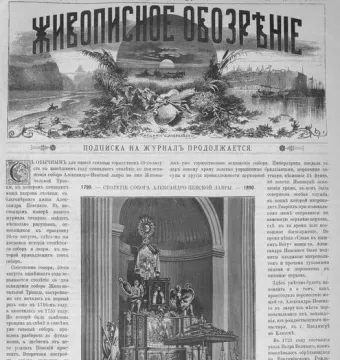
© Журнал «Живописное обозрѣнiе странъ свѣта» (1872—1900,1902—1905) / Живописное обозрение стран света [Zhivopisnoye obozreniye stran sveta (Foreign Lands' Pictorial Review)]; Российская национальная библиотека (РНБ); kmv20120 · Public domain
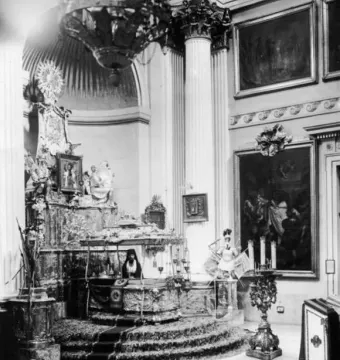
© Unknown authorUnknown author · Public domain
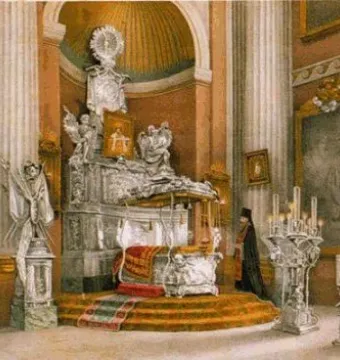
1890 © Кочетова О.А. · Public domain
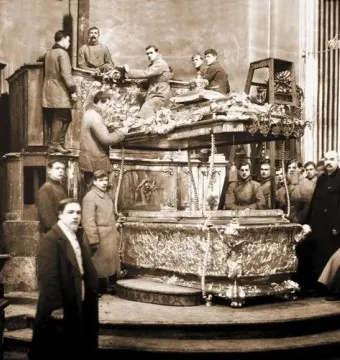
1922 © К. Булла · Public domain
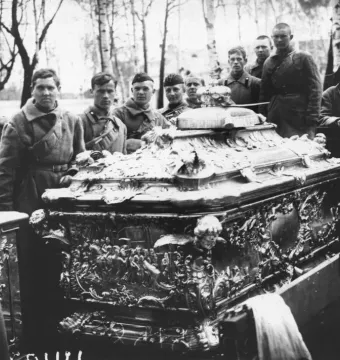
1922 © Виктор Булла · Public domain
Identification | |
| Name | Alexander Nevsky's reliquary |
| Alternative names | Alexander Nevsky shrine; memorial complex of the shrine of Alexander Nevsky |
| Type | Memorial complex; reliquary; tomb monument (raka) for the relics of Saint Alexander Nevsky |
| Art form | Russian decorative and applied art |
| Full name | Memorial complex of the reliquary of Alexander Nevsky |
Historical context | |
| Century | 18th century |
| Style | Elizabethan Baroque; the earlier wooden reliquary is also described as Moscow Baroque |
| Purpose | For the relics of Alexander Nevsky |
| Created during the reign of | Empress Elizabeth Petrovna |
| Uniqueness | Described as the only monumental structure made of high-grade silver in the world; also called a unique monument of the Elizabethan Baroque period |
Creator | |
| Supervision | Official supervision by Ivan Andreyevich Shlyater, with overall direction by Baron Ivan Antonovich Cherkasov |
| Craftsmen | Foreign silversmiths, Russian chasers, and masters from the Sestroretsk Arms Factory and the Saint Petersburg Mint; named makers include Erik Apelrot, Samuel Zilgershtein, Lorenzo Zilgershtein, Georg Berg, Johann Okman, Herman Jann, Mark Brener, Peter Less, Karl Dahlberg, Friedrich Hemikins, Karl Friedrich Vesgren, Georg Koyn, Friedrich Remers, Ivan Evlampiev, Demid Mikhailov, Pyotr Andreyev, Gavriil Plotnikov, Andrey Afanasyev, Erofey Eremeev, Vasily Ponomarev, Andrey Popov, and Ivan Sobolev |
| Bas-relief sketches by | Jakob Stehlin |
| Wooden model by | Ivan Shtalmeier |
| Design by | Court artist Georg Christoph Grooth |
Discovery and provenance | |
| Transfer of relics to new shrine | In 1697 Metropolitan Hilarion of Suzdal transferred the relics into a new silver-gilded reliquary |
| Completion date | 30 August 1753 |
| Silver source | Silver was melted at the Saint Petersburg Mint; additional silver came from the Kolyvan factories |
| Design tradition | Follows the tradition of monumental architectonic reliquaries said to have come to Russia from Catholic countries |
| Placement after relocation | After the transfer, the relics were placed in a new silver reliquary commissioned under Elizabeth Petrovna |
| Relocation to Saint Petersburg | The relics were transferred from Vladimir to Saint Petersburg in 1723–1724 |
| Early inner reliquary | A small wooden reliquary lined or decorated with silver, made during the reigns of Ivan V and Peter I |
| Original shrine makers | A Moscow master artisan from the Armory and a goldsmith from Vladimir |
| Reason for restoration | The shrine had to be restored after the fires of 1681 and 1689 |
| Original shrine historical note | Mentioned as made under Peter I and Ivan V and blessed by Patriarch Adrian in 1695 |
| Original shrine inscription | A silver-gilded reliquary inscription beginning, 'In this silver-gilded reliquary are placed the holy relics of the blessed Prince Alexander Yaroslavich...' |
| Original shrine side decorations | Five large gilded copper medallions with inscriptions about the prince's military deeds and episodes from his life |
| Original shrine ornament | Chased floral motifs including sunflowers, lilies, and tulips |
| Original shrine material | Wooden chest/ark with a large wooden icon, a silver plaque, and gilded copper plates |
| Original shrine location | Nativity Monastery in Vladimir |
| Original shrine date | 1695 |
Physical characteristics | |
| Central relief | Bas-relief of Alexander Nevsky holding a banner in the middle of the second tier |
| Decorative inscriptions | One inscription on the angels' shields dates the transfer of Alexander Nevsky's remains to 1724 |
| Southern decoration | The southern side of the sarcophagus has a medallion with an epitaph by M. V. Lomonosov |
| Side reliefs | The sides of the sarcophagus have thematic reliefs depicting the main events of his life |
| Upper figures | Two seated angels are placed on the upper corners of the pyramid |
| Composition | The pyramidal three-tiered headpiece dominates the monument |
| Overall form | A monumental multi-tiered pyramid resembling an architectural structure |
| Weight of silver used | About 90 poods of 82-grade silver |
| Weight of each angel | 10 poods 36 pounds |
| Weight | 89 poods, 22 pounds, and 1 1/3 zolotniks |
| Number of parts | 7 parts |
Materials | |
| Main material | Silver |
| Additional materials | Wood, gilded copper, and precious cloth |
Technique | |
| Decoration technique | High repoussé and chased ornamentation |
| Surface treatment | Some parts were remade and others cleaned of patina |
Appearance | |
| Stylistic features | Asymmetric forms, almost no straight horizontal lines, and a combination of architectural and sculptural motifs |
| Craftsmanship | Finely cast details with luxurious decoration |
| Contemporary reputation at creation | Considered from its creation to be a marvel of the young Russian capital |
Location and ownership | |
| Display conditions | Kept without additional vitrines or kiosks; special climate and engineering equipment maintains temperature and humidity |
| Returned by | The Hermitage |
| Current location | Church of Alexander Nevsky on the second floor of the Annunciation Church of the Alexander Nevsky Lavra |
| Returned to | Alexander Nevsky Lavra |
| Loan terms | Transferred by the Hermitage to the Lavra for gratuitous temporary use for 49 years |
| Returned on | 8 September 2023 |
| Relics transferred to | Museum of Religion and Atheism in Kazan Cathedral |
| 1922 storage location | State Hermitage Museum, Concert Hall |
| Removed in | 1922 |
| 18th-century location | Trinity Cathedral of the Alexander Nevsky Lavra |
History and restoration | |
| Copy estimate | The Hermitage estimated the copy would cost about 330 million rubles |
| Copy project | A project to make an exact silver copy for display at both the Hermitage and the Lavra was launched in the 2000s, but the copy was never made because funding was not found |
| Contract award | The contractor was selected in December 2013 |
| Restoration method | Mechanical cleaning of the wooden base, strengthening joints with fish glue, repairing cracks with similar wood, matching silver overlays, filling fixing holes, and making new holes to avoid stress on the silver overlays |
| 2013 restoration tender | In November 2013 the Hermitage sought a contractor to restore the small reliquary; the starting maximum state contract price was more than 16.5 million rubles |
| 2012 restoration details | Two flanking compositions were restored in 2012 |
| Restoration in the 2010s | The Hermitage began restoration in 2012 using laser metal-restoration equipment; restoration of the pyramid had been ongoing since late 2019 and was expected to finish no earlier than 2024 |
| World War II evacuation | Evacuated with museum valuables to Sverdlovsk in 10 crates |
| Return after the war | Returned to Leningrad in 1949, restored, and exhibited in the Hermitage Concert Hall |
| 1930 threat | In 1930 the reliquary again came under threat of destruction, but the Hermitage preserved it |
| Outcome of 1922 case | The case was closed; in October 1922 it was decided to confiscate the relics despite a petition signed by more than 1,500 believers |
| 1922 expertise | Georgy Shor's team concluded the bones were human and ancient; Alexander Zakharyin and historians Nikolai Nikolsky and Ivan Bychkov supported the note's authenticity |
| Findings in 1922 | A note dated 30 May 1681, about 85 mm × 57 mm, was found inside; it stated that Alexander Nevsky's relics were saved from fire |
| Opening in 1922 | The reliquary was opened on 12 May 1922 at noon in a public, documented operation |
| Placement in Trinity Cathedral | In 1790 the reliquary was transferred to the Trinity Cathedral and placed behind the right choir screen |
| Gift from Catherine II | In 1768 she gave a costly gold hanging lamp and a covering with an image of Alexander Nevsky and a diamond insignia of the order named after him |
Significance | |
| Art-historical importance | An important monument in the history of 18th-century Russian art and a famous example of memorial architecture/sculpture where Baroque reached its apogee |
| Historical reputation | A distinctive landmark and unique of its kind; described by 18th-century travelers and 19th-century historians |
| Religious subject | Relics of Saint Alexander Nevsky, canonized in 1547 |
Other | |
| Associated earlier shrine | The original 1695 shrine and the smaller wooden reliquary are the same earlier container made after the fires of 1681 and 1689 |