
Guards Memorial
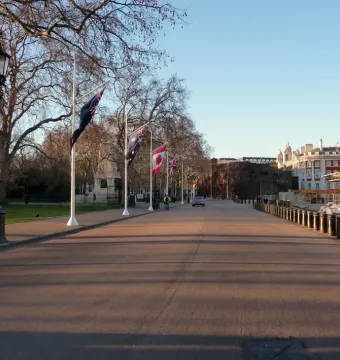
Guards Memorial is an open war memorial on the west side of Horse Guards Road, opposite Horse Guards Parade in London. Designed by Harold Chalton Bradshaw, it commemorates soldiers of the Guards Division and related units who served in the First World War, as well as Home Forces units during the Second World War and later conflicts from 1918 onward. The monument is a broad, low obelisk of white Portland stone set on a stepped base. On the east side stand five bronze soldier statues by Gilbert Ledward, one for each Foot Guards regiment, with bronze panels on the other sides showing military equipment and artillery in action. The inscriptions include a verse by Rudyard Kipling.
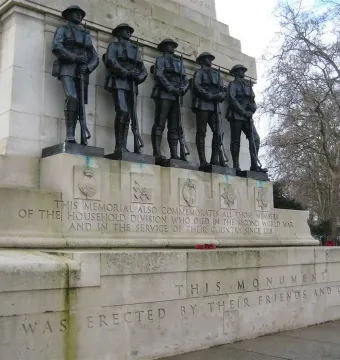
February 2010 © Carlos Menendez San Juan · CC BY-SA 2.0
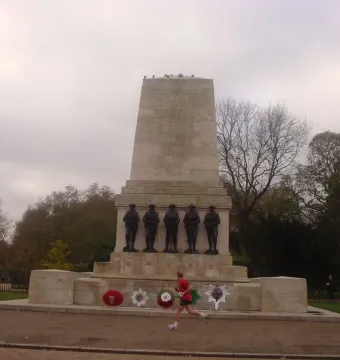
November 2008 © Lemur12 · CC BY-SA 3.0
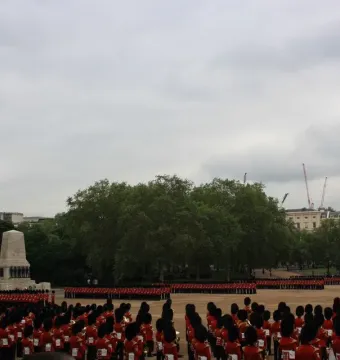
June 2012 © Richard Symonds · CC BY 3.0
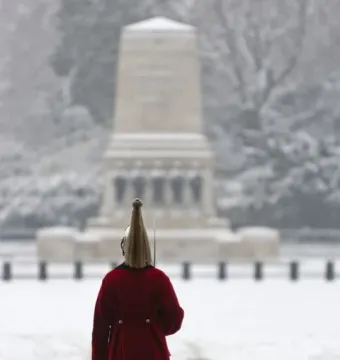
January 2010 © Harland Quarrington · OGL v1.0
March 2010 © Lewis Clarke · CC BY-SA 2.0
Identification | |
| Title | Guards Memorial |
| Alternative title | War Memorial of the Guards Division; Guards Division War Memorial |
| Type | open-air war memorial; cenotaph memorial |
Location and ownership | |
| Location | West side of Horse Guards Road, opposite Horse Guards Parade, London, United Kingdom |
Historical context | |
| Commemorated groups | Guards Division and related units; Household Division; British Army Home Forces units |
| Conflicts commemorated | World War I; World War II; other conflicts since 1918 |
| Historical period commemorated in original inscription | Great War, 1914–1918; service in France and Belgium, 1915–1918 |
| Later commemorative inscription | After World War II, an inscription was added to commemorate members of the Household Division who died in the Second World War and in the service of their country since 1918 |
Creator | |
| Inscription author | Rudyard Kipling |
| Sculptor of bronze figures | Gilbert Ledward |
| Designer | H. Chalton Bradshaw |
Discovery and provenance | |
| Built by | the Birmingham Guild |
| Construction cost | around £22,000 |
Materials | |
| Main material | White Portland stone |
| Bronze material source | Bronze taken from German guns melted down after the First World War |
| Foundry | William Morris Art Bronze Foundry |
Physical characteristics | |
| Bronze panel subjects | Two side panels depict military equipment; the rear panel depicts artillery in action |
| Bronze panels | Three bronze panels on the other three sides of the cenotaph |
| Bronze statue models | Serving guardsmen: Sergeant R. Bradshaw MM of the Grenadier Guards; Lance Corporal J. S. Richardson of the Coldstream Guards; Guardsman J. McDonald of the Scots Guards; Guardsman Simon McCarthy of the Irish Guards, with legs modeled by Lance Sergeant W. J. Kidd; and Guardsman A. Comley of the Welsh Guards |
| Bronze statue placement | On a raised platform on the east side of the memorial, facing Horse Guards Parade |
| Bronze statue pose | Standing easy with rifles in hand |
| Bronze statue subject | One soldier representing each of the Foot Guards regiments |
| Base | White stone base with three steps |
| Height | 38 feet (12 m) |
| Bronze statues | Five bronze soldier figures, each slightly larger than life size |
Appearance | |
| Main form | A broad squat white Portland stone obelisk |
| Decorative motif above inscription | An incised cross between bands of horizontal incised lines |
| Side inscriptions | Further inscriptions on the sides record the units involved; the west side has a cross and records the battle honours |
Inscription | |
| Military units named in inscription | Foot Guards; Household Cavalry; Royal Regiment of Artillery; Corps of Royal Engineers; Royal Army Service Corps; Royal Medical Corps; other units serving with the Guards Division |
| Places named in inscription | France; Belgium |
| Secondary inscription | This monument was erected by their friends and comrades. |
| Main inscription text | To the Glory of God and in the memory of the officers, warrant officers, non-commissioned officers and guardsmen of His Majesty's Regiments of Foot Guards who gave their lives for their King and Country during the Great War 1914–1918, and of the officers, warrant officers, non-commissioned officers and men of the Household Cavalry, Royal Regiment of Artillery, Corps of Royal Engineers, Royal Army Service Corps, Royal Medical Corps and other units who, while serving the Guards Division in France and Belgium 1915–1918, fell with them in the fight for the World's Freedom. |
History and restoration | |
| Unveiled by | Field Marshal Prince Arthur, Duke of Connaught and Strathearn |
| Unveiling date | 16 October 1926 |
| Unveiling ceremony | Included General Sir George Higginson, a 100-year-old veteran of the Crimean War, and a march-past by 15,000 serving and former guardsmen |
| Dedication by | Reverend H. J. Fleming, senior chaplain of the Guards Division when it was formed in 1915 |
| Blessing by | Reverend Alfred Jarvis, Chaplain-General of the Armed Forces |
| War damage | Damaged by bombs during the Second World War |
| Post-war condition | Some bomb damage was left unrestored, described as 'honourable scars' |
| Heritage designation | Grade II listed in 1970; upgraded to Grade I in October 2014 |
Significance | |
| Reason for Kipling's connection | His only son John was killed in action while serving in the Irish Guards at the Battle of Loos in September 1915 |