
Running Fence
Running Fence was an installation art piece by Christo and Jeanne-Claude, completed in California on September 10, 1976. First conceived in 1972, the project took more than four years to plan and build, and it was removed 14 days after installation, leaving no visible trace. The work consisted of a veiled fence extending across the hills of Sonoma and Marin counties in northern California. It was made of heavy woven white nylon fabric hung from steel cables and supported by steel poles, guy wires, and earth anchors, without any concrete. The route crossed roads and private ranch land before reaching the Pacific Ocean south of Bodega Bay.
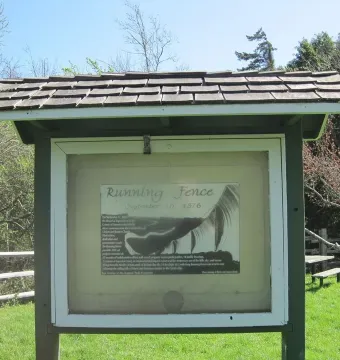
March 2011 © CrabTree13 · CC BY-SA 3.0
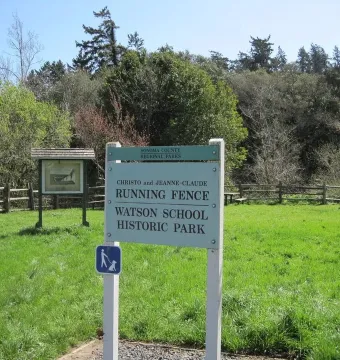
March 2011 © CrabTree13 · CC BY-SA 3.0
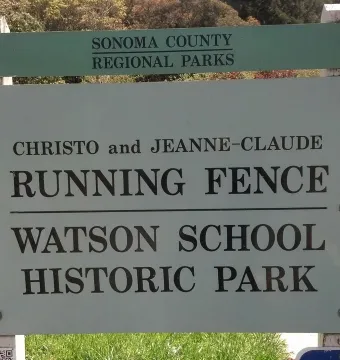
April 2013 © Cullen328 · CC BY-SA 3.0
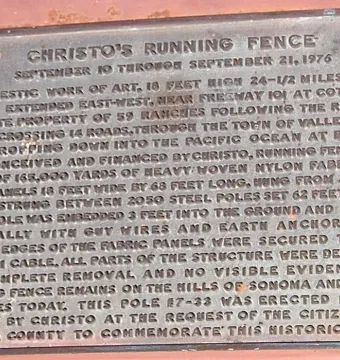
October 2008 © Stepheng3 · Public domain
October 2023 © DemocracyAwarenessProject · CC BY-SA 4.0
Identification | |
| Title | Running Fence |
| Type | installation art piece |
Creator | |
| Artists | Christo and Jeanne-Claude |
Historical context | |
| First conceived | 1972 |
| Original concept title | Curtains for West Berlin |
| Original purpose | to block the view of the Berlin Wall |
| Possible inspiration | fences demarcating the Continental Divide in Colorado |
Discovery and provenance | |
| Surveyed by | Jeanne-Claude and Christo |
| Survey year | 1973 |
Location and ownership | |
| Largest remaining intact and continuous section | hangs below the ceiling of the Rio Theater in Monte Rio, California |
| Designated landmark | Valley Ford site (pole #7-33) designated as Sonoma County History Landmark #24 in December 1976 |
| Historic markers | commemorated by historic markers at Watson School near Bodega, California, and at State Route 1 in Valley Ford, California |
| Alternative location surveyed | Harmony, California |
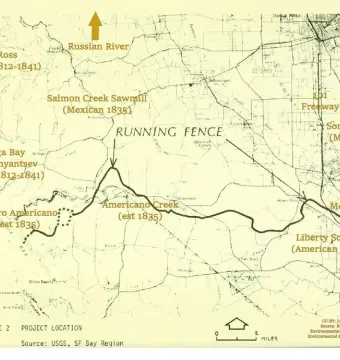
| Ocean entry point | entered the Pacific Ocean about midway between the Estero Americano and the Estero de San Antonio in northwestern Marin County |
| Route | began near U.S. Highway 101 and crossed 14 roads and the private property of 59 ranchers to reach the Pacific Ocean south of Bodega Bay |
| Location | across the hills of Sonoma and Marin counties in northern California, United States |
| Relocation | relocated to rural Sonoma and Marin Counties just south of the historic Russian settlements of Fort Ross and Port Rumyantsev at Bodega Bay in the Mexican bulwark of Rancho Americano |
Physical characteristics | |
| Form | veiled fence |
| Length | 24.5 miles |
| Height | 5.80 m |
| Number of panels | 2,050 |
| Number of poles | 2,050 |
| Number of hooks | 350,000 |
| Pole dimensions | each steel pole was 6.4 meters long and 9 centimeters in diameter |
| Pole embedding depth | 1 meter into the ground |
Materials | |
| Construction method | nylon panels hung from steel cables with 350,000 hooks |
| Main materials | heavy woven white nylon fabric panels, steel poles, steel cables, steel guy wires, and earth anchors |
| Cable length | 145 kilometers (90 miles) of steel cable |
| Fabric quantity | 200,000 square meters (2,222,222 square feet) of white nylon fabric |
History and restoration | |
| Project outcome | completed |
| Public appreciation | some people appreciated the beauty of the work |
| Protesters | several Californians, including Expressionist painter Byron Randall |
| Local response | ranged from excitement to resentment and active protest |
| Reasons for protest | land infringement and lack of artistic merit |
| After removal | left no visible trace |
| Installation duration | 14 days |
| Installation date | September 10, 1976 |
| Funding | all expenses were paid by Christo and Jeanne-Claude through the sale of studies, preparatory drawings and collages, scale models, and original lithographs |
| Construction requirements | required 42 months of collaborative efforts, 18 public hearings, 3 sessions at the Superior Courts of California, and a 450-page Environmental Impact Report |
| Planning and construction period | more than four years |
Significance | |
| Artist statement | Christo said he considered Running Fence to encompass its social, legal, and technical dimensions |
| Documentary film | Running Fence (1978), directed by Albert and David Maysles |
| Exhibition | Christo and Jeanne-Claude: Remembering the Running Fence |
| Exhibition venue | Smithsonian American Art Museum |
| Exhibition dates | April 1, 2010 through September 25, 2010 |
| Exhibition contents | over 350 archival and related works and photographs |
| Visitor interaction | visitors could touch the actual nylon fabric panels and steel poles from the original work |
| Museum exhibit | The Charles M. Schulz Museum in Santa Rosa has a permanent exhibit on Christo featuring a portion of fabric from the Running Fence |
| Reference in Peanuts | Schulz's Peanuts comic strip featured Christo's art and the Running Fence in 1978 |
| Historic features noted along the course | Russian, Mexican, and American historic features |