
Monument to Karl Marx in Ulyanovsk
The Monument to Karl Marx in Ulyanovsk was opened on 7 November 1921, though planning began in 1918 as part of Soviet monument policy. The sculptural project was created by Sergey Merkurov, with architectural design by Vladimir Shchuko. The figure, made of black granite, rises from a black column on a four-sided gray granite pedestal. It stands 8.5 meters high and reflects the image of Marx as a powerful force supporting humanity. The monument has been moved several times within the city and has stood near Gymnasium No. 1 since April 1986. It is located at Karazina Lane, in a square, and is recognized as a federal cultural heritage site.
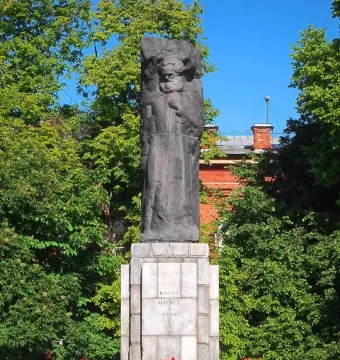
June 2018 © Сергей С. Петров · CC BY-SA 4.0
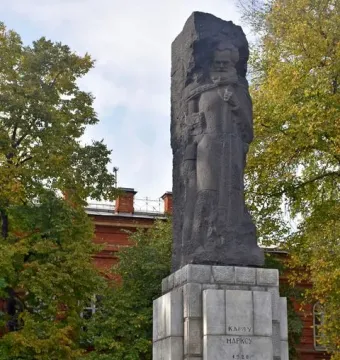
September 2015 © Vadimgimov · CC BY-SA 4.0
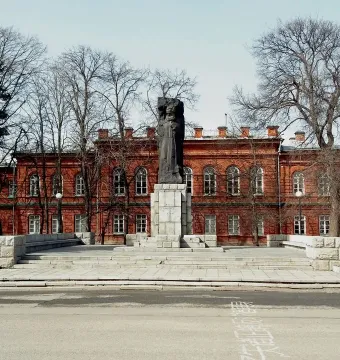
April 2023 © Sergey M R · CC BY-SA 4.0
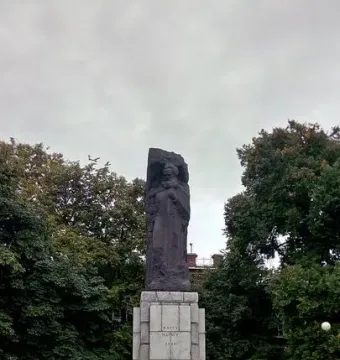
August 2015 © Derzotanich · CC BY-SA 4.0
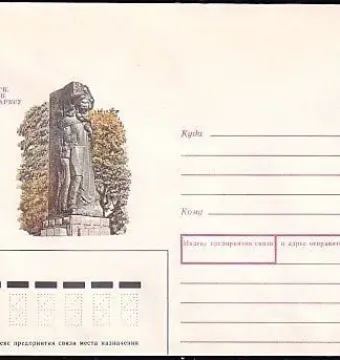
1990 © USSR Post · Public domain
Identification | |
| Title | Monument to Karl Marx in Ulyanovsk |
| Type | Monument |
| Alternative title | Monument to Karl Marx |
Iconography and meaning | |
| Stylistic interpretation | The sculptor is believed to have used the myth of Atlas supporting the vault of the universe; Marx is shown as bearing the burden of humanity's world problems |
| Depicted person | Karl Marx |
| Subject significance | Founder of the communist movement |
Historical context | |
| Commissioning and planning context | Initiated in autumn 1918 by I. M. Vareikis, chairman of the Simbirsk provincial committee of the RCP(b), as part of the Soviet plan of monumental propaganda for Simbirsk; on 30 July 1918 a list of 66 names for proposed monuments was approved, including Karl Marx; on 12 April 1918 the Council of People's Commissars of the RSFSR adopted the decree "On Monuments of the Republic" calling for removal of monuments to tsars and erection of new monuments |
Creator | |
| Sculptor | S. D. Merkurov |
| Architect | V. A. Shchuko |
Discovery and provenance | |
| Figure delivery date | The figure for the pedestal was delivered to Simbirsk in May 1921 |
| Former nearby square name | Karl Marx Square |
| Planned completion | Initially intended to be installed by the end of 1920 |
| Original installation site | Former Nikolaevsky Garden in Simbirsk (later Ulyanovsk) |
| Initial temporary monument | A plaster statue painted to imitate bronze, installed on 12 November 1918 on the pedestal of the uncompleted Alexander II monument on Goncharovskaya Street (renamed Karl Marx Street at the time) |
History and restoration | |
| Heritage register entry | Registered in the Unified State Register of Cultural Heritage Objects of the Peoples of the Russian Federation by order of the Ministry of Culture of the Russian Federation of 15 October 2015 No. 8879-r, number 731410065810006 |
| Heritage designation basis | Resolution of the Council of Ministers of the RSFSR of 30 August 1960 No. 1327, "On Further Improvement of the Protection of Cultural Monuments in the RSFSR" |
| Landscaping after 1969 rotation | A Karl Marx Garden was laid out around it in April 1969 according to a design by Shafransky, Timofey Potapovich |
| Reason for 1985–1986 relocations | The monument lay on the projected esplanade for the Lenin Memorial; the 1985 central location was later judged very unsuccessful |
| Reason for 1969 rotation | It had previously stood sideways to people walking along the esplanade |
| Relocation history | In April 1969 it was rotated 90 degrees to face east; in summer 1985 it was moved to the center of the esplanade; in April 1986 it was moved next to Gymnasium No. 1, where it remains |
| Labor used in pedestal installation | Prisoners from a concentration camp located in the closed Spassky Monastery were used to install the stone pedestal; one of them was the clergyman Alexander Pavlovich Smirnov |
| Opening date | 7 November 1921 |
Physical characteristics | |
| Height | 8.5 metres including the sculpture |
| Construction | The thinker’s figure is made of black granite and was assembled from separate blocks because no single block of stone was available |
Materials | |
| Pedestal material | Gray granite |
| Sculpture material | Black granite |
Appearance | |
| Inscriptions | Front: "Karl Marx 1920"; back: Karl Marx's words: "Ideas, once they seize the masses, become the greatest driving victorious force" |
| Form description | A black column rises from a four-sided pedestal of gray granite, with the figure of Karl Marx emerging from the column |
Location and ownership | |
| Current location | Next to Gymnasium No. 1, on Karazina Lane, in a square, Ulyanovsk, Russia |
| Heritage status | Object of cultural heritage of federal significance |