
Fontaine Le Lion de Monzon
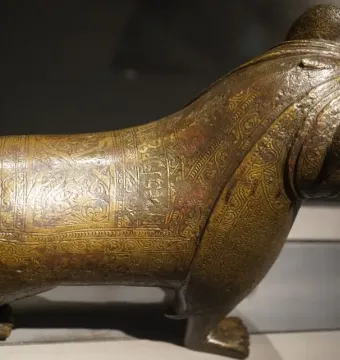
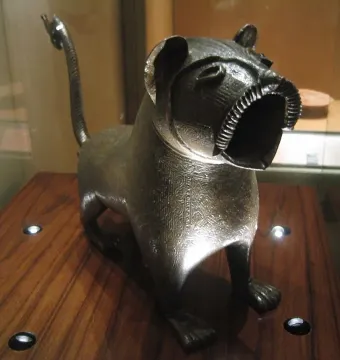
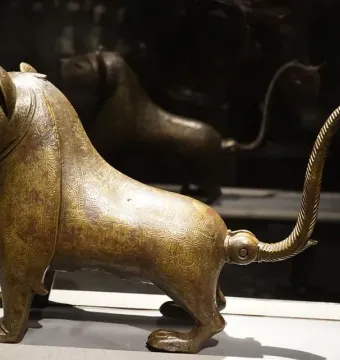
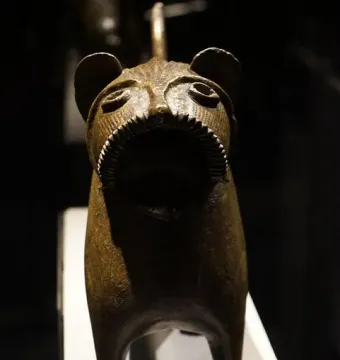
Fontaine Le Lion de Monzon is an Islamic bronze object in the shape of a lion, decorated with engraved ornament. It is now considered to have been an automaton piece and was made in southern Andalusia, probably in Córdoba, between the late 10th and 11th centuries. Its exact date has been much debated, with proposals ranging from the Fatimid period to the 11th century. Based on epigraphy and comparisons with other objects, recent studies support an Andalusian origin and a Cordoban workshop. The sculpture is currently preserved in the Department of Islamic Arts at the Louvre, inventory number OA 7883.
January 2016 © G.Garitan · CC BY-SA 4.0
© Unknown artistUnknown artist · GFDL 1.2
January 2016 © G.Garitan · CC BY-SA 4.0
January 2016 © G.Garitan · CC BY-SA 4.0
August 2022 © Faqscl · CC BY-SA 4.0
Identification | |
| Title | Fontaine Le Lion de Monzon |
| Alternative name | Lion dit "de Monzon" |
| Object type | Lion sculpture / fountain element |
| Subject | Lion |
Historical context | |
| Dating | Made in Córdoba between the late 10th century and the early 11th century |
| Earlier proposed date | Various proposals placed it in the 9th or 10th century, the 10th or 11th century, the 11th or 12th century, or more broadly the Fatimid period |
| Origin attribution | Spain, now considered certain; a Fatimid origin was once proposed but is no longer accepted |
| Current interpretation | Now considered to have been a clock automaton |
| Earlier interpretation | Formerly considered to be a fountain spout |
Creator | |
| Treatise title | Kitāb al-asrār fī natā'ij al-afkār (The Book of Secrets Resulting from Thoughts) |
| Treatise author | Al-Muradi |
Discovery and provenance | |
| Later owner | Purchased by Eugène Piot after the Fortuny sale |
| Depictions | Depicted in a lithograph by Francisco Contreras around 1870, in a painting of Fortuny's studio by Ricardo de Madrazo in 1874, and in a photograph of the same studio in Barcelona |
| Early scholarship | Charles Davillier produced a monograph prepared for the sale of the Fortuny collection |
| Early scholarship | José Amador de los Ríos published a first study in 1874 without having seen the piece |
| Exhibition history | Shown in a 1992 exhibition in New York and Granada with a 9th- or 10th-century dating label |
| Exhibition history | Presented in Munich in 1910 as originating in Spain and dated to the 10th or 11th century |
| Exhibition history | Acquired by Eugène Piot for display at the 1878 Universal Exhibition in Paris, in the eastern gallery of the Trocadéro, intended to display works from private collections |
| Entry into the Louvre | After Ernesta Stern's death in 1926, the piece entered the Louvre collection |
| Bequest to the Louvre | Louis Stern made a bequest to the Louvre before his death in 1900 |
| Later owner | Purchased by Louis Stern after Piot's collection was auctioned in 1890 |
| Exhibition history | Lent by Ernesta Stern for the 1903 Exhibition of Muslim Art at the Musée des Arts décoratifs in Paris, directed by Gaston Migeon and Raymond Koechlin |
| Auction sale | After Fortuny's death, the collection was dispersed at Hôtel Drouot in Paris in April 1875 |
| Sale | Sold to Mariano Fortuni y Marsal in 1872 |
| Attempted sale | Offered unsuccessfully to the National Archaeological Museum of Madrid |
| Transfer | Moved to Valladolid |
| Early ownership / acquisition | Acquired by Miguel Jalón, 10th Marquess of Castrofuerte, owner of the land where it was found; another account mentions a pharmacist from Valladolid as an early intermediary |
| Current location of associated object | National Archaeological Museum of Madrid |
| Relationship to associated object | The lion and the associated object were initially found together and then quickly separated |
| Associated object | A metal mortar, later identified as a receptacle, found together with the lion; it has twelve chamfered sides and comparable style |
| Historical context of discovery place | Monzón de Campos was briefly part of al-Andalus, though its inhabitants did not convert to Islam; another account says the region was never under Islamic rule |
| Discovery circumstances | According to the most probable hypothesis, it was found in the countryside by peasants in a hiding place of the destroyed castle of Monzón de Campos; another version says it was found in a field |
| Discovery date | 1849 |
| Discovery place | Monzón de Campos, Province of Palencia, Spain |
Physical characteristics | |
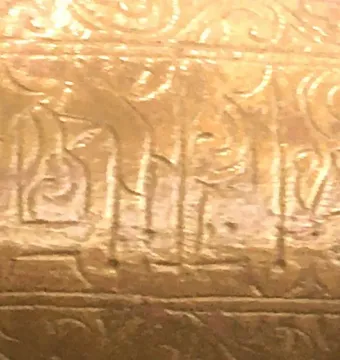
| Calligraphic features | Ligatures extend in half-circles below the writing line; some letter endings have a swan-neck form |
| Inscription style | Flowered Kufic script |
| Inscription placement | 'Perfect blessing' on the right flank, 'Complete happiness' on the left flank, repeated on the back in two parts |
| Inscription | Baraka kamila / Ni'ma shamila ('Perfect blessing' / 'Complete happiness') |
| Tail | Flowered, striped, articulated, and nearly as long as the body |
| Surface decoration | Engraved decoration covering the body with motifs, palmettes, epigraphic inscriptions, and birds |
| Belly | Perforated with a large opening |
| Mouth | Open |
| Pose | Standing on its hind legs |
| Shape | Lion sculpture |
Materials | |
| Material | Bronze |
| Associated object material | Metal |
Technique | |
| Manufacturing technique | Lost-wax casting |
| Stylistic associations | A characteristic style of al-Andalus |
| Comparative features | Compared with the Griffin of Pisa and other metal figures from Medina Azahara in Córdoba for similarities in formulae, fur treatment, technique, ocelli and fleurons bands, and punch marks |
Location and ownership | |
| Current location | Department of Islamic Arts, Louvre Museum |
| Inventory number | OA 7883 |
Significance | |
| Scholarly conclusion | The object was made in Córdoba between the late 10th century and the early 11th century, and Spanish origin was definitively confirmed by Manuel Gómez Moreno's work |
| Dating debate | French historians have argued for a 9th- or 10th-century date, while Claire Déléry supported that dating in 2018 on epigraphic grounds; other scholars supported a Fatimid or 11th- to 12th-century dating |
| Automaton evidence | Al-Muradi's treatise describes automata of animals that mark the hours, making a clock-automaton interpretation plausible; Gwenaëlle Fellinger argued against a fountain-spout function and considered the articulated tail significant for the automaton hypothesis |