
Court of Neptune Fountain
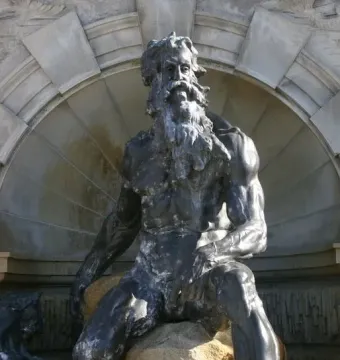
Court of Neptune Fountain is a granite semi-circular fountain adorned with bronze sculptures made by Roland Hinton Perry and Albert Weinert in the late 1890s. Jerome Connor may have assisted in their manufacture. Completed in 1898 after three years of work, the project was designed by architects John L. Smithmeyer, Paul J. Pelz, and Edward Pearce Casey, with founding completed by the Henry-Bonnard Bronze Company. The fountain stands on the west side of the Thomas Jefferson Building, the main building of the Library of Congress in Washington, D.C. Its bronze figures include Neptune, his Tritons, and naiads, and the fountain has been cleaned and restored many times.
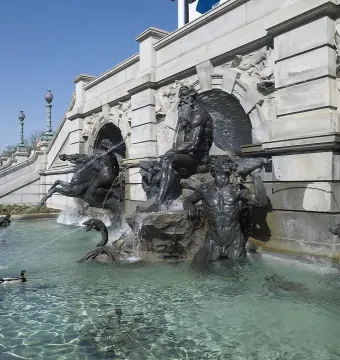
January 2007 © Carol M. Highsmith · Public domain
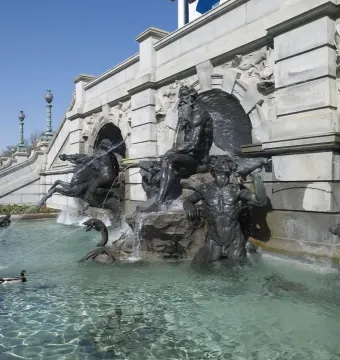
© Carol M. Highsmith · Public domain
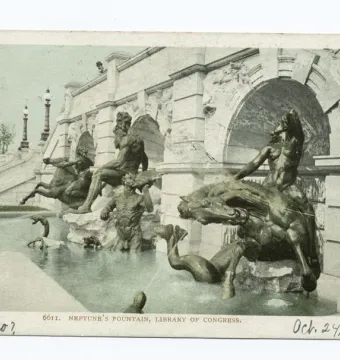
© Detroit Publishing Company · Public domain
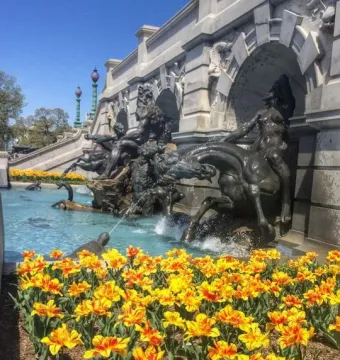
April 2014 © USCapitol · Public domain
January 2006 © David · CC BY 2.0
Identification | |
| Type | Fountain with bronze sculptures |
| Title | Court of Neptune Fountain |
Historical context | |
| Date of creation | 1897–1898 |
| Construction period | Three years |
| Completion date | February 23, 1898 |
| Historical context | Made in the late 1890s |
Creator | |
| Possible assistants or contributors | Jerome Connor may have assisted in manufacture |
| Foundry | Henry-Bonnard Bronze Company |
| Planning and commission | Perry was commissioned in 1896 to design the fountain after being commissioned in 1894 to create interior bas-reliefs for the Thomas Jefferson Building; he was chosen to design the fountain and its statues during construction of the building |
| Architects | Paul J. Pelz, John L. Smithmeyer, and Edward Pearce Casey |
| Other sculptor | Albert Weinert |
| Designer | Roland Hinton Perry |
Discovery and provenance | |
| Casting and shipment | Cast in bronze and shipped to the site piece by piece |
Location and ownership | |
| Location | In front of the west façade of the Thomas Jefferson Building, Library of Congress, Washington, D.C., facing First Street SE, with Neptune Plaza between the fountain and the main entrance |
| Associated building | Thomas Jefferson Building, Library of Congress |
| Setting | Street level |
| Building context | Installed as part of the French Renaissance main building of the Library of Congress |
| Role in the building exterior | A focal point of the exterior; it greets visitors entering the library and has been described as the Library's "doorman" |
| Historic designation | Added to the District of Columbia Inventory of Historic Sites on November 8, 1964; designated a National Historic Landmark on December 21, 1965 |
| Building significance | Contributing property to the Thomas Jefferson Building's National Historic Landmark designation |
| Related inventory listing | Listed on the District of Columbia Inventory of Historic Sites |
Physical characteristics | |
| Additional figures | Dolphins, a sea serpent, four frogs, two turtles, and sea horses |
| Heights | Neptune: 12 feet (3.7 m); Tritons: 12 feet; Naiads: approximately 10 feet (3 m) |
| Form | Granite semi-circular fountain with a semi-circular basin set into the plaza's retaining wall |
| Main sculptural figures | Neptune, Tritons, and naiads |
| Basin length | 50 feet (15 m) |
Materials | |
| Materials | Granite and bronze |
| Bronze casting | Bronze cast by Henry-Bonnard Bronze Company |
Technique | |
| Technique | Granite niches topped by bas-reliefs of stalactites and dolphins |
Appearance | |
| Neptune depiction | An older bearded man with long hair and great physical strength, seated on large rocks |
| Tritons depiction | The Tritons flank Neptune and blow conch shells, beckoning sea people |
| Sea serpent depiction | Awaiting orders from Neptune, their king |
| Water features | Water spouts from the Tritons' conch shells, the sea serpent, four frogs, and two turtles |
Iconography and meaning | |
| Inspired by | The Trevi Fountain in Rome |
| Artist statement | Perry said he tried to embody the physical joy of rushing water through Neptune and the naiads; he noted that some of this effect is lost when the fountain does not play, and that the strong movement and muscularity of the figures were intended to represent the intense activity, restlessness, and push of "our peoples" |
Significance | |
| Contemporary评价 | Upon completion, Herbert Small said the fountain was the most ornate in the United States |
History and restoration | |
| Site preparation | Construction crews began preparing the area by late 1896 |
| Restoration history | Cleaned and restored on numerous occasions; repairs have included broken concrete, water pipes, mineral buildup, stains, and masonry, and the basin was repainted in 2017 |
| Vandalism | The fountain has been vandalized; in 1998 someone removed the fig leaf covering Neptune's genitals |
| Fig leaf replacement | The fig leaf was not replaced because there were no known photographs showing its details, making it difficult to replicate, and visitors did not seem to care about the missing piece |
Other | |
| Public commentary | In 2001 artist Raymond Wiger cited the fountain's nudity in response to Senator Mitch McConnell's denial of permission to display nude artworks in the Russell Senate Office Building rotunda; he said, "It's probably the most explicit...just a block across from the U.S. Capitol." |
| Related works by designer | Commonwealth in Pennsylvania; the Thompson Elk Fountain in Oregon; the Perry Lions on the Taft Bridge in Washington, D.C. |
| Image note | Photographs show the fountain in 1899, the Neptune sculpture, the south-side naiad, the north-side naiad, and the fountain at night |