
Frieze of Parnassus
Frieze of Parnassus is a large carved stone frieze that surrounds the podium of the Albert Memorial in London. Built in the 1860s in memory of Prince Albert, it takes its name from Mount Parnassus, the mythical home of the Muses. The frieze runs for about 64 metres and includes 169 life-size figures in a mixture of low and high relief, depicting composers, architects, poets, painters, and sculptors from history. The work was intended as the “soul” of the monument and was carved in situ, a process George Gilbert Scott described as one of the most laborious sculptural undertakings ever attempted. It was completed in 1872 by Henry Hugh Armstead and John Birnie Philip.
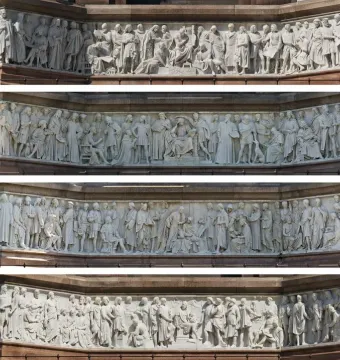
May 2008 © Diliff · CC BY-SA 3.0
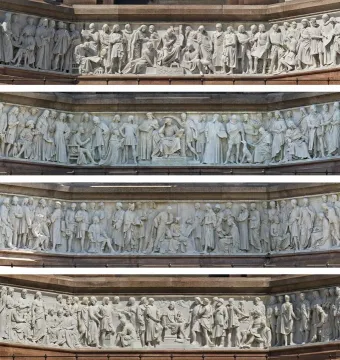
May 2008 © Diliff · CC BY-SA 3.0
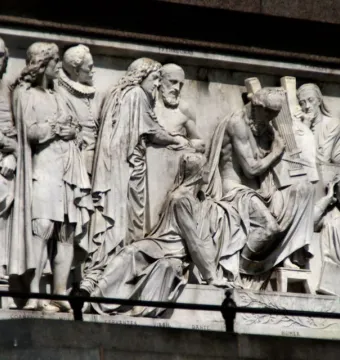
April 2017 © chrisinphilly5448 · CC BY-SA 2.0
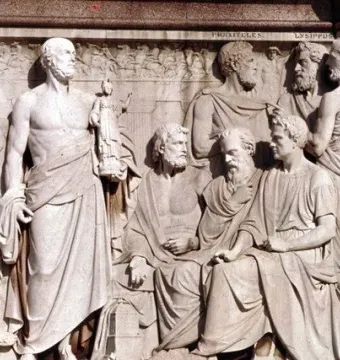
1960 © David Wright · CC BY-SA 2.0
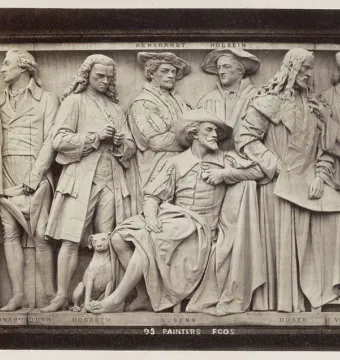
© Rijksmuseum · CC0
Identification | |
| Title | Frieze of Parnassus |
| Type | Large carved stone frieze |
| Original title | Il Fregio del Parnaso |
Historical context | |
| Associated monument | Albert Memorial |
| Monument date | Built in the 1860s |
| Dedication | In memory of Prince Albert, husband of Queen Victoria |
| Name origin | Named after Mount Parnassus, the preferred resting place of the muses in ancient Greek mythology |
| Historical context | Large groups of eminent historical figures often decorated public buildings and monuments in the late 19th century |
| Comparable monuments | Walhalla temple in Bavaria and the Panthéon in Paris |
Creator | |
| Designer inspiration | George Gilbert Scott said he was inspired by Paul Delaroche's Hémicycle des Beaux Arts |
Physical characteristics | |
| Sculptural treatment | A mixture of low-relief and high-relief |
| Length | Approximately 64 metres (210 feet) |
| Number of figures | 169 life-size full-length sculptures |
Technique | |
| Method of execution | Carved in situ |
Appearance | |
| Arrangement | Poets and musicians are on the preferred south side; sculptors and painters are on the west and east sides; architects are on the north side |
| Research basis for figures | Many figures were based on materials in a collection of artworks and drawings assembled to ensure authentic representations where possible |
| Figure treatment | The front-facing figures were necessarily imaginary |
| Specific authentic details | Phidias is depicted as bald; Homer holds a phorminx; William Hogarth's dog is shown; Paolo Veronese's hand rests on a greyhound; Daniel Auber's right arm is in a sling; William of Wykeham and Jean de Chelles hold building models; Apollodorus of Damascus holds a model of Trajan's Column; Hiram holds an object; Dibutades and Phidias hold sculptures; Ghiberti leans over a panel; Donatello and Michelangelo hold sculptures; a group to Cellini's right admires a statue |
| Historical details in depiction | Authentic details of clothing, facial hair, furniture, and accessories are rendered throughout, including scrolls, books, swords, and palettes |
| Grouping of figures | The figures are posed individually or in groups, sometimes facing one another in admiring poses or in conversation |
| Orientation within memorial | The memorial is not laid out precisely to the compass, but the sides are referred to by direction |
| Central figures | Homer for the poets, Raphael for the painters, and Michelangelo for the sculptors |
| North side subjects | Architects |
| West side subjects | Sculptors |
| East side subjects | Painters |
| South side subjects | Musicians and poets |
| Subjects depicted | Composers, architects, poets, painters, and sculptors from history |
Iconography and meaning | |
| English poets | No English poet after John Milton was included |
| Other figures on memorial but not frieze | Apelles, King Solomon, and King David are commemorated elsewhere on the Albert Memorial, on the dome mosaics, but not on the frieze |
| Reason for Nitocris | She may have been selected because she was once thought to be the pharaoh responsible for the pyramid now attributed to Menkaura |
| Female figure | Nitocris is the only female figure on the frieze |
| South side symbolism | The south side was considered the preferred side because it faces the direction toward which Prince Albert's statue looks |
| Included and omitted artists | Giulio Romano and Duccio di Buoninsegna are omitted; Botticelli and Vermeer had not yet been rediscovered; El Greco, Caravaggio, and Goya were mostly regarded with suspicion; a modern list would include Antoine Watteau and François Boucher |
| Poets' placement | Poets are placed in the center of the south side in accordance with the Victorian concept of poetry as the highest of all arts |
| Victorian interpretation | The arrangement reflects Victorian thinking: poetry is treated as the highest of the arts, the fine arts are placed on the east and west, the south side is spiritual, and the north side is material |
| Intended role in monument | Intended to be the 'soul' of the memorial |
| Paintings represented | The painters reflect a predominantly classical tradition; there is no hint of Mannerism or Rococo taste |
Location and ownership | |
| Location | Encircles the podium or base of the Albert Memorial in London, England |
History and restoration | |
| Initial contract price | £7,781 15s |
| Execution attribution | Carved by Henry Hugh Armstead and John Birnie Philip in situ |
| Scott's replacement and self-representation | Scott replaced his own statue with Pugin's and then placed himself as a relief head looking over Pugin's shoulder |
| Reason Pugin was added | Scott realized he had forgotten Pugin, whom he described as the great genius of the Victorian Gothic Revival |
| Scott's intended architect figure | Scott originally intended the last of the architects depicted in full to be himself |
| Scott's description | Perhaps one of the most laborious works of sculpture ever undertaken |
| Completion date | 1872 |
| Final cost | About £2,000 more than the contract price |
| Contract date | Around 1864 |
| Planned completion time | Four years |
| Philip's arrangement | Arranged in chronological order |
| Philip's figure count | 89 named figures, plus two generic figures |
| Philip's sections | Sculptors and architects |
| Armstead's arrangement | Grouped according to national schools |
| Armstead's figure count | 80 in total |
| Armstead's sections | Painters, musicians, and poets |
| Sculptors | Henry Hugh Armstead for the south and east sides; John Birnie Philip for the west and north sides |
Other | |
| Related nearby institution | The Victoria and Albert Museum near the Albert Memorial has many figures of visual artists |
| Adjacent related monument | A mosaic frieze of more generalised figures from the arts runs around the circular Royal Albert Hall adjacent to the memorial |
| Art-historical comparison | Raphael's Parnassus (1511) is an earlier group portrait of great artists |