
The Ghosts
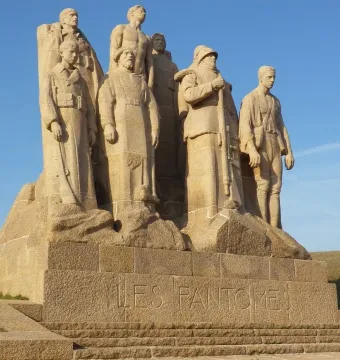
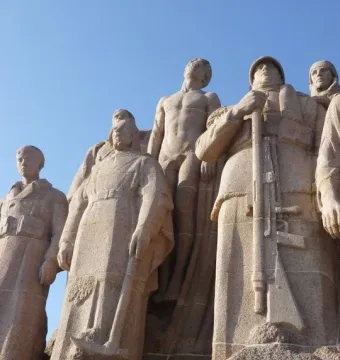
The Ghosts is a monumental sculptural group by the French sculptor Paul Landowski (1875–1961). It forms part of the national memorial to the Second Battle of the Marne, a World War I monument erected in the plain of Chalmont at Oulchy-le-Château in the Aisne, on the exact site where the battle’s outcome was decided in 1918. Originally modeled in plaster under the title Les Morts, the work already featured ghost-like figures rather than recumbent effigies. The granite group received an honourable mention at the 1923 Salon des artistes français. The monument was later selected by veterans, classified as a historic monument in 1934 before its completion, and inaugurated by President Albert Lebrun.
February 2019 © Mazzella-Bour · CC BY-SA 4.0
February 2019 © Mazzella-Bour · CC BY-SA 4.0
February 2019 © Mazzella-Bour · CC BY-SA 4.0
February 2019 © Mazzella-Bour · CC BY-SA 4.0
February 2019 © Mazzella-Bour · CC BY-SA 4.0
Identification | |
| Title | The Ghosts |
| Original working title | Les Morts |
| Type | Monumental linked group sculpture |
| Original French title | Les Fantômes |
Historical context | |
| Associated monument | National Monument to the Second Battle of the Marne |
| Commemorates | The Second Battle of the Marne in 1918 |
| Historical context | Related to World War I (1914–1918) |
Creator | |
| Artist | Paul Landowski (French, 1875–1961) |
| Commissioned by | the French State |
| Promise date | 1916 |
Discovery and provenance | |
| Funding | Construction financed by a national subscription |
| Site options considered | Verdun, the Douaumont Ossuary, and finally the Butte de Chalmont at Oulchy-le-Château |
| Project presented | In a state competition in 1919 |
| Site selected | 1927 |
| Plaster model completed | 1923 |
Physical characteristics | |
| Number of sculptural groups | Two |
| Height | 8 meters each |
| Number of figures in The Ghosts | Eight |
| Figures represented | Seven soldier figures: a young recruit, a sapper, a grenadier, a colonial soldier, a machine gunner, an infantryman, and an aviator; plus a naked young man |
| Pose | The figures have closed eyes and are slightly inclined, as if rising from their graves or shroud |
Materials | |
| Material | Plaster for the model; granite for the executed sculpture |
Technique | |
| Form | A group sculpture executed in granite after a plaster project |
Appearance | |
| Base | The soldiers rise on a stepped pedestal |
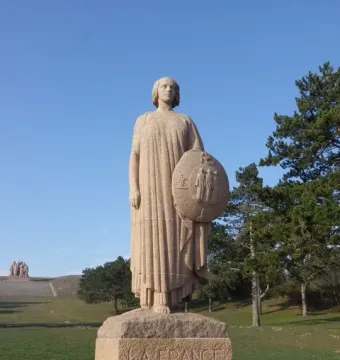
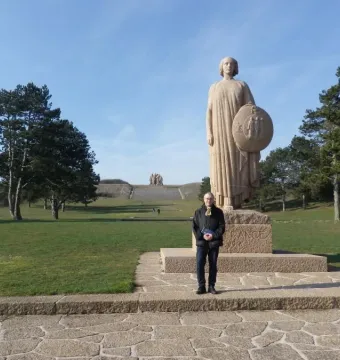
| Associated sculpture | France |
Iconography and meaning | |
| Depiction | Ghosts rather than effigies of the dead lying in state (gisants) |
| Symbolism | The seven ghosts surround and protect the naked young man, a symbol of the unarmed civilian population and a young martyr protected by elders returned from the dead |
| Symbolism | France is shown as a young woman shielding herself with a shield inscribed 'Liberty, Equality, Fraternity', with no offensive weapons, symbolizing defense of universal values and France not acting as an aggressor |
| Meaning | The two sculptures express the ambiguity of France and its allies' victory in the war |
| Meaning | The monument commemorates soldiers who died or went missing in the Second Battle of the Marne |
Location and ownership | |
| Heritage protection status | Classified as a historic monument since 1934, before completion |
| Ownership | Property of the French State |
| Site significance | Placed at the spot where the fate of the Second Battle of the Marne was decided; the hill overlooks the battlefields |
| Current location | Butte de Chalmont, at the top of the hill near Oulchy-le-Château, Aisne, France |
History and restoration | |
| Unveiled on | 27 February 1935 |
| Unveiled by | President Albert Lebrun |
| Monument structure | The monument is composed of three ensembles |
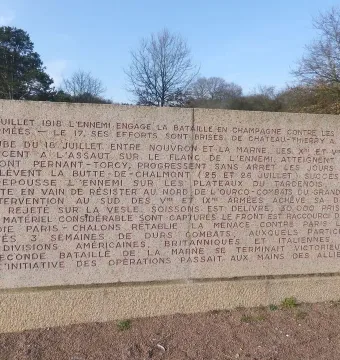
| Inscribed steles | Two steles on each side of the France statue with inscriptions recounting the history of the fighting |
Significance | |
| Award | Honor medal at the Salon des artistes français in 1923 |
| Classification note | The early classification as a historic monument was unusual |
Other | |
| Artist's war experience | Landowski personally fought in World War I and found the experience shocking |
| Artist's diary comment | He wrote in his diary, 'I will resurrect them' |