
The Chalice
The Chalice, also sometimes called Millennium Cone, is a steel and aluminium sculpture in Cathedral Square in Christchurch, New Zealand. It stands beside the damaged Christ Church Cathedral and is considered one of the city’s landmarks. The work was commissioned to mark the 150th anniversary of Christchurch and the Canterbury region in 2001. Designed by New Zealand artist and sculptor Neil Dawson, it was inaugurated on 10 September 2001, when the interior floodlights were first switched on. The sculpture features 42 aluminium leaves representing native tree species set into a hexagonal steel framework. It is painted blue inside and silver outside, and is illuminated from both inside and out at night.
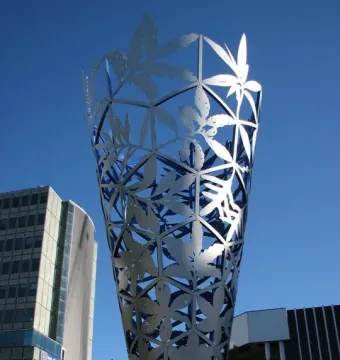
November 2006 © Markus Koljonen · CC BY 2.0
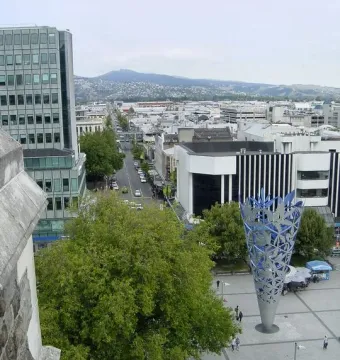
January 2007 © Robert Cutts · CC BY 2.0
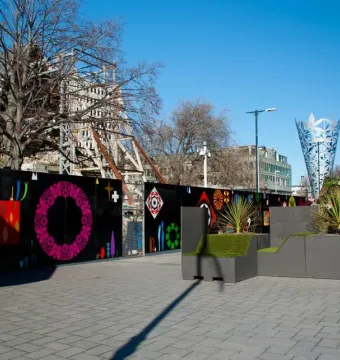
July 2013 © Jocelyn Kinghorn · CC BY-SA 2.0
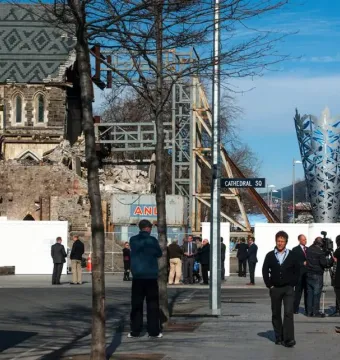
August 2013 © Jocelyn Kinghorn · CC BY-SA 2.0
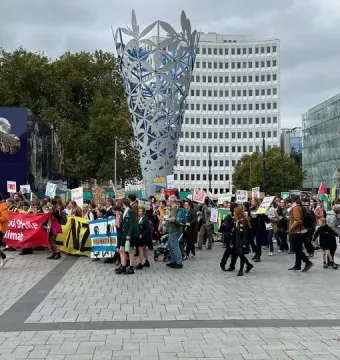
April 2024 © David Palmer · CC BY-SA 4.0
Identification | |
| Title | The Chalice |
| Alternative name | Millennium Cone |
| Type | Sculpture |
Historical context | |
| Commissioned for | The 150th anniversary celebration of Christchurch and the Canterbury region |
| Installed | 2001 |
| Inauguration date | 10 September 2001 |
| Inauguration method | Opened with the first switching on of the floodlights inside |
| Original cost | $400,000 |
Creator | |
| Occupation | New Zealand artist and sculptor |
| Designer | Neil Dawson |
Physical characteristics | |
| Shape | Conical |
| Height | 18 meters |
| Base diameter | 2 meters |
| Upper rim diameter | 8.5 meters |
| Base ring | Six-segment dark granite ring, 3 meters in diameter |
Materials | |
| Primary materials | Steel and aluminum |
| Structure | Steel skeleton built from hexagonal honeycombs with 42 aluminum leaves incorporated into it |
Appearance | |
| Lighting | Illuminated from inside and outside at night |
| Interior color | Blue |
| Exterior color | Silver |
Iconography and meaning | |
| Represented tree species | Mapou, kōwhai, māhoe, tōtara, kāramu, tī kōuka, ngāio, mārātata, and koromiko |
| Symbolism | Intended to connect the sculpture with Christchurch’s nickname "Garden City" |
| Design inspiration | The shape was intended to reflect the spire of Christ Church Cathedral |
| Decorative motif | Leaves of native New Zealand plants |
Location and ownership | |
| Location | Cathedral Square, Christchurch, New Zealand |
| Landmark status | A landmark of Christchurch, together with the earthquake-damaged Christ Church Cathedral |
History and restoration | |
| Restoration start date | March 2025 |
| Restoration approval | Part of the council's long-term plan and approved by a delegated authority |
| Restoration work | Leaves temporarily removed for repainting; scaffolding placed around the structure; sculpture wrapped to protect it from dust and weather; lighting replaced; corrosion fixed |
| Restoration budget | $400,000 |
| Nickname meaning | "Abluftschacht einer unterirdischen Toilette" |
| Post-earthquake interpretation | Dawson said it could become a sign of recovery rather than a sign of the quake |
| Response to 2011 Christchurch earthquake | Not damaged, unlike other structures in Cathedral Square such as Christ Church Cathedral, which lost its spire |
| Response to September 11 attacks | After the lighting ceremony, it became a place where local people placed flowers and messages for the victims |
| Reception | Christchurch architect Peter Beaven called it "vent to an underground toilet" |
| Criticism of restoration | Christchurch City councillor James Gough criticised the cost and called for an immediate halt, saying the funds would be better allocated to roads, footpaths, and essential core services |