
Gioiello di Vicenza
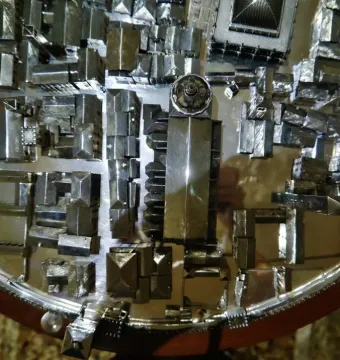
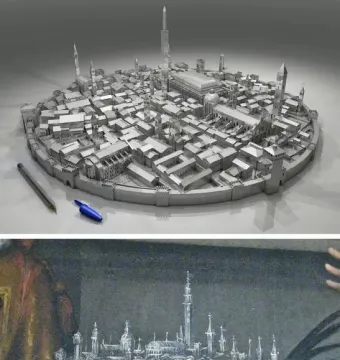
The Gioiello di Vicenza is an ancient silver model of the city of Vicenza, attributed to Andrea Palladio and originally made in the 16th century as an ex voto. The original work was lost after being taken by Napoleon during the Italian Campaign. A faithful reconstruction was created between 2012 and 2013 and is now preserved at the Diocesan Museum of Vicenza. Built in 925/1000 silver, it measures 58 cm in diameter, weighs 15 kg, and includes more than 300 miniature buildings. Its reconstruction drew on paintings by Francesco Maffei and Alessandro Maganza, as well as the medieval city plan known as the Pianta Angelica.
October 2019 © Zairon · CC BY-SA 4.0
September 2010 © Pottercomuneo · CC BY-SA 3.0
September 2013 © Plusultra78 · CC BY-SA 4.0
September 2013 © Pottercomuneo · Public domain
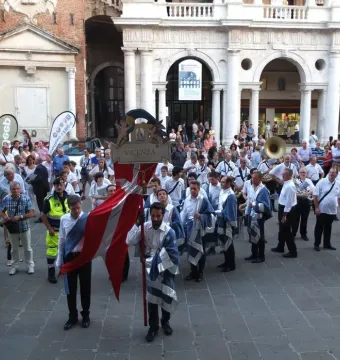
April 2012 © Plusultra78 · CC BY-SA 4.0
Identification | |
| Title | Gioiello di Vicenza |
| English title | The Jewel of Vicenza |
| Type | silver sculptural model of the city of Vicenza |
Historical context | |
| Historical significance | Important artifact from Vicenza's century-long tradition of goldsmithing |
| Function | Ex-voto |
| Dedication | Offered by the citizens of Vicenza as an ex-voto to the Madonna of Mount Berico |
| Reason for offering | To ward off the Plague of Saint Charles Borromeo |
| Plague context | The plague had spread two years earlier in the Duchy of Milan and reached cities in the western Republic of Venice, as far as Verona |
| Commissioned by | The citizens of Vicenza |
| Work time | About 2,000 hours |
| Date | 1578 |
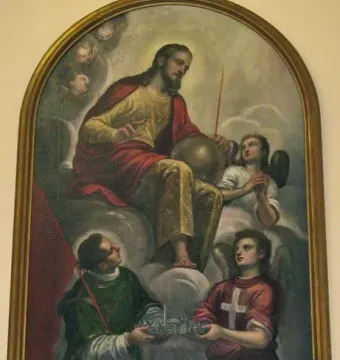
| Later visual evidence | Six oil paintings from the 17th and 18th centuries show Saint Vincent holding the model of Vicenza from different viewpoints and are the main evidence for its appearance |
Creator | |
| Attribution | Attributed to Andrea Palladio; possibly also to a goldsmith of the Capobianco family, though this is uncertain |
| Attributed occupation | architect |
| Attribution evidence | A document discovered in 2012 in the archive of the Sanctuary of the Madonna di Monte Berico supports the attribution |
| Craftsman | Silversmith Carlo Rossi, using laser technology supplied by a company in Bressanvido |
Discovery and provenance | |
| Historical interpretation | For Palladio, the Jewel may have represented his mental conception of the city of Vicenza |
| Related family | Capobianco family |
| Related historical figures | Niccolò Ridolfi and Matteo Priuli |
| Original display location | The church of Monte Berico, next to the Sanctuary of the Madonna di Monte Berico, Vicenza |
Appearance | |
| Depicted subject | The city of Vicenza enclosed within its medieval walls, shown frontally |
| Figures in later paintings | Saint Vincent holds the silver model in his hands |
Location and ownership | |
| Current location of reconstruction | Museo diocesano di Vicenza |
| Display at museum | Placed beside Maffei's painting San Vincenzo col modello della città di Vicenza at the Museo Diocesano |
| Associated location | Vicenza, Monte Berico, Sanctuary of the Madonna di Monte Berico |
History and restoration | |
| Reconstruction | A faithful reconstruction was made between 2012 and 2013 |
| Original work status | Lost |
| Failure of melting | It burned instead because it was made of wood covered with silver |
| Later exhibition | Exhibited in Milan at Expo 2015 |
| Reason for destruction attempt | The French believed it was entirely silver |
| Ceremonial attendance | 30,000 participants |
| Return to the city | Returned to the citizens for the patronal feast on 7 September 2013 and joined the procession to the Basilica of St. Mary of Mount Berico |
| Completion | Summer 2013 |
| Partial exhibition | From 6 April to 9 June 2013 the half-completed Gioiello was exhibited at the Museo Diocesano with support from FAI |
| First completed section | The Church of San Lorenzo was the first completed building presented in September 2012 at the Gallerie di Palazzo Leoni Montanari |
| Official presentation | 15 June 2012 in Piazza dei Signori, Vicenza |
| Original fate | Taken by French troops during the Italian Campaign in 1797 and destroyed after an attempted melting |
| Donation campaign | A second phase collected silver donations to recreate the model; the target was 30 kg and more than 50 kg was collected by 2012, with fundraising continuing until 25 December 2012 |
| Reconstruction project | A competition for a virtual restoration was held; it was won by architect Romano Concato of Trissino |
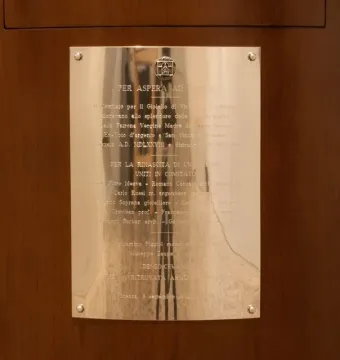
| Committee | Committee for the Jewel of Vicenza, founded in May 2010 with support from the Office of Cultural Heritage and other local institutions |
Physical characteristics | |
| Form | Large rounded tray |
| Central element | A gold miniature of the Rua at the center of Piazza dei Signori |
| Notable buildings represented | Basilica Palladiana, the Cathedral, Torre Bissara, and many churches |
| Scale | More than 300 miniature buildings, including 61 historically important buildings |
| Weight | 15 kg net |
| Diameter | 58 cm |
Materials | |
| Original material | Wood covered with silver plates |
| Material | 925/1000 silver; gold for the Rua miniature |
Technique | |
| Production method | Made from small wax models that were cast, then finished with chasing and engraving |
| Absence of originals | No original drawings survive |
| Reconstruction basis | Based on two paintings by Francesco Maffei, two paintings by Alessandro Maganza, the Pianta Angelica drawn by Giovanni Pittoni in 1580, medieval city planimetrics, and study of period building dimensions |
| Design method | Models were proportioned using the golden ratio |
Significance | |
| Recognition | The Museo Diocesano exhibition received the Medal of Representation of the President of the Italian Republic |
| Award | Confartigianato Design Award 2015, awarded to Carlo Rossi for the reconstruction |