
Anscavallo
Anscavallo is a sculpture located on Ansbach’s Palace Square, near the main entrance to the Residence. It was created by sculptor Jürgen Goertz and installed on 25 July 1993 following a competition of ideas for designing the square. The name combines “Ans-,” from Ansbach, with “-cavallo,” the Italian word for horse, and also alludes to cavalry. It is the largest of several artworks on the square. Other nearby features include two bus shelters with flying ducks on the roof and the Ansbachchantin fountain, which shows an Amazon drinking wine and various wheels symbolizing the busy traffic around it.
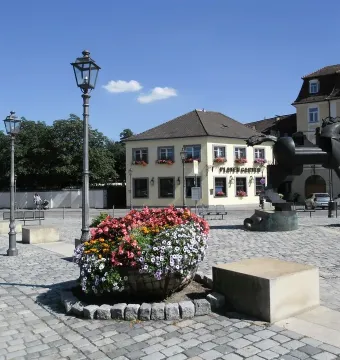
© Jürgen Goertz · CC BY-SA 3.0
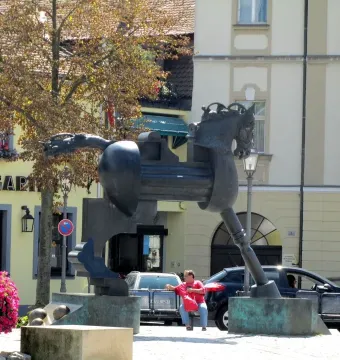
© Jürgen Goertz · Public domain
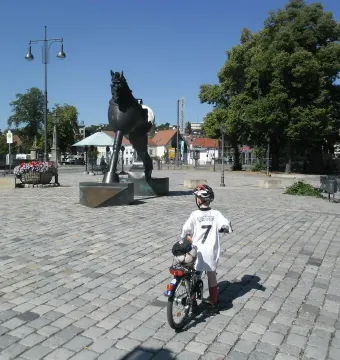
© Jürgen Goertz · CC BY-SA 3.0
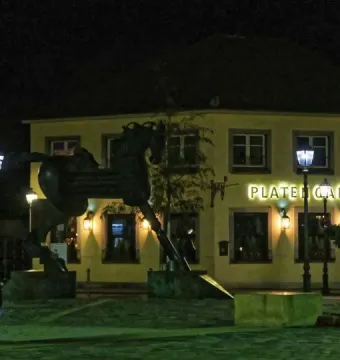
© Burkhard Mücke · CC BY-SA 4.0
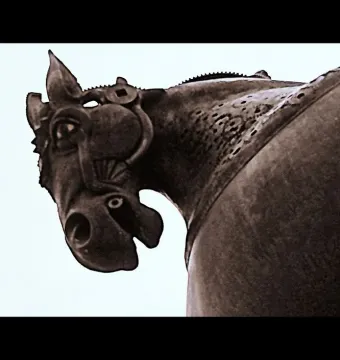
© Jürgen Goertz · CC BY 2.0
Identification | |
| Title | Anscavallo |
| Type | Sculpture |
Creator | |
| Artist | Jürgen Goertz |
Historical context | |
| Installation context | Installed as a result of an ideas competition for the design of the square |
| Installation date | 25 July 1993 |
Location and ownership | |
| Location reference | Ansbach |
| Location | Schlossplatz (castle square), in front of the main entrance to the Residenz of the Margraves of Brandenburg-Ansbach in Ansbach |
Materials | |
| Material | Bronze |
Physical characteristics | |
| Rear pedestal detail | Three golden hemispheres in the recess of the rear pedestal, symbolizing horse dung |
| Rear support leg | Double support leg with a Baroque-style profile |
| Subject | Horse |
| Hindquarters | Plump |
| Body | Approximately ring-shaped, cylindrical |
| Tail | Disheveled tail made of cast vine-wood hair |
| Head | Three-eyed |
| Neck | Swan-like |
| Chest | Egg-shaped |
| Front leg | A single turned, wooden-like rod |
| Composition | The sculpture consists of a front part and a rear part with differing forms and meanings |
| Structure | Horse standing on two separate pedestals |
| Mane | Made of gear parts |
Iconography and meaning | |
| Front part interpretation | Represents technology |
| Rear part interpretation | Represents nature because of its more realistic form |
| Art-historical reference | Reminiscent of Baroque riding horses |
| Other reference | Also evokes Kaspar Hauser's hobby horse |
| Historical reference | Refers to Ansbach as a garrison town at the time |
| Conceptual theme | The connection between tradition and modernity |
Other | |
| Name meaning | Derived from "Ans-" from Ansbach and "-cavallo" from the Italian word for horse; also intended to allude to cavalry |
Significance | |
| Relative size | The largest of several artworks on the Schlossplatz |